Red Maple
- Hardiness
- 3-9
- Mature size
- 40-70 ft
- Growth rate
- Fast
- Pollination
- Very early red blooms feed the first bees of March
- Bloom season
- March (red haze before leaves)
- Harvest season
- Can be tapped for syrup (lower sugar than sugar maple)
Family Sapindaceae
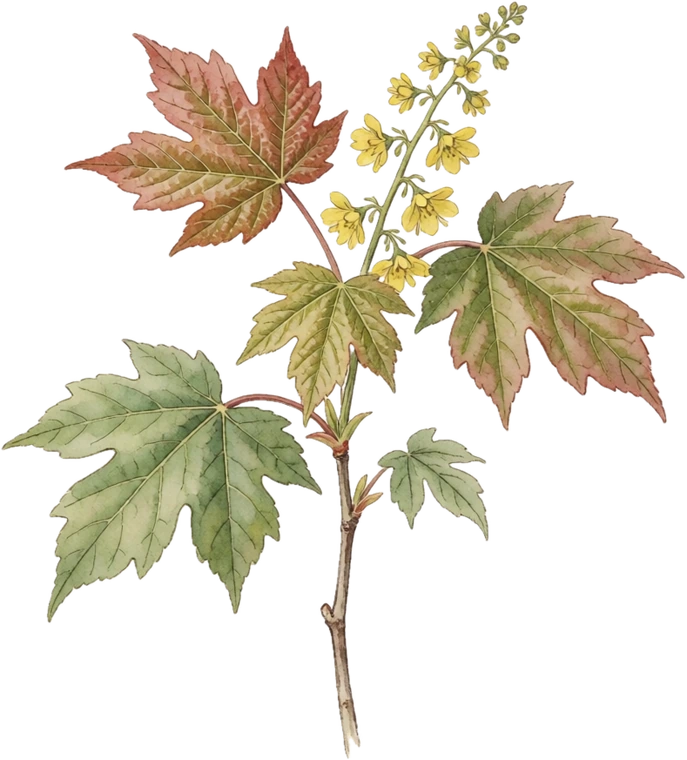
Maples own autumn — the scarlet, orange, and gold that people drive hours to look at can stand in your own yard. This entry covers three: red maple for blazing fall reliability, sugar maple, the syrup tree itself, and Japanese maple for small-space sculpture.
Between the three there's a maple for zones 3 through 9 and nearly any yard, from full shade canopy to courtyard accent. One firm caution: wilted maple leaves can poison horses, so keep every maple out of pastures. Everywhere else, plant one and own the fall.
 Moderate water
Hardiness differs across the 3 maples in this guide, so pick yours and this panel answers for that one.
Red Maple
Maple · Common problems
Nothing common enough to list for maple. Watch it like anything else in the garden, and check the plants growing next to it.
Maple · Which one do you have?
Where these differ, the key facts above give the span across all of them. Each type’s own figures, as the catalogue records them:
Maple · Growing & propagation
Maple merges several types whose light, water and soil needs differ — the care groups and the growing playbook carry what applies to each.
 Propagate
Maple · Calculators & field guides
Maple · Yearly calendar
No fixed season calendar for maple — its care follows conditions, not the calendar.
Maple · Ecology & uses
 Deer
DeerProtect young plants
! Some parts toxic — see notesTOXIC TO HORSES — wilted or dried leaves and bark (fresh leaves are not); about 1.5 lb is toxic and 3 lb can be lethal, and dried leaves stay toxic for around 30 days. Not a pasture tree. Llamas and alpacas are also susceptible; ruminants are not. · Caution around horses. Extension services implicate only RED maple, but in-vitro work found sugar maple leaf extract also oxidises equine red cells (Am J Vet Res 2002), and silver maple leaf toxicosis is clinically documented. Sources disagree — do not let horses eat wilted leaves of any maple. · No documented toxicity — but no trusted source affirmatively clears it either, so this is 'not known to be toxic', not 'known to be safe'. As with any maple, keep wilted leaves away from horses.
Edibility, identification, and traditional-use notes here are general reference — not medical or veterinary advice, and not a claim that any plant treats or prevents anything. Medicinal ratings record how strongly a plant features in herbal tradition, nothing more. Never eat or dose a plant you have not positively identified. More on how to use this library.
Maple · Varieties & cultivars
Compare hardiness, mature size, growth habit, days to maturity and intended use in the seller’s variety description. Where this guide covers several plant types, start with the type you want to grow, then choose a variety for your season and space.
Sources & plant identity
Hardiness, size and timing vary with your cultivar, soil and climate.
University extension research, brought together with hands-on growing experience at Story Thyme Farms.
Maple questions, answered straight.
With care. TOXIC TO HORSES — wilted or dried leaves and bark (fresh leaves are not); about 1.5 lb is toxic and 3 lb can be lethal, and dried leaves stay toxic for around 30 days. Not a pasture tree. Llamas and alpacas are also susceptible; ruminants are not. · Caution around horses. Extension services implicate only RED maple, but in-vitro work found sugar maple leaf extract also oxidises equine red cells (Am J Vet Res 2002), and silver maple leaf toxicosis is clinically documented. Sources disagree — do not let horses eat wilted leaves of any maple. · No documented toxicity — but no trusted source affirmatively clears it either, so this is 'not known to be toxic', not 'known to be safe'. As with any maple, keep wilted leaves away from horses. Site it accordingly if children or pets roam the garden. This is general reference, not medical or veterinary advice — call a vet or poison control if something has actually been eaten.
Seed (stratify), cuttings, or layering.
Where maple sits in the library.
 Apple
Apple Peach
Peach Plum
Plum Pluot
Pluot