The illustrated growing guide

Olive

Olea europaea

Family Oleaceae

Est. zones 8-10

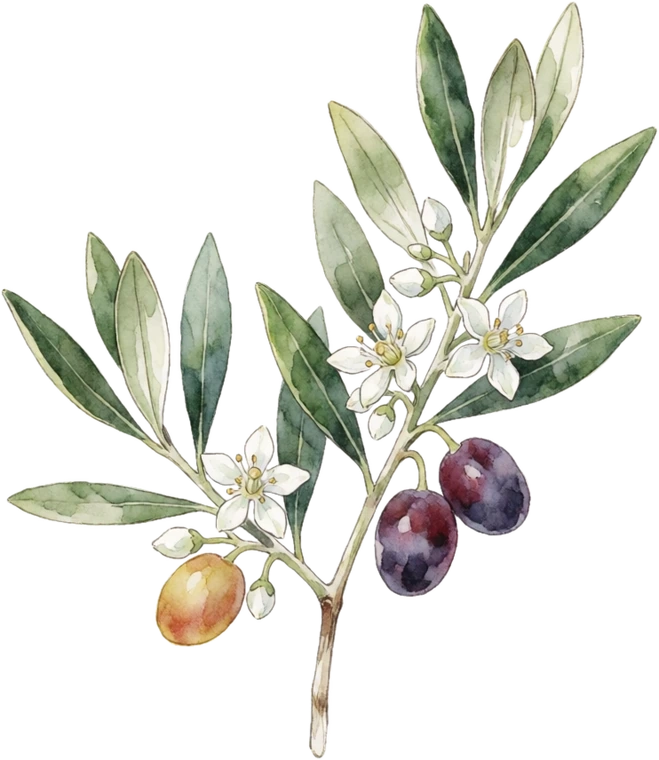
Botanical illustration of Olive
Tree · Olea europaea

Silver evergreen beauty in a pot — summer outside, cool bright room (not hot living room) in winter. 'Arbequina' fruits young; brine-cure your own olives once and you're hooked.

TreeFull SunDrought-tolerant · low waterSlow growthExcellent edible

Where to buy the plant — 3 nurseries

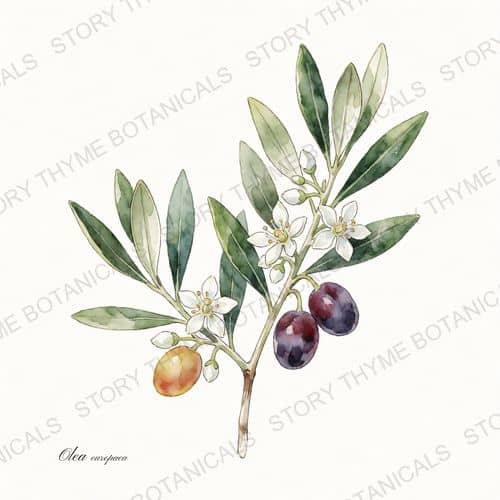
Olive Branch — a print from the Wildflowers & Meadow collection

From the print shop

Growing olive? Hang it.

Our Wildflowers & Meadow collection carries oliveOlea europaea, print Nº 9, “Olive Branch.”

16 designsfrom $21.99white or black groundmatte poster, unframed

Shop Wildflowers & Meadow botanical prints →

I

Overview

Will olive suit your garden, and what goes wrong.

Will it fruit where you are?

Enter your ZIP — we look up your USDA hardiness zone (2023 map) and check it against what olive actually needs.

Life cyclePerennial zones 8–10, annual elsewhere
PollinationSelf-fertile

Olive at a glance

Life cyclePerennial zones 8–10, annual elsewhere
Mature size10-25 ft (pot-restrained: 5-6 ft)
PollinationMostly self-fertile; wind-pollinated
Chill requirementNot yet established
Bloom seasonSpring (tiny cream sprays)
Harvest seasonOctober - November (green = firm/bitter, black = ripe; ALL need curing)
Growth rateSlow

Common olive problems

  • Scale
  • Olive Fruit Fly (West Coast)
  • Peacock Spot
  • Verticillium

II

Growing

Light, water, soil, propagation and the season’s jobs.

How to grow olive: light, water & soil

LightFull Sun
WaterVery low — the definition of drought-tolerant
SoilPoor, gravelly, perfectly drained · pH 6.5 - 8.0
FertilizerMinimal; a little nitrogen in spring
PruningLate Winter — Open center; olives fruit on last year's wood — alternate light/harder years.
SpacingContainer or 12-20 ft

How to plant & propagate olive

PropagateGrafted, or from cuttings/layering (seed won't come true)

The olive growing playbook

Field-tested instructions for every job olive asks of you, compiled from university extension guidance — in the order the season brings them.

Feeding

Split the nitrogen: half at growth start, the rest before bloom

Give half the year's nitrogen in early spring as growth starts and the remainder before the tree flowers. Aim for 8 to 20 inches of new shoot growth a year and adjust the rate up or down from what the tree actually gives you. A mature dooryard olive in reasonable soil often needs nothing at all. Nitrogen applied after flowering pushes vegetative growth at the expense of the crop, and the soft growth it forces is also what reduces cold hardiness and dilutes oil quality. Getting it in before bloom feeds the flowers and the fruit set instead of the shoots.

Stop nitrogen well before fall - late-season applications force frost-tender new growth into winter on a tree that is already cold-sensitive. If you want to fertilize by numbers, sample leaves between June and early August, when leaf nutrient levels are most stable. Boron has a very narrow margin between deficiency and toxicity, so correct it only with small amounts.

Pruning

Olive knot: do your pruning in dry summer weather

Take your annual pruning in dry summer weather, not in winter or spring. Open the canopy so light reaches the interior where next year's fruiting wood forms, and cut out any knotted, galled twigs well below the swelling. Wipe or dip your shears in a 10 percent bleach solution between cuts and between trees. Olive knot bacteria cannot enter intact bark - they need a fresh wound and rain to wash them into it. Pruning wounds made in the dry summer months are not susceptible to infection, while winter and spring cuts sit open through the rains and become new infection courts.

Bag the knotted prunings and remove them rather than chipping them back under the tree. Sterilize tools with a 10 percent bleach solution any time you must prune outside the dry season, because the bacteria ride on the blades from tree to tree.

What to watch for

Hang an olive fruit fly trap and read it weekly

Hang a yellow sticky trap baited with pheromone or ammonium bicarbonate, or a McPhail or Olipe trap baited with torula yeast, in the canopy and check it once a week through summer and fall. Replace yellow sticky traps about monthly, or sooner if they get wet, dusty, or clogged with other insects, and refresh McPhail lures on schedule. Olive fruit fly can finish a generation in as little as 30 to 35 days at optimum temperatures of 68 to 86 F, so a population builds fast and out of sight - the maggot is inside the fruit. The trap catch is the only thing that tells you whether to bait at all and when to start; by the time you can see stung fruit, the larvae are already in.

Spraying

Peacock spot: copper on the leaves before the rains start

Spray a fixed copper fungicide, copper sulfate, or Bordeaux mixture to thorough coverage of the whole canopy in late fall, before the first sustained rains arrive where you are. Repeat in spring if wet weather keeps up. Peacock spot spores germinate and infect leaves between 35 and 80 F when about 48 hours of free moisture is present, so nearly all new infection happens during fall and winter rain. Untreated, it defoliates the tree, which weakens the following bloom and cuts the crop.

Copper is a protectant that works only on the leaf surface - it must be on the tree before the rain, not after, and it will not cure infections already inside the leaf. Copper is allowed with restrictions in organic production; confirm your specific product is listed.

Olive fruit fly: spinosad bait once your traps catch flies

Start spinosad bait (GF-120 NF Naturalyte Fruit Fly Bait) as soon as your traps are catching adult flies, or about 2 to 3 weeks before pit hardening, whichever comes first. Put it out as a coarse spray or stream of large droplets onto a small patch of foliage on part of the tree rather than covering the canopy, and repeat every 7 days as long as flies keep showing on traps. Apply pre-dawn or in the early evening so the droplets resist evaporation. This is a bait, not a contact insecticide - the adult fly has to find it and feed on it, so a few large wet droplets outperform a full-cover spray and an evaporated droplet does nothing. The point is to kill the females before they sting the fruit, which is why the trap catch, not the calendar, starts the program: once the maggot is inside the fruit no spray reaches it.

Spinosad has a 0-day preharvest interval on olive. This is a fruit-stage bait and must never be applied during bloom - no insecticide on a flowering tree. Spinosad is toxic to bees while the spray is still wet, so keep bait droplets off any open blossoms and apply outside foraging hours. Follow all label requirements.

Harvesting

Pick at the ripeness you want - then cure, always

Decide what you are making before you pick. Green-ripe olives come off while the fruit is still firm and has turned an even pale green to straw color. Naturally black-ripe olives stay on the tree until they reach dark red, purple, or black, which UC Davis puts at roughly 3 to 4 months past the green stage. Either way, every olive has to be cured in water, brine, dry salt, or lye before it is edible. Raw olives are loaded with oleuropein, a bitter compound most abundant in green fruit. Curing is what leaches or chemically breaks that bond - there is no ripeness at which an olive becomes good to eat straight off the tree. Ripeness is a choice about flavor and texture, not a deadline.

Use a tested curing recipe from a food-preservation source, not an improvised one - UF/IFAS FS469 (Fermented Foods: Olives) covers brine, lye, and dry-salt methods. Lye is caustic and demands eye and skin protection plus complete rinsing. Brine-cured olives carry a high salt load - a preservation requirement, not a nutrition feature.

Strip and destroy every leftover olive after you pick

Once you have harvested, go back and strip every olive still hanging in the tree, then rake up all the fruit on the ground. Bury it at least 4 inches deep or bag it for the landfill. Do not leave it in a pile, and do not compost it in place. Larvae in leftover fruit drop out, burrow into the soil, and pupate there - that carryover is exactly the population that stings next year's crop. Fruit left hanging on the tree keeps feeding fly generations right through the fall.

Mulching or mowing the dropped fruit also works if you can destroy it thoroughly; a shallow pile of culls just concentrates the next generation next to your tree.

III

The year

What olive asks for, month by month.

The olive year, month by month

MonthJanFebMarAprMayJunJulAugSepOctNovDec
Bloom
Prune
Harvest

What each band means

  • Bloomflowers open — pollinators working, frost on blossoms is the danger.
  • Pruneshape it now — cuts heal cleanly and structure is visible.
  • Harvestpicking time — check ripeness every few days.

The olive year as text

  • Jan quiet month
  • Feb pruning
  • Mar bloom, pruning
  • Apr bloom
  • May bloom
  • Jun quiet month
  • Jul quiet month
  • Aug quiet month
  • Sep quiet month
  • Oct harvest
  • Nov harvest
  • Dec quiet month

These are the species' typical months — expect them a few weeks earlier in warm zones and later in cold ones. Watch the plant, not just the calendar.

IV

Ecology & uses

What it does for the garden, and what it is grown for.

Olive in the garden system

  • Understory layer tree
AttractsBirds
MoistureUpland / dry
DeerBrowsed — protect young plants
OriginIntroduced

What olive is grown for

✓ Commonly eatenraw olives inedibly bitter, not toxic

UseContainer Mediterranean
UseCuring project
UseSilver foliage
Edible value4/5

Harvesting & storing olive

October - November (green = firm/bitter, black = ripe; ALL need curing).

Edibility, identification, and traditional-use notes here are general reference — not medical or veterinary advice, and not a claim that any plant treats or prevents anything. Medicinal ratings record how strongly a plant features in herbal tradition, nothing more. Never eat or dose a plant you have not positively identified. More on how to use this library.

V

Cultivars

Named varieties of olive, ruled as a catalogue.

Best olive varieties & cultivars

12 on file

Named varieties of olive differ in winter-chill needs, ripening time, hardiness, and whether they set fruit on their own — pick one that fits your climate.

Arbequina · Arbequin, Arbequi

Partly self-fertile
Chill150–300 hrsRipensOct-NovZones8-11Diseasemoderate; some peacock spot susceptibilitySizecompact 10-15 ft, dwarfish and precocious
Pollinationsets some fruit alone but yields much better with a pollinizer such as Arbosana, Koroneiki, or Picual; recent research shows it can behave as self-incompatible

mild buttery oil, low pungency; fruit too small for table use — The go-to low-chill, relatively cold-tolerant, precocious variety for Southern and warm-winter US home growers and containers. Self-fertility is disputed: long treated as self-fruitful, but recent extension/research sources classify it as partly self-incompatible, so plant a pollinizer for reliable set.

Where to buy ‘Arbequinaverified

Story Thyme Farms may earn a small commission from these links, at no cost to you — it never changes what we recommend.
Arbosana

Partly self-fertile
Chill150–300 hrsRipensLate Oct-NovZones8-11DiseasemoderateSizesmall, low-vigor, high-density friendly
Pollinationcommonly paired with Arbequina; the two overlap in bloom and cross-pollinate each other

fruity oil, more pungent and bitter than Arbequina — Ripens about 2-3 weeks after Arbequina, extending the harvest and boosting yields when planted alongside it. Like most olives it fruits best with cross-pollination.

Where to buy ‘Arbosana

Story Thyme Farms may earn a small commission from these links, at no cost to you — it never changes what we recommend.

Koroneiki · Koroni

Partly self-fertile
Chill150–300 hrsRipensOct-Nov (mid-late)Zones9-11DiseasemoderateSizemedium, spreading open canopy
Pollinationoften listed as self-fruitful and widely used as a pollinizer for other varieties; still benefits from a cross-pollinizer

very small fruit; intense herbal-green, high-yield oil — Greek oil champion with very high oil content, but the least cold-hardy of this set-best in zone 9+ or used as a pollinizer.

Where to buy ‘Koroneikiverified

Story Thyme Farms may earn a small commission from these links, at no cost to you — it never changes what we recommend.

Mission · California Mission

Self-fertile
Chill300–400 hrsRipensSept (green) to Nov (black)Zones7-10Diseasemoderate; some olive knot susceptibilitySizelarge, upright and vigorous, standard tree

dual-purpose black table olive and oil, mild to rich — The classic hardy American variety-among the most cold-tolerant and dependable choices for cooler US olive climates. One of the few olives consistently rated self-fruitful.

Where to buy ‘Mission

Story Thyme Farms may earn a small commission from these links, at no cost to you — it never changes what we recommend.

Manzanillo · Manzanilla

Needs a pollinizer
Chill250–400 hrsRipensSept-Oct (green table)Zones9-11Diseasesusceptible to peacock spot, olive knot and cold injurySizemedium, spreading, moderate vigor
Pollinationself-sterile per UF/IFAS and UC; needs a compatible pollinizer such as Sevillano, Barouni, or Ascolano. Do NOT rely on Mission-Manzanillo and Mission are cross-incompatible

the premier large green/black table olive, mild — America's most popular table olive but cold-sensitive-reserve for mild-winter regions. Corrected from the draft: it is self-sterile and Mission does NOT pollinate it (documented cross-incompatibility); use Sevillano or Barouni instead.

Where to buy ‘Manzanilloverified

Story Thyme Farms may earn a small commission from these links, at no cost to you — it never changes what we recommend.
Frantoio · Paragon, Frantoiano

Self-fertile
Chill500–700 hrsRipensNov-Dec (late)Zones8-10Diseasegood; moderate cold toleranceSizelarge, weeping graceful habit

benchmark rich, fruity, peppery Tuscan oil — Higher-chill Italian oil standard and a dependable pollinizer. Only moderately cold-hardy-do not count on it overwintering in zone 7b (that hardiness belongs more to Mission and Arbequina). Note: olive chill requirements are not well quantified in the chill-hours model, so treat these numbers as a relative ballpark.

Where to buy ‘Frantoio

Story Thyme Farms may earn a small commission from these links, at no cost to you — it never changes what we recommend.

Leccino

Needs a pollinizer
Chill500–700 hrsRipensOct-Nov (early-mid)Zones8-10Diseasegood; among the more cold-hardy and disease-tolerantSizelarge, upright then spreading
Pollinationself-incompatible-needs a pollinizer such as Frantoio, Pendolino, or Maurino

mild, sweet, low-bitterness oil; ripens early and evenly — One of the hardier oil olives, but it is genuinely self-sterile and fruits poorly without a compatible pollinizer nearby-this is well documented, so pairing is mandatory.

Where to buy ‘Leccinoverified

Story Thyme Farms may earn a small commission from these links, at no cost to you — it never changes what we recommend.

Ascolano · Ascolana Tenera

Partly self-fertile
Chill300–400 hrsRipensSept-OctZones8-10Diseasemoderate; soft fruit bruises easilySizelarge, vigorous
Pollinationlisted self-fruitful by UF/IFAS but yields better with a pollinizer such as Pendolino or Frantoio

very large, tender, mild green table olive; low oil — Prized large, tender gourmet table olive. The draft's claim that it is the most cold-hardy large table variety is not well supported-Ascolano is fairly cold-sensitive; treat cold-hardiness as unproven.

Where to buy ‘Ascolano

Story Thyme Farms may earn a small commission from these links, at no cost to you — it never changes what we recommend.

Sevillano · Spanish Queen

Partly self-fertile
Chill300–400 hrsRipensOctZones8-10Diseasemoderate; hardy overallSizevery large, spreading
Pollinationsources conflict-some extension listings call it self-fruitful, others say it needs a pollinizer; also used as a pollinizer for Manzanillo. Not compatible with Barouni

giant, meaty, mild table olive; very low oil — Grown for its jumbo brine-cured table fruit rather than oil. Draft's self_fertile 'yes' downgraded to 'partial' due to conflicting sources. Dropped the 'Gordal' alias: Gordal (Gordal Sevillana) is a distinct Spanish cultivar frequently conflated with the California Sevillano-do not treat them as identical.

Where to buy ‘Sevillano

Story Thyme Farms may earn a small commission from these links, at no cost to you — it never changes what we recommend.

Picual

Partly self-fertile
RipensEarlyZones8-10SizeVigorous

High oil content; robust, stable, high-polyphenol oil — Nursery variety specifications list Picual as partially self fertile with high oil content, early ripening, and high cold tolerance. Early ripening is a real pest advantage where olive fruit fly is established, since the crop comes off before the late-season generations peak.

Where to buy ‘Picual

Story Thyme Farms may earn a small commission from these links, at no cost to you — it never changes what we recommend.

Kalamata · Kalamon

Self-fertile
RipensLateZones8-10SizeMedium-vigorous

Medium oil content; the famous almond-shaped dark table olive — Nursery variety specifications list Kalamon (Kalamata) as self fertile with medium oil content, late ripening, and medium cold tolerance, used for both table and oil. It is picked dark-ripe for the classic table olive, which means it hangs on the tree through the tail of the fruit fly season - keep the traps up.

Where to buy ‘Kalamata

Story Thyme Farms may earn a small commission from these links, at no cost to you — it never changes what we recommend.

Swan Hill · Swan Hill Olives

RipensNone - fruitlessZones8-10SizeFull-size landscape tree

UC Marin Master Gardeners list Swan Hill as a non-fruiting olive. Because it sets no fruit, none of the olive fruit fly rules apply to it - no bait, no post-harvest sanitation - and there is no fruit drop to stain paving. It still gets olive knot and peacock spot, so the dry-summer pruning and pre-rain copper still stand.

Where to buy ‘Swan Hill

Story Thyme Farms may earn a small commission from these links, at no cost to you — it never changes what we recommend.

VI

Sources & plant ID

Where the care distinctions come from, and how the plant is filed.

Research basis

Sources behind this profile

No extension citations are attached to oliveyet. The care figures below come from the library's own catalogue rather than a traced primary source.

Plant ID

BinomialOlea europaea
FamilyOleaceae
TypeTree · Tender Perennial
USDA symbolOLEU
OriginIntroduced
Invasive riskLow

VII

Where to buy

Third-party nurseries — not Story Thyme Farms.

Third-party nurseries, not Story Thyme Farms. Prices are theirs.

Story Thyme Farms may earn a small commission from these links, at no cost to you — it never changes what we recommend.

VIII

Questions

Olive questions, answered straight.

Do I need two olive plants to get fruit?

No — olive is self-fertile, so a single plant will set a crop. A second one usually improves yields, but it isn't required.

Is olive safe for kids and pets?

Olive is commonly eaten and isn't considered toxic, but "commonly eaten" isn't a guarantee for any particular person or animal — allergies, quantity, and which part you eat all matter. One caveat on this one: raw olives inedibly bitter, not toxic. Never eat a plant you haven't positively identified, and check with a vet before letting pets or livestock graze anything new.

When do you harvest olive?

October - November (green = firm/bitter, black = ripe; ALL need curing).

How do you propagate olive?

Grafted, or from cuttings/layering (seed won't come true).

IX

Elsewhere

Where olive sits in the library.