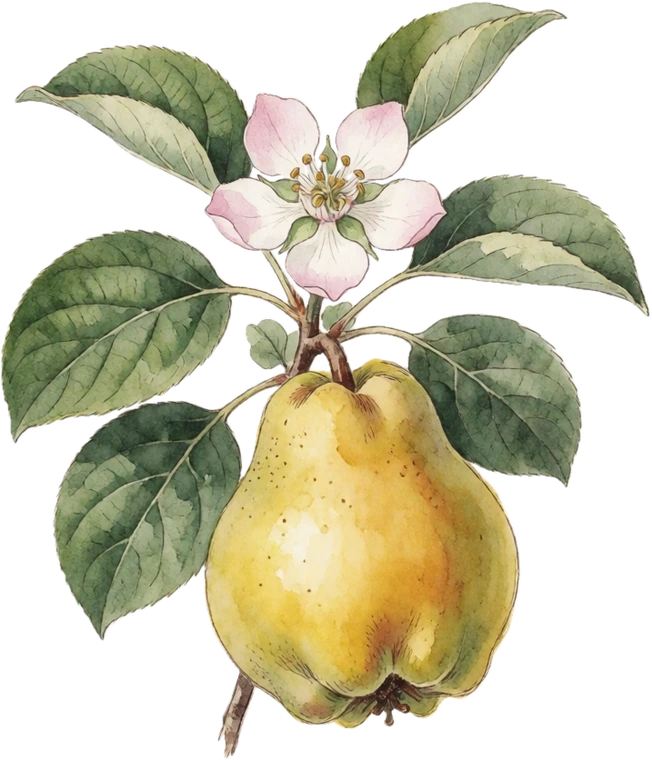
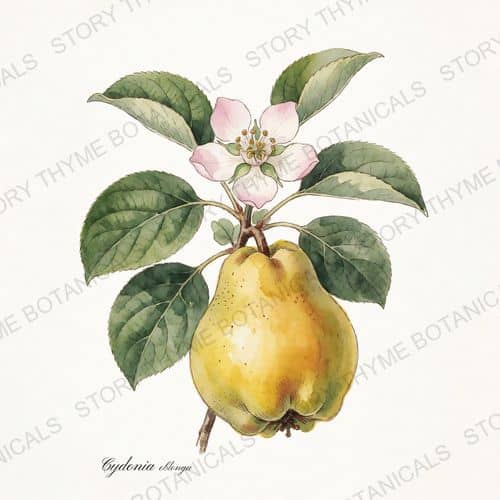
Named varieties of quince differ in winter-chill needs, ripening time, hardiness, and whether they set fruit on their own — pick one that fits your climate.
Pineapple · Pineapple Quince
Self-fertileChill300–400 hrsRipensOctZones5-9Diseasesusceptible to fireblight and quince leaf blightSize12-15 ft (semi-dwarf on quince roots)
tangy pineapple-like when cooked; classic for jelly, paste, and preserves — The most widely sold US quince (a Burbank introduction, 1890s) and a reliable, broadly adaptable choice for a first tree. Self-fruitful, so a single tree crops.
Where to buy ‘Pineapple’
Story Thyme Farms may earn a small commission from these links, at no cost to you — it never changes what we recommend.
Aromatnaya · Aromatnaia
Self-fertileChill300–400 hrsRipensOctZones4-9Diseasepartial resistance to quince leaf blightSize10-15 ft
intensely fragrant, low astringency; one of the few that can be eaten fresh when fully ripe — Pick this if you want fruit tender enough to slice raw and the cold-hardiness to try quince in Zone 4-5 (among the hardiest quinces, listed to about -25 to -30F). Removed the erroneous 'Krymsk' alias, which is a rootstock series, not a synonym.
Where to buy ‘Aromatnaya’
Story Thyme Farms may earn a small commission from these links, at no cost to you — it never changes what we recommend.
Smyrna
Self-fertileChill300–400 hrsRipensOct-NovZones5-9Diseasesusceptible to fireblightSize12-20 ft, vigorous
large, lemon-yellow, richly aromatic; excellent for cooking and paste — A vigorous, heavy-bearing Turkish variety with very large fruit and relatively low chill needs (~300 hrs); best where the season is long enough to ripen the big fruit. Self-fruitful.
Where to buy ‘Smyrna’
Story Thyme Farms may earn a small commission from these links, at no cost to you — it never changes what we recommend.
Orange · Apple Quince, Orange Quince
Self-fertileChill300–400 hrsRipensSept-OctZones5-8Diseasesusceptible to fireblightSize10-15 ft
round apple-shaped fruit, orange-tinted flesh, strong flavor for jelly and paste — One of the earliest-ripening quinces, a good fit for shorter-season gardens wanting fruit before hard frost. Self-fruitful.
Where to buy ‘Orange’verified
Story Thyme Farms may earn a small commission from these links, at no cost to you — it never changes what we recommend.
Champion
Self-fertileChill300–500 hrsRipensOct-NovZones5-9Diseasesusceptible to fireblightSize10-15 ft
large pear-shaped fruit, tender light-green flesh, delicate lemon-like flavor — Late-ripening and productive with relatively tender flesh; needs a longer, warmer season and somewhat more chill than the early types. Self-fruitful.
Where to buy ‘Champion’
Story Thyme Farms may earn a small commission from these links, at no cost to you — it never changes what we recommend.
Van Deman
Self-fertileChill300–500 hrsRipensSept-OctZones5-9Diseasesusceptible to fireblightSize10-15 ft
large, spicy-aromatic fruit; robust flavor prized for cooking and preserves — A Burbank cross of Orange and Portugal (1890s) noted for a rich spicy aroma; typically an early- to mid-fall ripener. Self-fruitful.
Where to buy ‘Van Deman’
Story Thyme Farms may earn a small commission from these links, at no cost to you — it never changes what we recommend.
Serbian Gold · Leskovac, Leskovacka
Self-fertileChill300–500 hrsRipensOctZones5-9Diseasegood resistance to quince leaf blightSize10-15 ft
apple-shaped, aromatic; flesh turns rose-pink when cooked, excellent for paste and jelly — Choose this heavy-cropping Serbian variety (Leskovac) if quince leaf blight, common in humid, wet-summer regions, is your main worry. Self-fruitful.
Where to buy ‘Serbian Gold’
Story Thyme Farms may earn a small commission from these links, at no cost to you — it never changes what we recommend.
Cooke's Jumbo · Jumbo
Self-fertileChill100–100 hrsRipensSept-early OctZones5-10Size12-15 ft
white flesh, mild; a cooking quince for pies, candy, and jelly — The low-chill quince: Dave Wilson lists it at about 100 hours, far under the 300-plus of the standard varieties, which makes it the one to try where winters are too mild to satisfy an Orange or a Pineapple. Fruit runs roughly twice the size of other quinces. Found at Dinuba, California and named for the L.E. Cooke Co.; University of Missouri Extension lists it among the standard quince cultivars as 'Jumbo'. No disease-resistance claim is made for it, so assume it is as fire-blight-prone as the rest.
Where to buy ‘Cooke's Jumbo’
Story Thyme Farms may earn a small commission from these links, at no cost to you — it never changes what we recommend.
Karp's Sweet
Self-fertileZones5-9Size10-12 ft
unusually sweet and low in astringency; rich in pectin with a floral aroma, fine for jelly and preserves — The quince to plant if the point is eating it raw - named for fruit writer David Karp and brought north from Peru via Edgar Valdivia. The catch is that the sweetness depends on summer heat: Cloud Mountain, in the cool Pacific Northwest, says it is still best cooked there. Sourced as hardy to zone 5; the upper end follows the species range rather than a per-cultivar source. No source gives a chill figure for it, so chill is left blank rather than guessed.
Where to buy ‘Karp's Sweet’
Story Thyme Farms may earn a small commission from these links, at no cost to you — it never changes what we recommend.