Sweet William
Dianthus barbatus
Family Caryophyllaceae
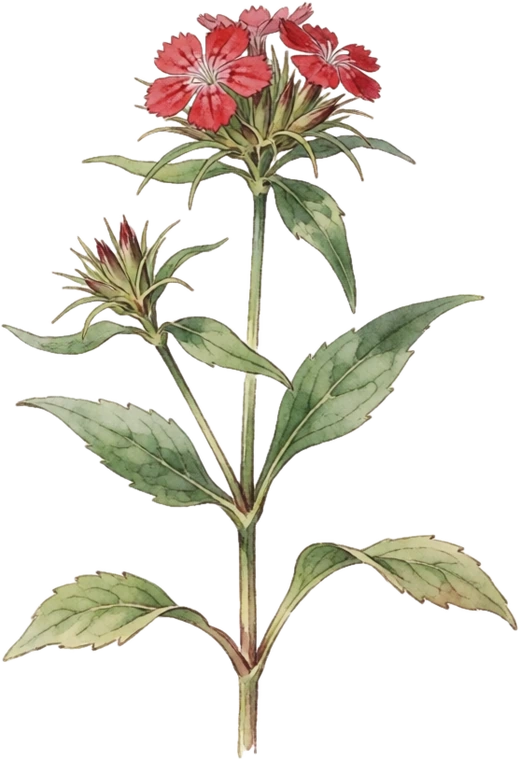
Sweet William smells the way old gardens are supposed to — warm clove drifting from tight clusters of fringed flowers in saturated reds, pinks, and crisp bicolors that seem painted on. Butterflies visit all day, and the cut stems last remarkably in a vase, perfume included.
Classically a biennial that seeds itself into a returning patch, though modern strains flower their first year, it stays knee-height and tidy at a border's front. The clove-scented petals are edible, scattered over cakes and salads. Hummingbirds check the reds. Sow a drift and let it settle in.
 Full Sun to Part Shade
 Moderate water
 Fast growth
 Attracts hummingbirds
 Attracts butterflies
 Attracts bees
From the print shop
Growing sweet william? Hang it.
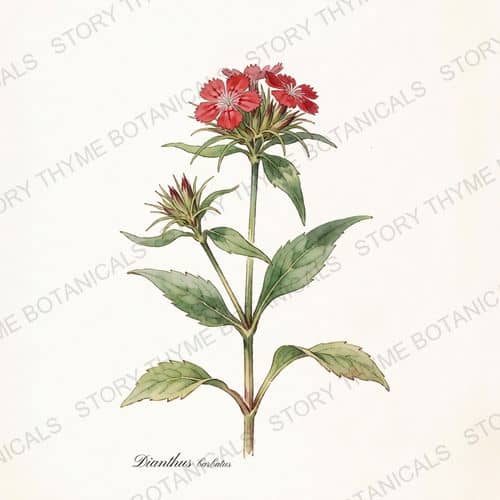
Our Plant Library collection carries sweet william — Dianthus barbatus, print Nº 467, “Sweet William.”
526 designsfrom $12.99white or black backgroundmatte poster, unframed
Will it fruit where you are?
Enter your ZIP — we look up your USDA hardiness zone (2023 map) and check it against what sweet william actually needs.
 Life cycleBiennial, grown as an annual
Sweet William · Common problems
Common sweet william problems

Sweet William · Growing & propagation
Growing sweet william
- Light
- Full Sun to Part Shade
- Water
- Moderate
 Soil
Soil- Rich, well-drained, neutral-alkaline · pH 6.5 - 7.5
 Fertilizer
- Light spring feed
 Pruning
- Deadhead for tidiness
A cottage-garden classic — dense, flat-topped clusters of fringed flowers in rich reds, pinks, and bicolors with a sweet clove fragrance, beloved by butterflies and a fine cut flower. A biennial (rosette year one, bloom year two) that self-sows to persist, and some modern types bloom the first year. Easy, fragrant, and old-fashioned charm for borders and bouquets.
 Spacing
- 6-8 in
Sweet William · Seasonal care & spray guidance
The sweet william growing playbook

When to spray sweet william
Growing season. Good drainage prevents rot.
Sweet William · Calculators & field guides
A little help in the garden.
Sweet William · Yearly calendar
The sweet william year, month by month
Jan
No calendar activity is listed for this month.
 Bloom
BloomBloomMay to June
What each band means
- Bloom — flowers open — pollinators working, frost on blossoms is the danger.
These are the species' typical months — expect them a few weeks earlier in warm zones and later in cold ones. Watch the plant, not just the calendar.
Sweet William · Ecology & uses
Ecology & uses
Dianthus barbatus
Sweet William in the garden system
- Herbaceous layer biennial
- Nectary/insectary
- Attracts
- Hummingbirds, Butterflies, Bees
- Moisture
- Facultative / average
 Deer
Deer- Browsed
Protect young plants
 Origin
- Introduced
What sweet william is grown for
✓ Commonly eatenedible clove-scented flowers
 Use
Use- Cottage clusters
- Use
- Fragrance
- Use
- Cut flowers
- Use
- Butterflies
Harvesting & storing sweet william
Edible flowers (clove-scented garnish); reseeds.
Edibility, identification, and traditional-use notes here are general reference — not medical or veterinary advice, and not a claim that any plant treats or prevents anything. Medicinal ratings record how strongly a plant features in herbal tradition, nothing more. Never eat or dose a plant you have not positively identified. More on how to use this library.
Sweet William · Varieties & cultivars
Choosing a sweet william variety
'Nigrescens'/'Sooty' (dark); 'Amazon' (first-year bloom); 'Heart Attack'; heirloom mixes
Sources & plant identity
Know what you’re growing.
See where the knowledge comes from.
Sweet William
Dianthus barbatus
The plant, at a glance.
- Botanical name
- Dianthus barbatus
- Plant family
- Caryophyllaceae
- Growth habit
- Biennial
- Origin
- Introduced
- USDA plant symbol
- DIBA
- Invasive risk
- Low
Hardiness, size and timing vary with your cultivar, soil and climate.
Rooted in research.
University extension research, brought together with hands-on growing experience at Story Thyme Farms.
for Sweet William
Research from these sources

Publisher marks identify sources, not sponsorship or endorsement.
Questions
Sweet William questions, answered straight.
Is sweet william safe for kids and pets?
Sweet William is commonly eaten and isn't considered toxic, but "commonly eaten" isn't a guarantee for any particular person or animal — allergies, quantity, and which part you eat all matter. One caveat on this one: edible clove-scented flowers. Never eat a plant you haven't positively identified, and check with a vet before letting pets or livestock graze anything new.
When do you harvest sweet william?
Edible flowers (clove-scented garnish); reseeds.
Elsewhere
Where sweet william sits in the library.
 Sunflower
 Zinnia
 Peony
Peony Daylily