The illustrated growing guide

Garlic Chives

Allium tuberosum

Family Amaryllidaceae

Est. zones 4-9

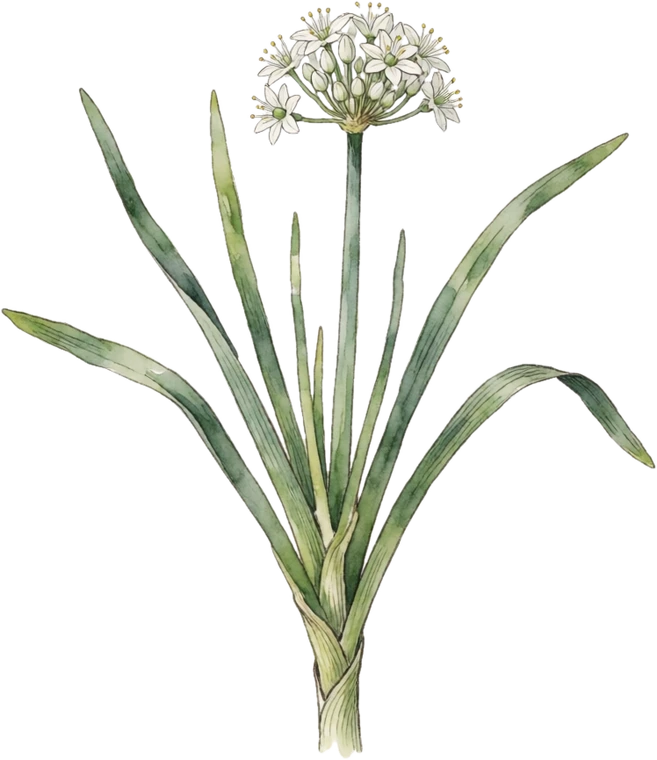
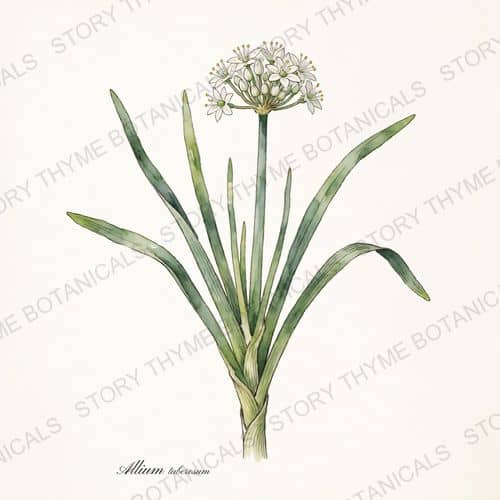
Botanical illustration of Garlic Chives
Perennial · Allium tuberosum

Chives' garlicky cousin — flat green blades with a gentle garlic flavor you snip all season for dumplings, eggs, and stir-fries, plus edible buds and pretty, bee-covered white flowers in late summer. Just deadhead promptly: those flowers self-sow into a garlic-chive takeover if you let them.

PerennialFull Sun to Part ShadeLow waterModerate growthExcellent edibleAttracts bees

Where to buy the plant — 2 nurseries

Chives — a print from the Herbs, Greenery & Desert collection

From the print shop

The closest print we make

We don’t print Allium tuberosum. The closest we have is Allium schoenoprasum (“Chives”) in the Herbs, Greenery & Desert collection — the same genus, Allium, not the same species.

16 designsfrom $21.99white or black groundmatte poster, unframed

Shop Herbs, Greenery & Desert botanical prints →

I

Overview

Will garlic chives suit your garden, and what goes wrong.

Will it fruit where you are?

Enter your ZIP — we look up your USDA hardiness zone (2023 map) and check it against what garlic chives actually needs.

Hardy inZones 4-9

Garlic Chives at a glance

HardinessUSDA 4–9
Mature size12-18 in
PollinationLate-summer white flowers are a BEE magnet
Chill requirementNot yet established
Bloom seasonLate Summer (fragrant white star clusters)
Harvest seasonFlat garlicky leaves all season; edible flower buds and flowers; a staple in dumplings and stir-fry
Growth rateModerate

Common garlic chives problems

  • Almost none
  • Almost none

II

Growing

Light, water, soil, propagation and the season’s jobs.

How to grow garlic chives: light, water & soil

LightFull Sun to Part Shade
WaterLow-Moderate
SoilAny well-drained · pH 6.0 - 7.0
FertilizerLight compost
PruningCut spent flower stalks to limit self-sowing — Like chives but with a mild garlic flavor and flat leaves — endlessly cut-and-come-again, and essential in Chinese dumplings and Korean cooking. The late-summer white flowers are gorgeous and mobbed by bees, but deadhead them or it self-sows aggressively.
Spacing8-10 in

How to plant & propagate garlic chives

PropagateDivision or seed

The garlic chives growing playbook

Field-tested instructions for every job garlic chives asks of you, compiled from university extension guidance — in the order the season brings them.

Sowing

Direct sow shallowly once soil hits about 50F

Sow seed a quarter inch deep in moist, well-drained soil in full sun to part shade, once soil temperature reaches roughly 50F. Expect germination in 7 to 14 days. Seed can also be sown in fall as soon as it ripens, or in spring in a cold frame. The seed is small and needs warmth and steady moisture near the surface to germinate, and a quarter inch is as deep as it can push from.

Feeding

Feed lightly in spring, and only if the clump looks weak

If an established clump is looking weak, give it a very light application of a 5-10-5 fertilizer once in spring. Skip it entirely if the plant is growing well. For plants in containers, use a liquid fertilizer at half the label strength every four to six weeks. Over-fertilizing harms chives. Slower, more compact growth gives stronger flavor and a healthier plant, so pushing the foliage with nitrogen works against the reason you grow it.

Thinning

Thin seedlings to 12 inches once they reach 2 inches tall

When the seedlings are about 2 inches tall, thin them to stand 12 inches apart. Pulled thinnings are edible, so eat them rather than composting them. A mature clump fills roughly 12 inches across, and crowded seedlings compete into thin, weak foliage instead of the broad flat leaves worth harvesting.

Dividing

Lift and split the clump every three to four years

Every three or four years, lift the clump in early spring, pull the bulbs apart into smaller sections, and replant them at 12 inch spacing. Spring is the best time for this. Spare divisions transplant readily or make good gifts. The clump thickens on its own tuberous rootstock until the bulbs are competing with each other, and vigor and bloom fall off. Splitting resets that.

Pruning

Cut every flower stalk to the soil line as blooming ends

As soon as the flowers finish and before seed sets, cut the flower stalks off at the soil line. Do not leave the dried seed heads standing in the garden. If a stalk gets away from you and drops seed, pull the seedlings while they are small. Garlic chives self-seeds aggressively and can become invasive. Each head sets abundant seed, and cutting the stalk before seed set is the one intervention that stops the spread while also keeping the plant productive.

This plant is highly weedy and invasive under some conditions. If you cannot commit to deadheading every year, grow it in a container instead of open ground.

Harvesting

Snip leaves at the base any time they are green

Harvest by snipping leaves off at the base of the plant, not by shearing the tops. Leaves are good any time they are green. Cutting the foliage back encourages fresh growth. The flavor is best fresh, but chopped leaves freeze well: chop prewashed leaves into small pieces and freeze them in containers. Cutting at the base removes whole leaves and triggers new ones from the crown, while topping leaves behind blunt, browning stubs that never regrow cleanly.

Leaves, bulbs and flowers are all edible, but this is a sulfide-containing allium. Eaten in quantity it can cause nausea, vomiting or diarrhea.

Pick the white flowers shortly after they open

Pick the fragrant white star-shaped flowers shortly after they open, for garnish, salads or cut arrangements. The stalks also cut well for the vase, and left alone the seed heads dry for winter displays. Picked shortly after opening the flowers are at their best, and every flower you take now is one that cannot set the seed that makes this plant a weed.

III

The year

What garlic chives asks for, month by month.

The garlic chives year, month by month

MonthJanFebMarAprMayJunJulAugSepOctNovDec
Bloom

What each band means

  • Bloomflowers open — pollinators working, frost on blossoms is the danger.

The garlic chives year as text

  • Jan quiet month
  • Feb quiet month
  • Mar quiet month
  • Apr quiet month
  • May quiet month
  • Jun quiet month
  • Jul quiet month
  • Aug bloom
  • Sep quiet month
  • Oct quiet month
  • Nov quiet month
  • Dec quiet month

These are the species' typical months — expect them a few weeks earlier in warm zones and later in cold ones. Watch the plant, not just the calendar.

IV

Ecology & uses

What it does for the garden, and what it is grown for.

Garlic Chives in the garden system

  • Herbaceous layer perennial
  • Nectary/insectary
AttractsBees
MoistureUpland / dry
DeerBrowsed — protect young plants
OriginIntroduced

What garlic chives is grown for

! Some parts toxic — see notesToxic to dogs, cats and horses — organosulfur compounds cause Heinz-body haemolytic anaemia; also toxic to cattle, sheep and goats. Cats are the most sensitive.

UseDumplings
UseStir-fry
UseBee flowers
UseCut-and-come-again
Edible value4/5

Harvesting & storing garlic chives

Flat garlicky leaves all season; edible flower buds and flowers; a staple in dumplings and stir-fry.

Edibility, identification, and traditional-use notes here are general reference — not medical or veterinary advice, and not a claim that any plant treats or prevents anything. Medicinal ratings record how strongly a plant features in herbal tradition, nothing more. Never eat or dose a plant you have not positively identified. More on how to use this library.

V

Cultivars

Named varieties of garlic chives, ruled as a catalogue.

Best garlic chives varieties & cultivars

'Garlic Chives' / Chinese chives; 'Geisha' (broad leaf)

VI

Sources & plant ID

Where the care distinctions come from, and how the plant is filed.

Research basis

Sources behind this profile

No extension citations are attached to garlic chivesyet. The care figures below come from the library's own catalogue rather than a traced primary source.

Plant ID

BinomialAllium tuberosum
FamilyAmaryllidaceae
TypePerennial
USDA symbolALTU3
OriginIntroduced
Invasive riskLow

VII

Where to buy

Third-party nurseries — not Story Thyme Farms.

Third-party nurseries, not Story Thyme Farms. Prices are theirs.

Story Thyme Farms may earn a small commission from these links, at no cost to you — it never changes what we recommend.

VIII

Questions

Garlic Chives questions, answered straight.

Is garlic chives safe for kids and pets?

With care. Toxic to dogs, cats and horses — organosulfur compounds cause Heinz-body haemolytic anaemia; also toxic to cattle, sheep and goats. Cats are the most sensitive. Site it accordingly if children or pets roam the garden. This is general reference, not medical or veterinary advice — call a vet or poison control if something has actually been eaten.

When do you harvest garlic chives?

Flat garlicky leaves all season; edible flower buds and flowers; a staple in dumplings and stir-fry.

How do you propagate garlic chives?

Division or seed.

IX

Elsewhere

Where garlic chives sits in the library.

Where garlic chives sits in the library

Grows in the same world