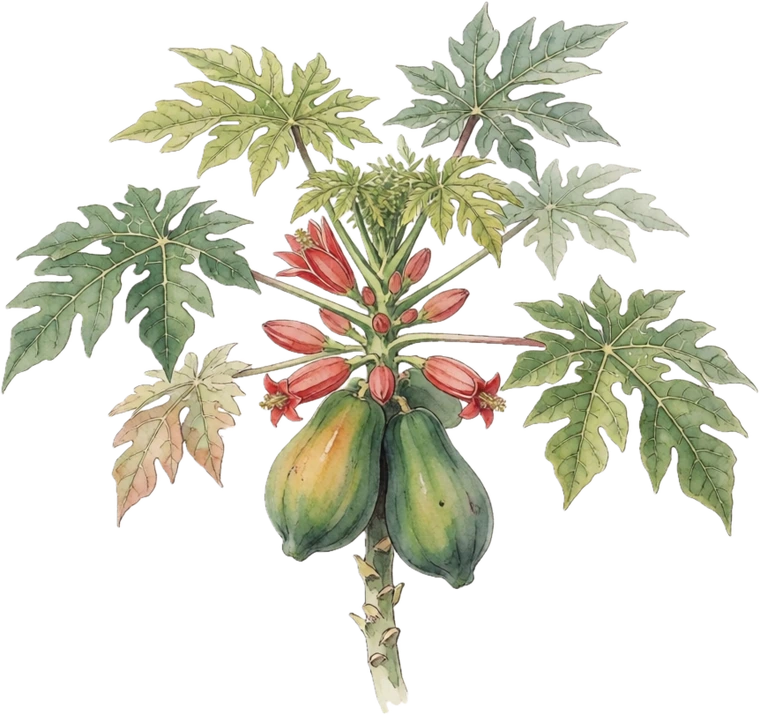
Named varieties of papaya differ in winter-chill needs, ripening time, hardiness, and whether they set fruit on their own — pick one that fits your climate.
Kapoho · Kapoho Solo
Partly self-fertileRipensFirst fruit about 14 months from planting, then continuously in warmthZones9-11SizeSmall pear-shaped solo fruit, 1 to 3 lb
High sugar, harvested at color break — Susceptible to papaya ringspot virus. Requires uniform, mild temperature and rainfall and makes small fruit under hot, dry conditions. Flowers at about 8 months, later than other solos, and takes about 14 months to first harvest. Inbred for many generations, so it reproduces true to type from seed. Seed gives female and hermaphrodite plants: hermaphrodites self-pollinate, females need a pollen source.
Where to buy ‘Kapoho’
Story Thyme Farms may earn a small commission from these links, at no cost to you — it never changes what we recommend.
Waimanalo
Partly self-fertileRipensFirst fruit about 10 to 12 months from planting, then continuously in warmthZones9-11SizeSmall pear-shaped solo fruit, 1 to 3 lb
Yellow flesh, good brix in heat and low brix where it is cool — Susceptible to papaya ringspot virus. Adapted to hot, dry locations; grown somewhere cooler it has low brix and a high incidence of carpeloidy, the cat-face fruit deformity, in winter. Shelf life is intermediate between Sunrise and Kapoho. Inbred and reproduces true to type from seed. Seed gives female and hermaphrodite plants.
Where to buy ‘Waimanalo’
Story Thyme Farms may earn a small commission from these links, at no cost to you — it never changes what we recommend.
Sunrise
Partly self-fertileRipensFirst fruit about 10 to 12 months from planting, then continuously in warmthZones9-11SizeSmall pear-shaped solo fruit, 1 to 3 lb
Red flesh, harvested at color break — Susceptible to papaya ringspot virus. Red-fleshed cultivars like this one are adapted to a wider range of climatic conditions than the yellow-fleshed cultivars. Has the shortest shelf life of the Hawaii solos and must be used promptly after picking. Inbred and reproduces true to type from seed. Seed gives female and hermaphrodite plants.
Where to buy ‘Sunrise’
Story Thyme Farms may earn a small commission from these links, at no cost to you — it never changes what we recommend.
Sunset
Partly self-fertileRipensFirst fruit about 10 to 12 months from planting, then continuously in warmthZones9-11SizeSmall pear-shaped solo fruit, 1 to 3 lb
Red flesh; brix develops slowly, so pick at quarter to half ripe rather than color break — Susceptible to papaya ringspot virus. Red-fleshed and adapted to a wide range of climatic conditions. Has the best shelf life of the Hawaii solos along with Kapoho. Because brix develops slowly, harvest should be delayed past color break to the quarter-ripe to half-ripe stage. Inbred and reproduces true to type from seed. It is the parent of the ringspot-resistant UH SunUp.
Where to buy ‘Sunset’
Story Thyme Farms may earn a small commission from these links, at no cost to you — it never changes what we recommend.
UH Rainbow · Rainbow
Partly self-fertileRipensFirst fruit about 10 to 12 months from planting, then continuously in warmthZones9-11DiseaseHighly resistant to papaya ringspot virus (genetically engineered)SizePear-shaped with a short neck to elliptical, 1 to 2 lb, averaging 1.5 lb, with 1 inch thick flesh
Sweet at 12 to 16 percent sugar, mild aroma, uniform juicy texture, yellow-orange flesh; ready to eat at 70 to 90 percent yellow — F1 hybrid of Kapoho crossed with UH SunUp, so seed saved from its fruit will not breed true and the seedlings may not be resistant to ringspot; new hybrid seed must be obtained each generation. Seed requires a license agreement with the Papaya Administrative Committee and purchasers must first attend a short orientation course; packets are available to home gardeners through CTAHR's Agricultural Diagnostic Service Center. Segregates 1:1 hermaphrodite to female, so leave five seedlings per spot when thinning rather than three.
Where to buy ‘UH Rainbow’
Story Thyme Farms may earn a small commission from these links, at no cost to you — it never changes what we recommend.
UH SunUp · SunUp
Partly self-fertileRipensFirst fruit about 10 to 12 months from planting, then continuously in warmthZones9-11DiseaseResistant to papaya ringspot virus (genetically engineered)SizeSmall pear-shaped solo fruit, 1 to 3 lb
Red flesh; brix develops slowly, so pick at quarter to half ripe rather than color break — A genetically transformed Sunset carrying engineered resistance to papaya ringspot virus, and the parent that supplies Rainbow its resistance. Like Sunset, harvest should be delayed past color break to the quarter-ripe to half-ripe stage because brix develops slowly. Seed requires a license agreement with the Papaya Administrative Committee; packets are available to home gardeners through CTAHR's Agricultural Diagnostic Service Center. Seed gives female and hermaphrodite plants.
Where to buy ‘UH SunUp’
Story Thyme Farms may earn a small commission from these links, at no cost to you — it never changes what we recommend.