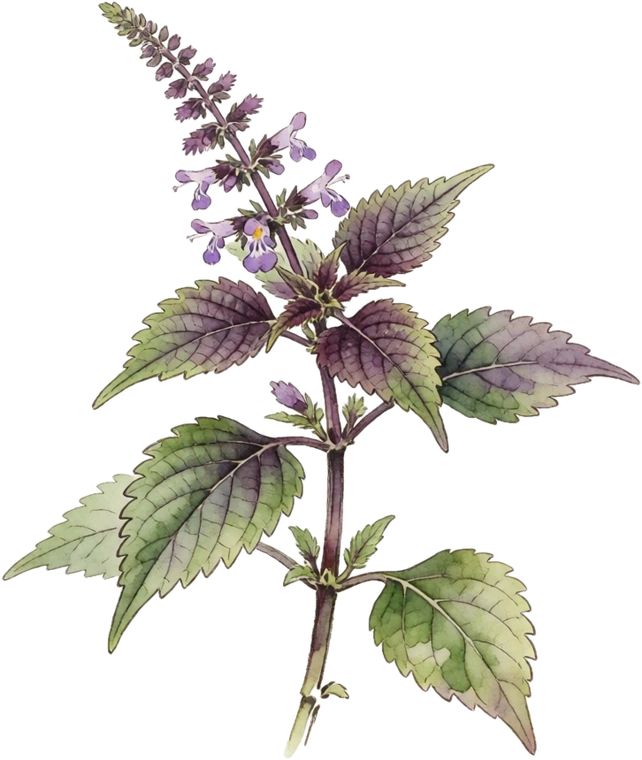
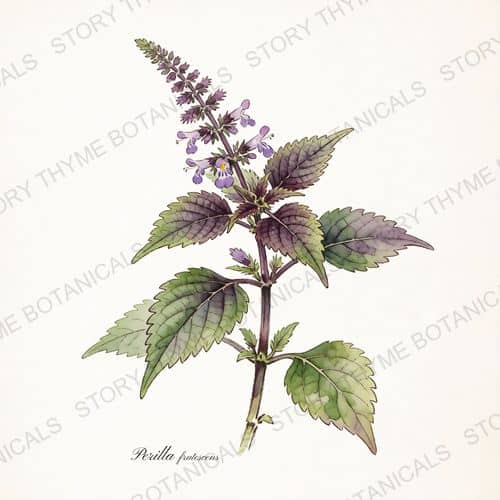
The illustrated growing guide
Perilla (Shiso)
Perilla frutescens
Family Lamiaceae
Grown as an annual

The sushi-plate herb and Korean BBQ wrap — a cinnamon-cumin-mint flavor unlike anything else, on a plant that grows like a weed and reseeds forever. The purple form doubles as a dark-foliage bedding plant. One planting, permanent supply.
⚠ Invasive in parts of the USCheck your state before planting.
I
Overview
Will perilla (shiso) suit your garden, and what goes wrong.
Will it fruit where you are?
Enter your ZIP — we look up your USDA hardiness zone (2023 map) and check it against what perilla (shiso) actually needs.

Perilla (Shiso) at a glance
Common perilla (shiso) problems
- Almost none (aromatic, pest-resistant)
- Few
II
Growing
Light, water, soil, propagation and the season’s jobs.
How to grow perilla (shiso): light, water & soil
How to plant & propagate perilla (shiso)
The perilla (shiso) growing playbook
Field-tested instructions for every job perilla (shiso) asks of you, compiled from university extension guidance — in the order the season brings them.
Sowing
Sow or set out shiso once frost has passed
Shiso can be direct seeded in the garden or set out as transplants in spring. Give it full sun to partial shade and allow about 2 feet per plant, since a single plant fills out to roughly 2 to 3 feet tall and wants the room. Shiso is a frost-tender warm-season annual in the mint family, so it has no reason to go in the ground until the soil and air have warmed, and it grows fast enough to catch up.
Feeding
Feed lightly, and only to a soil test
Give shiso a moderate feeding at planting and leave it at that. Get a soil test for the bed and follow its lime and fertilizer recommendation rather than guessing; if you are cutting leaves hard all season, a light second feeding is reasonable. Herbs grown for leaf flavor need only moderate fertility, and pushing them with nitrogen buys you soft growth rather than better leaves.
Pruning
Pinch off the flower spikes as they appear
As soon as the spike-like flower clusters start rising from the leaf axils in late summer, pinch them off. Keep after them every week or so until frost takes the plant. Pinching the flowers before they set seed both keeps the plant putting its energy into leaves and stops the wind-dispersed seed that lets shiso escape the bed.
What to watch for
Pull the plants before the seed drops, and check for volunteers
Pull or mow shiso down before the seed heads mature, and walk the surrounding ground the following spring for volunteer seedlings. Hand pulling while plants are young is the whole job; let one season of seed drop and you will be at it for years. Shiso self-seeds prolifically and the seed travels on wind, which is how it has naturalized along roadsides and woodland edges; it is listed as invasive in Virginia, West Virginia, Tennessee, and Kentucky.
⚠ Do not let this plant reach pasture or a fence line grazed by cattle. Perilla ketone in the plant causes atypical interstitial pneumonia, and the plant grows generally more toxic as it enters its reproductive phase, when it flowers roughly July through September. Do not assume livestock will simply leave it alone: in fall, when forage quality and quantity drop, cattle congregate in the shaded areas where perilla mint tends to infest, which puts them at greater risk of eating it.
Harvesting
Cut leaves through the season, best just before bloom
Pick leaves for fresh use as soon as the plants are established and keep picking all summer. For the strongest flavor, take stems individually, cutting about 6 inches below the flower buds, in the stretch just before the plant blooms. The essential oils that carry shiso's flavor peak in the foliage just prior to blooming, and cutting stems rather than stripping leaves keeps the plant branching.
III
The year
What perilla (shiso) asks for, month by month.
The perilla (shiso) year, month by month
What each band means
- Bloom — flowers open — pollinators working, frost on blossoms is the danger.
The perilla (shiso) year as text
- Jan quiet month
- Feb quiet month
- Mar quiet month
- Apr quiet month
- May quiet month
- Jun quiet month
- Jul quiet month
- Aug bloom
- Sep quiet month
- Oct quiet month
- Nov quiet month
- Dec quiet month
These are the species' typical months — expect them a few weeks earlier in warm zones and later in cold ones. Watch the plant, not just the calendar.
IV
Ecology & uses
What it does for the garden, and what it is grown for.
Perilla (Shiso) in the garden system
- Herbaceous layer annual
What perilla (shiso) is grown for
✓ Commonly eatenSafe (culinary leaves); the plant is toxic to cattle and horses (perilla ketones cause fatal respiratory distress) and Missouri banned its sale under SB 105
Harvesting & storing perilla (shiso)
Leaves all season — pinch for bushiness. About 70-90 days from planting.
Edibility, identification, and traditional-use notes here are general reference — not medical or veterinary advice, and not a claim that any plant treats or prevents anything. Medicinal ratings record how strongly a plant features in herbal tradition, nothing more. Never eat or dose a plant you have not positively identified. More on how to use this library.
V
Cultivars
Named varieties of perilla (shiso), ruled as a catalogue.
Best perilla (shiso) varieties & cultivars
Green (Japanese cooking); 'Red'/purple (Korean kkaennip, and ornamental); 'Britton' (bicolor)
VI
Sources & plant ID
Where the care distinctions come from, and how the plant is filed.
Research basis
Sources behind this profile
No extension citations are attached to perilla (shiso)yet. The care figures below come from the library's own catalogue rather than a traced primary source.
Plant ID
VII
Where to buy
Third-party nurseries — not Story Thyme Farms.
Third-party nurseries, not Story Thyme Farms. Prices are theirs.
Story Thyme Farms may earn a small commission from these links, at no cost to you — it never changes what we recommend.
VIII
Questions
Perilla (Shiso) questions, answered straight.
Is perilla (shiso) safe for kids and pets?
Perilla (Shiso) is commonly eaten and isn't considered toxic, but "commonly eaten" isn't a guarantee for any particular person or animal — allergies, quantity, and which part you eat all matter. One caveat on this one: culinary leaves); the plant is toxic to cattle and horses (perilla ketones cause fatal respiratory distress) and Missouri banned its sale under SB 105. Never eat a plant you haven't positively identified, and check with a vet before letting pets or livestock graze anything new.
When do you harvest perilla (shiso)?
Leaves all season — pinch for bushiness. From planting, expect about 70-90 days to maturity.
How do you propagate perilla (shiso)?
From seed.
Is perilla (shiso) invasive?
It can be invasive in some regions — give it room or a barrier, and check your state's invasive-species list before planting.
IX
Elsewhere
Where perilla (shiso) sits in the library.
Comfrey
Lavender
Rosemary
Anise Hyssop