The illustrated growing guide

Watermelon

Citrullus lanatus

Family Cucurbitaceae

Grown as an annual

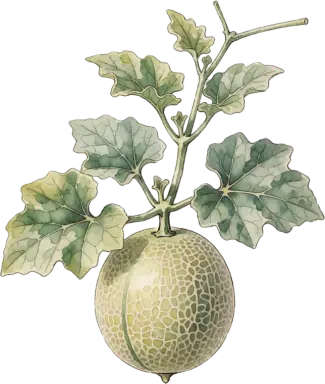
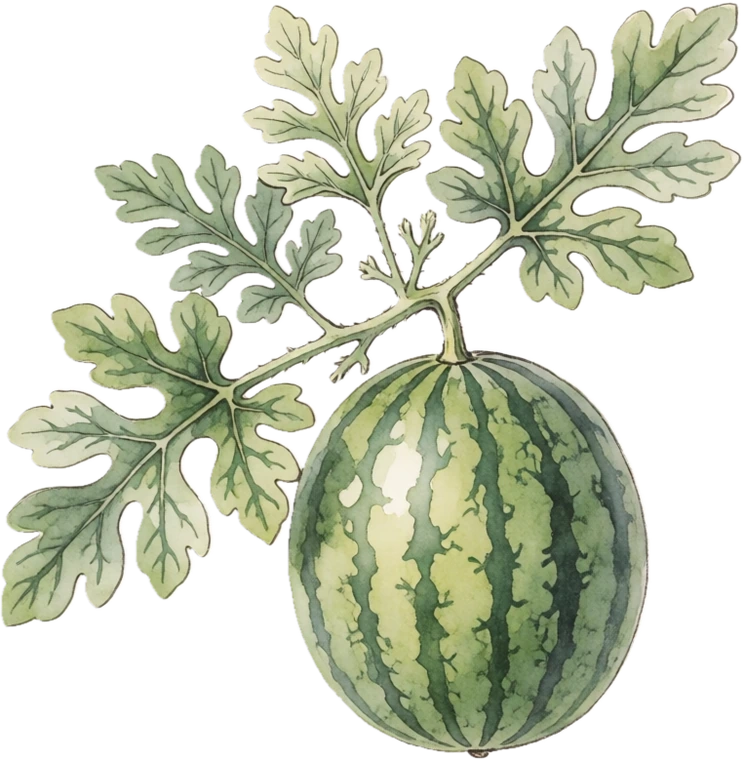
Botanical illustration of Watermelon
Annual · Citrullus lanatus

Needs room, heat, and patience — then delivers the single best August moment a garden makes. Short-season growers: 'Sugar Baby' on black plastic.

AnnualFull SunModerate waterFast growthExcellent edibleAttracts beesNone winter chill

Where to buy the plant — 3 nurseries

Moon and Stars — a print from the Melons & Heirloom Vines collection

From the print shop

The closest print we make

Our Melons & Heirloom Vines collection carries Citrullus lanatus — the same species as watermelon — but the print shows “Moon and Stars,” a different cultivar of it, not watermelon itself.

16 designsfrom $21.99white or black groundmatte poster, unframed

Shop Melons & Heirloom Vines botanical prints →

I

Overview

Will watermelon suit your garden, and what goes wrong.

Will it fruit where you are?

Enter your ZIP — we look up your USDA hardiness zone (2023 map) and check it against what watermelon actually needs.

Life cycleAnnual
Winter chillNone

Watermelon at a glance

Life cycleAnnual
Mature sizeVines 10-20 ft
PollinationMonoecious — bees
Chill requirementNone (not chill-dependent)
Bloom seasonSummer
Harvest seasonAugust - September: brown tendril nearest fruit + yellow belly spot + hollow thunk = go
Growth rateFast

Common watermelon problems

II

Growing

Light, water, soil, propagation and the season’s jobs.

How to grow watermelon: light, water & soil

LightFull Sun
WaterDeep weekly until sizing, then taper hard — watery flavor is literal
SoilSandy, warm · pH 6.0 - 6.8
FertilizerCompost hill; ease off nitrogen after bloom
PruningNone — Limit to 2-3 fruits per plant; slide a board under each melon.
Spacing3-4 ft, vines given room

How to plant & propagate watermelon

Maturity80-100 days
From seedDirect-sow or start 3 wks early; soil 75°F+
PropagateFrom seed

When to spray watermelon

Growing season. Rotate cucurbit ground; resistant varieties.

The watermelon growing playbook

Field-tested instructions for every job watermelon asks of you, compiled from university extension guidance — in the order the season brings them.

Sowing

Direct sow once soil hits 65F

Wait until frost danger has passed and soil has warmed to 65F, then sow seed 1 to 2 inches deep in mounds spaced 4 feet apart, several seeds per mound. After the seedlings are up, thin to the best 2 plants per mound. Watermelon seed rots rather than germinates in cold wet soil, and the crop makes no useful growth until soil is genuinely warm, so sowing early buys nothing and often costs the stand.

Planting out

Short season: set out 6-week transplants instead

Where the season is too short to ripen a melon from seed, start plants indoors in peat pots or cell trays and set out 6-week-old transplants carrying 2 to 3 mature leaves and a well-developed root system, spaced 2 feet apart in rows 4 to 6 feet apart. Set plants out once soil is 65F and all frost danger has passed; with plastic mulch and row cover you can go 2 to 3 weeks before the last frost. Handle the rootball gently and set it at the depth it grew in the pot. Transplants mature about two weeks earlier than direct-seeded plants, which is often the whole margin between a ripe melon and a frost-killed vine in a cool zone. Watermelons resent root disturbance, so they must be grown in containers that go into the ground intact.

Watering

Water deeply all season, then ease off as melons ripen

Give 1 to 2 inches per week, applied deeply and infrequently, ideally by drip. Once the fruit has reached full size and is ripening, cut the water back. Water early in the day if you must wet the leaves. Sugar is concentration as much as production, so water taken up in the final ripening stretch dilutes the flesh and gives you a big bland melon. Watering early and low also lets leaves dry fast, which starves the splash-borne leaf diseases of the free water they need to infect.

Feeding

Sidedress nitrogen once the runners take off

After the vines put out runners, sidedress 3 to 4 tablespoons of 21-0-0 per plant and water it in. On long-season plantings, split the nitrogen: roughly half before planting and the rest 4 to 6 weeks after seeding, with a further feeding as fruit begins to size. Vine run is when the plant builds the leaf canopy that will later fill the fruit, so nitrogen pays there. Split applications match nitrogen to that demand curve instead of dumping it where rain can leach it away.

Do not overdo the nitrogen. Excess nitrogen pushes vine at the expense of fruit and lowers both yield and eating quality.

What to watch for

Cucumber beetles: watch the seedlings from the day they emerge

Check seedlings for striped and spotted cucumber beetles as soon as they break ground and keep checking until vines are running. Beetles feed on plants as soon as they emerge and will kill them outright or badly stunt them, and they will even enter soil cracks to feed on seedlings below the surface. Handpick, keep weeds down, and use row cover as the first line. If beetles are numerous on unflowered seedlings, bifenthrin, cyfluthrin, carbaryl, permethrin, or spinosad are labeled for them. The bacterial wilt pathogen overwinters inside the beetles' guts, so a beetle feeding on a two-leaf seedling is not just chewing, it is injecting a disease that kills the vine outright. Beetles also stunt or kill small plants by feeding alone.

Do not apply insecticide once the vines are flowering: watermelon is entirely dependent on insect pollination, and a female flower needs about eight bee visits to set a well-shaped, fully expanded melon - fruit set falls off sharply at only two to four visits. Confine treatment to the pre-bloom seedling stage. Pre-harvest intervals on cucurbits: bifenthrin 3 days, carbaryl 3 days, spinosad 3 days, cyfluthrin 0 days, permethrin 0 days. Always follow the product label, which is the legal authority.

Spraying

Gummy stem blight: protectant sprays once vines run

From the time vines run, apply chlorothalonil or mancozeb as a preventive protectant on a 7 to 10 day schedule. Alternate chemistries rather than spraying the same mode of action all season - rotate in a different mode of action such as tebuconazole or a premix. Gummy stem blight needs free water to infect and is splashed onto leaves and stems by rain and overhead irrigation, so it establishes during wet weather. Protectants only work ahead of infection, not after lesions are widespread. The gummy stem blight fungus has documented fungicide resistance, which is why rotating chemistries is not optional.

Do not apply chlorothalonil within 21 days of harvest: it causes rind burn on maturing watermelons. Late-season pre-harvest intervals can run as high as 14 days, so plan the last sprays around your picking date. Always follow the product label, which is the legal authority.

Protection

Row cover the young vines, then pull it off at first flower

Cover new seedlings or transplants with spunbonded fabric, hotcaps, or a low tunnel to hold warmth and keep cucumber beetles off. Ventilate whenever air under the cover passes 80F. Remove the cover entirely as soon as the vines start flowering, or when temperatures top 90F. The cover buys early warmth and is the single most effective barrier against the beetles that vector bacterial wilt into seedlings. But watermelon flowers open for one day only and are strictly insect-pollinated, so a cover left on through bloom simply starves the crop of bees and you get misshapen fruit or none.

Harvesting

Pick on the tendril, the belly spot, and the dull rind

Start checking about 35 to 45 days after the flower opened, sooner in hot weather. Harvest when the curly tendril nearest the fruit stem has dried brown, the patch where the melon rests on the ground has turned from white to a creamy yellow, and the rind has lost its gloss and gone dull. A hollow thump backs up the other three but is not reliable on its own. A watermelon does not ripen further once cut. Unlike a muskmelon it never slips from the vine to tell you it is ready, so these external signs are the only honest read on a fruit you cannot see inside.

III

The year

What watermelon asks for, month by month.

The watermelon year, month by month

MonthJanFebMarAprMayJunJulAugSepOctNovDec
Bloom
Harvest

What each band means

  • Bloomflowers open — pollinators working, frost on blossoms is the danger.
  • Harvestpicking time — check ripeness every few days.

The watermelon year as text

  • Jan quiet month
  • Feb quiet month
  • Mar quiet month
  • Apr quiet month
  • May quiet month
  • Jun bloom
  • Jul bloom
  • Aug bloom, harvest
  • Sep harvest
  • Oct quiet month
  • Nov quiet month
  • Dec quiet month

These are the species' typical months — expect them a few weeks earlier in warm zones and later in cold ones. Watch the plant, not just the calendar.

IV

Ecology & uses

What it does for the garden, and what it is grown for.

Watermelon in the garden system

  • Vine layer annual
AttractsBees
MoistureFacultative / average
DeerBrowsed — protect young plants
OriginIntroduced

What watermelon is grown for

✓ Commonly eaten

UseSummer tables
UsePickled rinds
Edible value4/5

Harvesting & storing watermelon

August - September: brown tendril nearest fruit + yellow belly spot + hollow thunk = go. About 80-100 days from planting.

Edibility, identification, and traditional-use notes here are general reference — not medical or veterinary advice, and not a claim that any plant treats or prevents anything. Medicinal ratings record how strongly a plant features in herbal tradition, nothing more. Never eat or dose a plant you have not positively identified. More on how to use this library.

V

Cultivars

Named varieties of watermelon, ruled as a catalogue.

Best watermelon varieties & cultivars

12 on file

Named varieties of watermelon differ in days to maturity, disease resistance, flavor, and habit — pick one that fits your season and space.

Crimson Sweet

Self-fertile
RipensmainZones2-11DiseaseResistant to Fusarium wilt race 0; susceptible to races 1, 2 and 3Sizelarge, 15-25 lb

sweet red flesh — Named by Utah State extension as an excellent home garden variety and the most widely carried standard seeded striped melon. Fusarium race resistance per UGA bulletin B1485, Table 1.

Where to buy ‘Crimson Sweetverified

Story Thyme Farms may earn a small commission from these links, at no cost to you — it never changes what we recommend.

Charleston Gray · Charleston Grey

Self-fertile
RipensmainZones2-11DiseaseResistant to Fusarium wilt race 0; susceptible to races 1, 2 and 3Sizelarge, elongated

sweet red flesh — Classic long gray-rinded Southern melon. Fusarium race resistance per UGA bulletin B1485, Table 1.

Where to buy ‘Charleston Grayverified

Story Thyme Farms may earn a small commission from these links, at no cost to you — it never changes what we recommend.

Allsweet

Self-fertile
RipensmainZones2-11DiseaseResistant to Fusarium wilt races 0 and 1; susceptible to races 2 and 3Sizelarge

sweet red flesh — One of the major seeded types in commercial production and a step up in Fusarium resistance from Crimson Sweet.

Where to buy ‘Allsweet

Story Thyme Farms may earn a small commission from these links, at no cost to you — it never changes what we recommend.

Calhoun Gray

Self-fertile
RipensmainZones2-11DiseaseResistant to Fusarium wilt races 0 and 1; susceptible to races 2 and 3Sizelarge, elongated

sweet red flesh — Gray-rinded melon bred for Fusarium resistance; worth choosing on ground with a history of wilt.

Where to buy ‘Calhoun Gray

Story Thyme Farms may earn a small commission from these links, at no cost to you — it never changes what we recommend.

Sugar Baby

Self-fertile
RipensearlyZones2-11DiseaseSusceptible to all four races of Fusarium wilt (0, 1, 2 and 3)Sizeicebox

sweet red flesh — Long-standing early icebox melon, widely available. UGA bulletin B1485 uses it as a susceptible check for Fusarium race identification: its wilt susceptibility is total, so avoid it on ground where wilt has appeared.

Where to buy ‘Sugar Babyverified

Story Thyme Farms may earn a small commission from these links, at no cost to you — it never changes what we recommend.

Mickylee

Self-fertile
RipensmainZones2-11Sizeicebox, 10-15 lb

sweet red flesh — Named by Utah State extension as one of three excellent varieties for the home garden.

Where to buy ‘Mickylee

Story Thyme Farms may earn a small commission from these links, at no cost to you — it never changes what we recommend.

Minilee

Self-fertile
RipensmainZones2-11Sizeicebox, 10-15 lb

sweet red flesh — Listed by Utah State extension among small icebox types alongside Mickylee.

Where to buy ‘Minilee

Story Thyme Farms may earn a small commission from these links, at no cost to you — it never changes what we recommend.

Yellow Baby

Self-fertile
RipensearlyZones2-11Sizeicebox

sweet yellow flesh — Named by Utah State extension as one of three excellent home garden varieties and listed there among the yellow-fleshed types.

Where to buy ‘Yellow Baby

Story Thyme Farms may earn a small commission from these links, at no cost to you — it never changes what we recommend.

Golden Crown

Self-fertile
RipensearlyZones2-11Sizesmall

yellow flesh — Listed by Utah State extension among the yellow-fleshed watermelon varieties for the home garden.

Where to buy ‘Golden Crown

Story Thyme Farms may earn a small commission from these links, at no cost to you — it never changes what we recommend.

Solitaire

Needs a pollinizer
RipensmainZones2-11Sizesmall round, mini seedless
Pollinationtriploid seedless - requires a seeded diploid pollenizer interplanted nearby

sweet red flesh — Recommended by University of Missouri extension for high tunnel production as a small, round mini seedless melon. As a triploid it makes almost no viable pollen and cannot set its own fruit.

Where to buy ‘Solitaire

Story Thyme Farms may earn a small commission from these links, at no cost to you — it never changes what we recommend.

Vanessa

Needs a pollinizer
RipensearlyZones2-11Sizemini seedless, solid dark rind
Pollinationtriploid seedless - requires a seeded diploid pollenizer interplanted nearby

sweet red flesh — Mini seedless cultivar trialed by University of Missouri extension for high tunnel production.

Where to buy ‘Vanessa

Story Thyme Farms may earn a small commission from these links, at no cost to you — it never changes what we recommend.

Extazy

Needs a pollinizer
RipensmainZones2-11Sizesmall round, mini seedless
Pollinationtriploid seedless - requires a seeded diploid pollenizer interplanted nearby

sweet red flesh — Mini seedless cultivar trialed by University of Missouri extension for high tunnel production.

Where to buy ‘Extazy

Story Thyme Farms may earn a small commission from these links, at no cost to you — it never changes what we recommend.

VI

Sources & plant ID

Where the care distinctions come from, and how the plant is filed.

Research basis

Sources behind this profile

No extension citations are attached to watermelonyet. The care figures below come from the library's own catalogue rather than a traced primary source.

Plant ID

BinomialCitrullus lanatus
FamilyCucurbitaceae
TypeAnnual
USDA symbolCILA3
OriginIntroduced
Invasive riskLow

VII

Where to buy

Third-party nurseries — not Story Thyme Farms.

Third-party nurseries, not Story Thyme Farms. Prices are theirs.

Story Thyme Farms may earn a small commission from these links, at no cost to you — it never changes what we recommend.

VIII

Questions

Watermelon questions, answered straight.

Is watermelon safe for kids and pets?

Watermelon is commonly eaten and isn't considered toxic, but "commonly eaten" isn't a guarantee for any particular person or animal — allergies, quantity, and which part you eat all matter. Never eat a plant you haven't positively identified, and check with a vet before letting pets or livestock graze anything new.

When do you harvest watermelon?

August - September: brown tendril nearest fruit + yellow belly spot + hollow thunk = go. From planting, expect about 80-100 days to maturity.

How do you propagate watermelon?

From seed.

IX

Elsewhere

Where watermelon sits in the library.

Where watermelon sits in the library

Grows in the same world