The illustrated growing guide

Avocado

Persea americana

Family Lauraceae

Est. zones 9-11

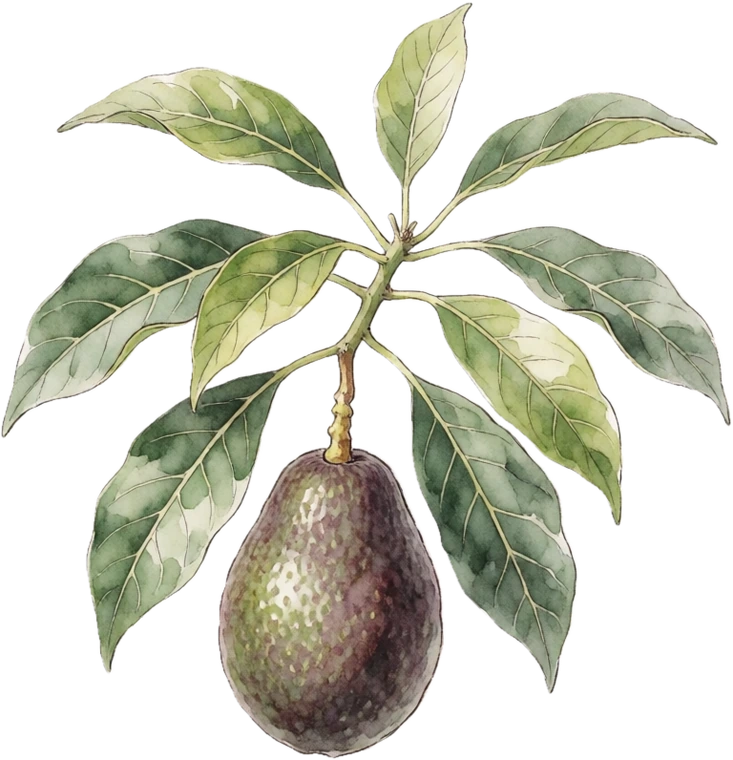
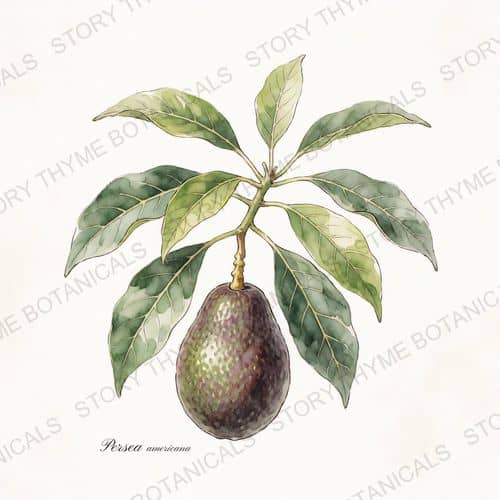
Botanical illustration of Avocado
Tree · Persea americana

The grocery pit on toothpicks is a fun kid project but rarely fruits — for real avocados buy a grafted 'Mexicola' and grow it in a pot you drag inside. Cold-hardy Mexican types push the frontier to zone 8.

TreeFull SunModerate waterFast growthExcellent edibleAttracts beesNone winter chillNeeds a pollination partner

Where to buy the plant — 3 nurseries

I

Overview

Will avocado suit your garden, and what goes wrong.

Will it fruit where you are?

Enter your ZIP — we look up your USDA hardiness zone (2023 map) and check it against what avocado actually needs.

Life cyclePerennial zones 9–11, annual elsewhere
Winter chillNone
PollinationPartner needed

Avocado at a glance

Life cyclePerennial zones 9–11, annual elsewhere
Mature size30-60 ft (dwarfed in pots)
PollinationType A + Type B flowering for best set (one tree fruits lightly alone)
Chill requirementNone (not chill-dependent)
Bloom seasonSpring (tiny greenish)
Harvest seasonFruit holds ON the tree for months — 'store on the tree', pick as needed; softens only after picking
Growth rateFast

Common avocado problems

II

Growing

Light, water, soil, propagation and the season’s jobs.

How to grow avocado: light, water & soil

LightFull Sun
WaterModerate — deep soak then dry; root rot is the killer
SoilLoose, fast-draining, slightly acid · pH 6.0 - 6.5
FertilizerCitrus/avocado feed 3-4x in season; zinc + iron matter
PruningAfter harvest — Tip-prune potted trees to stay bushy; stake young trunks.
Spacing20+ ft; container 5-8 ft

How to plant & propagate avocado

PropagateGrafted, or from cuttings/layering (seed won't come true)

When to spray avocado

Growing season. Perfect drainage is the whole disease program.

III

The year

What avocado asks for, month by month.

The avocado year, month by month

MonthJanFebMarAprMayJunJulAugSepOctNovDec
Bloom
Prune

What each band means

  • Bloomflowers open — pollinators working, frost on blossoms is the danger.
  • Pruneshape it now — cuts heal cleanly and structure is visible.

The avocado year as text

  • Jan quiet month
  • Feb quiet month
  • Mar bloom
  • Apr bloom
  • May bloom
  • Jun quiet month
  • Jul pruning
  • Aug pruning
  • Sep quiet month
  • Oct quiet month
  • Nov quiet month
  • Dec quiet month

These are the species' typical months — expect them a few weeks earlier in warm zones and later in cold ones. Watch the plant, not just the calendar.

IV

Ecology & uses

What it does for the garden, and what it is grown for.

Avocado in the garden system

  • Canopy layer tree
AttractsBees
MoistureFacultative / average
DeerBrowsed — protect young plants
OriginIntroduced

What avocado is grown for

✓ Commonly eatenSafe for people; leaves/bark/pit are dangerous to BIRDS, horses and livestock (persin). For dogs and cats the real risks are GI upset, pancreatitis from the fat, and choking on the pit — not persin poisoning

UseGuacamole ambitions
UsePatio tropical
UseKid science
Edible value4/5

Harvesting & storing avocado

Fruit holds ON the tree for months — 'store on the tree', pick as needed; softens only after picking.

Edibility, identification, and traditional-use notes here are general reference — not medical or veterinary advice, and not a claim that any plant treats or prevents anything. Medicinal ratings record how strongly a plant features in herbal tradition, nothing more. Never eat or dose a plant you have not positively identified. More on how to use this library.

V

Cultivars

Named varieties of avocado, ruled as a catalogue.

Best avocado varieties & cultivars

9 on file

Named varieties of avocado differ in winter-chill needs, ripening time, hardiness, and whether they set fruit on their own — pick one that fits your climate.

Hass · Hass Avocado

Partly self-fertile
RipensSpring through summer (Apr-Sep in CA)Zones9-11Diseasesusceptible to Phytophthora root rotSizestandard 15-30 ft (prune to keep smaller)
Pollinationflower type A (best yield with a type B nearby)

rich, nutty, high-oil; skin turns black when ripe — The industry standard for flavor, but tender (damaged below ~30F), so it needs a nearly frost-free spot.

Where to buy ‘Hassverified

Story Thyme Farms may earn a small commission from these links, at no cost to you — it never changes what we recommend.


Fuerte

Partly self-fertile
RipensNov-Apr (winter-spring)Zones9-11Diseasesusceptible to Phytophthora root rotSizestandard, large spreading 20-30 ft
Pollinationflower type B (classic pollinizer for Hass)

smooth, buttery, mild; green pear-shaped fruit — A hardier (to ~28F) green-skin classic and the traditional type-B partner planted alongside Hass.

Where to buy ‘Fuerte

Story Thyme Farms may earn a small commission from these links, at no cost to you — it never changes what we recommend.

Bacon

Partly self-fertile
RipensNov-Mar (fall-winter)Zones8-11Diseasesusceptible to Phytophthora root rotSizestandard, upright 15-25 ft
Pollinationflower type B (pairs with type A like Hass)

light, watery, mild flavor; thin green skin — One of the more cold-tolerant grafted varieties (to ~25-28F), making it a good pollinizer and backyard tree for cooler-winter areas.

Where to buy ‘Bacon

Story Thyme Farms may earn a small commission from these links, at no cost to you — it never changes what we recommend.

Zutano

Partly self-fertile
RipensOct-Jan (fall-early winter)Zones8-11Diseasesusceptible to Phytophthora root rotSizestandard, upright 15-25 ft
Pollinationflower type B (widely used to pollinize Hass)

light, watery, low-oil; thin green skin — Grown mostly as a reliable, cold-tolerant (to ~24-28F) type-B pollinizer rather than for its fairly bland fruit.

Where to buy ‘Zutano

Story Thyme Farms may earn a small commission from these links, at no cost to you — it never changes what we recommend.

Mexicola Grande · Mexicola

Partly self-fertile
RipensAug-Oct (late summer-fall)Zones8-11Diseasesusceptible to Phytophthora root rotSizestandard, vigorous 20-30 ft
Pollinationflower type A (fruits well alone; add a type B to boost set)

rich, nutty, anise-tinged; small fruit with thin black skin and large seed — A pure-Mexican variety hardy to about 18-20F, one of the best choices for pushing avocados into cooler climates.

Where to buy ‘Mexicola Grande

Story Thyme Farms may earn a small commission from these links, at no cost to you — it never changes what we recommend.
Lila · Opal

Partly self-fertile
RipensAug-Oct (late summer-fall)Zones8-11Diseasesusceptible to Phytophthora root rotSizecompact standard, semi-dwarf 10-15 ft
Pollinationflower type A (self-fruitful; benefits from a type B)

rich, classic Mexican-avocado flavor; medium green-purple fruit — Among the most cold-hardy avocados (to roughly 15F) on a naturally compact tree, ideal for Gulf Coast and marginal yards.

Where to buy ‘Lila

Story Thyme Farms may earn a small commission from these links, at no cost to you — it never changes what we recommend.

Brogdon · Brogden

Partly self-fertile
RipensJul-Sep (summer-early fall)Zones8-11Diseasesusceptible to Phytophthora root rotSizestandard, upright and narrow 15-25 ft
Pollinationflower type B (pairs with cold-hardy type A varieties)

rich, nutty; distinctive thin purple-black skin — A cold-hardy (to ~18F) type-B tree that gives Gulf-South growers a pollinizer partner for Mexican type-A avocados.

Where to buy ‘Brogdon

Story Thyme Farms may earn a small commission from these links, at no cost to you — it never changes what we recommend.

Reed

Partly self-fertile
RipensJul-Oct (summer-fall)Zones9-11Diseasesusceptible to Phytophthora root rotSizestandard but upright and columnar 15-20 ft
Pollinationflower type A (sets well alone; type B improves yield)

rich, buttery, high quality; large round green fruit — Its upright, space-saving habit and summer-ripening large fruit make it a favorite single-tree pick for warm-winter yards.

Where to buy ‘Reed

Story Thyme Farms may earn a small commission from these links, at no cost to you — it never changes what we recommend.

Wurtz · Little Cado, Minicado

Partly self-fertile
RipensMay-Sep (spring-summer)Zones9-11Diseasesusceptible to Phytophthora root rotSizetrue dwarf, weeping 8-12 ft
Pollinationflower type A (self-fruitful; a type B boosts set)

good, mild-to-rich; medium green pear-shaped fruit — The only genuine dwarf avocado, well-suited to containers and small gardens, though frost-tender to about 30F.

Where to buy ‘Wurtz

Story Thyme Farms may earn a small commission from these links, at no cost to you — it never changes what we recommend.

VI

Sources & plant ID

Where the care distinctions come from, and how the plant is filed.

Research basis

Sources behind this profile

No extension citations are attached to avocadoyet. The care figures below come from the library's own catalogue rather than a traced primary source.

Plant ID

BinomialPersea americana
FamilyLauraceae
TypeTree · Tender Perennial
USDA symbolPEAM3
OriginIntroduced
Invasive riskLow

VII

Where to buy

Third-party nurseries — not Story Thyme Farms.

Third-party nurseries, not Story Thyme Farms. Prices are theirs.

Story Thyme Farms may earn a small commission from these links, at no cost to you — it never changes what we recommend.

Avocado needs a pollination partner — plant two genetically distinct trees (two different cultivars, or a cultivar plus a seedling).

VIII

Questions

Avocado questions, answered straight.

Why isn't my avocado fruiting?

Most often: it has no genetically distinct partner nearby. Avocado is only partly self-fertile, so a lone plant sets a light crop at best — type a + type b flowering for best set (one tree fruits lightly alone). Plant a second, unrelated one nearby; two different cultivars, or a cultivar plus a seedling, is the classic pairing.

Is avocado safe for kids and pets?

Avocado is commonly eaten and isn't considered toxic, but "commonly eaten" isn't a guarantee for any particular person or animal — allergies, quantity, and which part you eat all matter. One caveat on this one: Safe for people; leaves/bark/pit are dangerous to BIRDS, horses and livestock (persin). For dogs and cats the real risks are GI upset, pancreatitis from the fat, and choking on the pit — not persin poisoning. Never eat a plant you haven't positively identified, and check with a vet before letting pets or livestock graze anything new.

When do you harvest avocado?

Fruit holds ON the tree for months — 'store on the tree', pick as needed; softens only after picking.

How do you propagate avocado?

Grafted, or from cuttings/layering (seed won't come true).

IX

Elsewhere

Where avocado sits in the library.