The illustrated growing guide

Mulberry

Morus alba × rubra / M. rubra

Family Moraceae

Est. zones 4-9

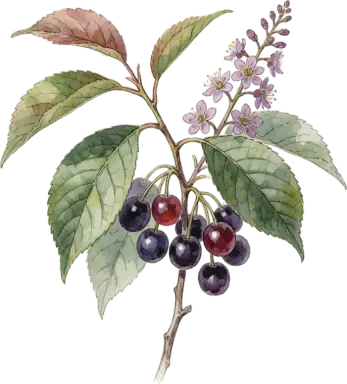
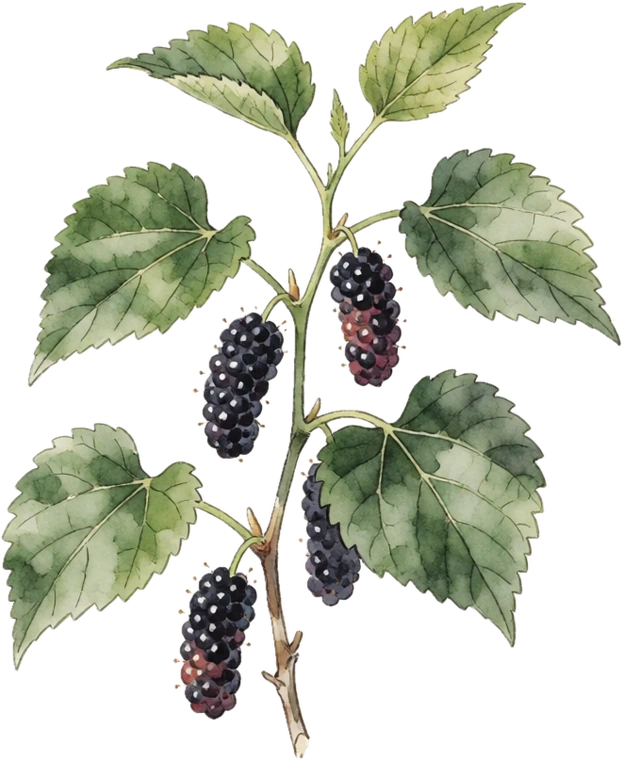
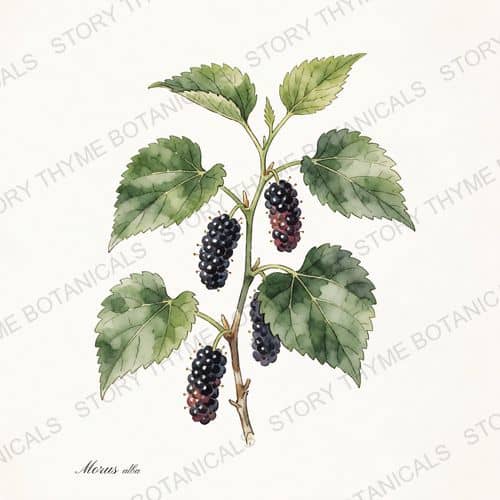
Botanical illustration of Mulberry
Tree · Morus alba × rubra / M. rubra

Plant AWAY from driveways/patios/laundry lines — fruit drop stains everything. Shake ripe fruit onto sheets. The chicken-run tree: birds + poultry + kids all fed for free.

TreeFull Sun to Part ShadeLow waterVery Fast growthExcellent edible400-400 winter chill (unconfirmed)

Where to buy the plant — 3 nurseries

Mulberry — a print from the Berry Plants collection

From the print shop

The closest print we make

We don’t print Morus alba × rubra / M. rubra. The closest we have is Morus nigra (“Mulberry”) in the Berry Plants collection — the same genus, Morus, not the same species.

16 designsfrom $21.99white or black groundmatte poster, unframed

Shop Berry Plants botanical prints →

I

Overview

Will mulberry suit your garden, and what goes wrong.

Will it fruit where you are?

Enter your ZIP — we look up your USDA hardiness zone (2023 map) and check it against what mulberry actually needs.

Hardy inZones 4-9
Winter chill400-400
Unconfirmed

Commonly quoted, but we have not traced this range to a university extension trial or another primary source, and published figures for the same plant often disagree. Chill-hour requirements were only ever established by trial for a handful of commercial fruit crops; for most species the work was never funded. Treat it as a starting point and check your local extension office before you plant on it.

PollinationSelf-fertile

Mulberry at a glance

HardinessUSDA 4–9
Mature size20-40 ft
PollinationSelf-Fertile (mostly)
Chill requirement400-400
Unconfirmed

Commonly quoted, but we have not traced this range to a university extension trial or another primary source, and published figures for the same plant often disagree. Chill-hour requirements were only ever established by trial for a handful of commercial fruit crops; for most species the work was never funded. Treat it as a starting point and check your local extension office before you plant on it.

Bloom seasonSpring
Harvest seasonJune - August (everbearing types, 8+ weeks)
Growth rateVery Fast

Common mulberry problems

  • Birds (but crops outproduce them)
  • Silkworms (rarely)
  • Few — popcorn disease occasionally

II

Growing

Light, water, soil, propagation and the season’s jobs.

How to grow mulberry: light, water & soil

LightFull Sun to Part Shade
WaterLow once established — tough as nails
SoilAdaptable to nearly anything · pH 5.5 - 7.0
FertilizerNone needed.
PruningWinter — Minimal. Head back for picking height while young.
Spacing20-30 ft

How to plant & propagate mulberry

PropagateGrafted, or from cuttings/layering (seed won't come true)

The mulberry growing playbook

Field-tested instructions for every job mulberry asks of you, compiled from university extension guidance — in the order the season brings them.

Feeding

Skip the fertilizer on an established mulberry

Do not feed an established mulberry as a matter of routine. Hold off unless a soil test or genuinely poor growth says the tree needs something, and water only through the first year or two while it roots in, or during an extended drought. Mulberries thrive in sandy, infertile soil and rarely need irrigation once established. Pushing a tree that is already among the fastest-growing fruit trees with nitrogen mostly buys you more wood to cut out next winter and lifts the fruit further out of reach.

Pruning

Prune only while the tree is leafless and fully dormant

Prune in late fall or winter, once the leaves are off and the tree is fully dormant. On a young tree, make light cuts to build a strong framework of well-spaced scaffolds and to hold the head low enough to pick from the ground, because a mulberry left alone will outgrow hand harvest fast. On an established tree, take out only dead, damaged, or crossing limbs rather than opening it up with big cuts. Every part of a mulberry runs with milky latex, and cuts made once the sap is moving bleed heavily; the wounds left by removing a major branch are also slow to callous over, so a large cut stays open to decay organisms for years.

The milky sap causes skin rashes in some people (UF/IFAS) - wear gloves and long sleeves, and keep the latex off your face. The leaves and young shoots contain a white latex that is mildly toxic if eaten.

What to watch for

Popcorn disease: pull and destroy every deformed berry

As the fruit colors, walk the tree and look for berries whose individual segments have swollen into pale, puffy lobes that stick out past the healthy fruit like popped corn. Pick every deformed berry off the tree and rake up the ones that have dropped, then bury or bag them. Do not compost them and do not leave them lying under the canopy. The fungus survives nowhere but in those infected berries. Each one left on the tree or on the ground dries into a mummy that produces the spore-bearing cups which reinfect next spring's flowers, so removing them is the control - and white mulberries and their hybrids are the most susceptible.

Spotted wing drosophila: your mulberry is the neighborhood's first nursery

Start watching about two weeks before the berries begin to color. Hang a trap baited with apple cider vinegar or a commercial lure in the shaded side of the canopy, three to five feet up. Whether or not you trap, pick up overripe and fallen fruit promptly - seal culls in a plastic bag and leave it in the sun, or bin them. Never compost infested fruit, and do not bury it shallower than about two feet. Mulberry is one of spotted wing drosophila's favorite wild hosts and ripens ahead of most cultivated berries, so an unpicked mulberry quietly breeds the flies that go on to hit your raspberries, blueberries, and cherries weeks later. The fly lays into sound, ripening fruit rather than waiting for damage, so the fallen crop underneath is a reservoir, not litter.

This rule is deliberately sanitation-only. Insecticides for spotted wing drosophila are labeled for commercial berry and cherry crops and carry crop-specific pre-harvest intervals; mulberry is not on those labels, so do not carry a berry spray over to it.

Spraying

Popcorn disease: protective Bordeaux as the tree leafs out

Only worth doing if popcorn disease deformed your crop last year. As the buds break and the first leaves push, apply Bordeaux mixture (copper sulfate plus hydrated lime) to the whole canopy, before the flowers and young fruit are exposed. Fungicides are not routinely recommended on mulberry and full coverage of a big tree is genuinely hard, so treat this as a supplement to sanitation, never a replacement for it. Ciboria carunculoides overwinters in mummified berries and releases its spores at the developing flowers and young fruit in late spring; a protectant copper film on that tissue during the infection window is the only chemical measure reported to help.

Bordeaux mixture is a copper fungicide - follow the label rate and confirm the label covers mulberry or fruit trees generally before you spray. Copper can burn foliage applied in hot or slow-drying weather.

Protection

Net the tree as the flowers finish, not when the fruit turns

Put netting up near the end of flowering, while the fruit is still small. Drape it over a frame rather than the branches themselves, run it to the ground on every side, and pin it down every two to three feet with sod staples so there are no gaps. Harvest by lifting a section of staples and picking from underneath instead of pulling the whole net off. Netting is the only reliable defense - birds learn within days that pie pans and rubber snakes are bluffing. Waiting until the berries color makes the net far harder to install, and any gap left at the bottom lets birds walk in and then trap them inside.

Gaps in the netting trap birds rather than exclude them - check the perimeter after installing, and keep the net off the foliage so berries and wildlife do not tangle in it.

Harvesting

Pick at full color, and expect a short, repeated window

Take the berries once they have gone fully dark - deep purple-black on red and hybrid types, or fully blushed on the white-fruited ones - and pull free with no resistance. Go over the tree every day or two. On an everbearing hybrid the ripening rolls on for weeks, but on a red mulberry the whole crop is often done in a few weeks in early summer. A fully ripe berry drops on its own within a day or two, so anything you leave feeds the birds, stains what is underneath, and breeds fruit flies. Unripe fruit is not worth taking either: greenish-white berries are simply not ripe, and the tree's latex is mildly toxic if eaten.

Pick only fully colored fruit - do not eat greenish-white unripe mulberries, and note that the leaves and young shoots contain a white latex that is mildly toxic if eaten. Ripe fruit stains badly, so keep the harvest and the drop off driveways, patios, and walkways.

III

The year

What mulberry asks for, month by month.

The mulberry year, month by month

MonthJanFebMarAprMayJunJulAugSepOctNovDec
Bloom
Prune
Harvest

What each band means

  • Bloomflowers open — pollinators working, frost on blossoms is the danger.
  • Pruneshape it now — cuts heal cleanly and structure is visible.
  • Harvestpicking time — check ripeness every few days.

The mulberry year as text

  • Jan pruning
  • Feb pruning
  • Mar bloom
  • Apr bloom
  • May bloom
  • Jun harvest
  • Jul harvest
  • Aug harvest
  • Sep quiet month
  • Oct quiet month
  • Nov quiet month
  • Dec pruning

These are the species' typical months — expect them a few weeks earlier in warm zones and later in cold ones. Watch the plant, not just the calendar.

IV

Ecology & uses

What it does for the garden, and what it is grown for.

Mulberry in the garden system

  • Canopy layer tree
AttractsBirds
MoistureUpland / dry
DeerBrowsed — protect young plants
OriginIntroduced

What mulberry is grown for

✓ Commonly eatenunripe fruit mildly irritating

UseFresh
UseJam
UseWine
UsePoultry forage
Edible value4/5

Harvesting & storing mulberry

June - August (everbearing types, 8+ weeks).

Edibility, identification, and traditional-use notes here are general reference — not medical or veterinary advice, and not a claim that any plant treats or prevents anything. Medicinal ratings record how strongly a plant features in herbal tradition, nothing more. Never eat or dose a plant you have not positively identified. More on how to use this library.

V

Cultivars

Named varieties of mulberry, ruled as a catalogue.

Best mulberry varieties & cultivars

12 on file

Named varieties of mulberry differ in winter-chill needs, ripening time, hardiness, and whether they set fruit on their own — pick one that fits your climate.

Illinois Everbearing

Self-fertile
Chill200–400 hrsRipensJuly through SeptemberZones4-9Diseasegood (few serious pests)Sizelarge, 20-35 ft (prune to keep small)

rich sweet, blackberry-like, one of the best fresh — The go-to cold-hardy (to about -20F) Morus alba x rubra mulberry with a long, weeks-long ripening season, making it the safest all-around choice for most US growers.

Where to buy ‘Illinois Everbearing

Story Thyme Farms may earn a small commission from these links, at no cost to you — it never changes what we recommend.
Kokuso · Korean Mulberry

Self-fertile
Chill200–400 hrsRipensEarly to mid JuneZones4-8DiseasegoodSizelarge tree, 20-30 ft

sweet, mild, low-staining — Korean Morus alba selection, a bit hardier than Illinois Everbearing (sometimes reliable in zone 4) and among the earliest to ripen, so it often finishes before spotted wing drosophila builds up. Exact chill requirement is poorly documented but likely low-to-moderate.

Where to buy ‘Kokuso

Story Thyme Farms may earn a small commission from these links, at no cost to you — it never changes what we recommend.

Gerardi Dwarf · Geraldi Dwarf, Girardi Dwarf

Self-fertile
Chill200–400 hrsRipensJuly through SeptemberZones5-9DiseasegoodSizetrue dwarf, 6-8 ft (excellent in containers)

sweet, full-flavored, blackberry-like — A genuinely dwarf, heavy-bearing Morus alba x rubra, top pick for small yards, patios, and containers. Cold-hardiness is often cited near -20F, but several sources rate it somewhat LESS hardy than other M. alba selections, so treat zone 5 as its practical cold edge.

Where to buy ‘Gerardi Dwarf

Story Thyme Farms may earn a small commission from these links, at no cost to you — it never changes what we recommend.

Dwarf Everbearing · Dwarf Black, Everbearing Dwarf

Self-fertile
Chill100–200 hrsRipensLate spring through summerZones5-10DiseasegoodSizecompact bush, prunable to 2-6 ft up to ~15 ft (container-friendly)

small, sweet, red-staining — A low-chill (~200 hrs), compact bush that fruits over a long everbearing season from late spring into summer and stays small with light pruning, ideal for pots and small spaces.

Where to buy ‘Dwarf Everbearing

Story Thyme Farms may earn a small commission from these links, at no cost to you — it never changes what we recommend.

Pakistan · Pakistani, Pakistan Red (Morus macroura)

Self-fertile
Chill100–200 hrsRipensJune into JulyZones7-10DiseasegoodSizelarge, vigorous tree

very long 3-4 in fruit, sweet raspberry-grape, non-staining juice — Actually Morus macroura, not M. alba. Prized for spectacular finger-long fruit but low-chill and wakes very early, so late frosts cause dieback; only reliably fruitful in zone 7 and warmer.

Where to buy ‘Pakistan

Story Thyme Farms may earn a small commission from these links, at no cost to you — it never changes what we recommend.

Black Beauty

Self-fertile
Chill100–200 hrsRipensLate June into JulyZones7-9Diseasegood in dry climates; prone to fungal issues in humid summersSizesmall tree or large shrub, 10-15 ft

large, rich, intensely flavored true black mulberry — A true black mulberry (Morus nigra) with arguably the finest flavor of all, but low-chill, slower-growing, and notably less cold-hardy than the alba hybrids (roughly 0F / zone 7). Best in dry-summer areas.

Where to buy ‘Black Beauty

Story Thyme Farms may earn a small commission from these links, at no cost to you — it never changes what we recommend.
Shangri-La

Self-fertile
Chill0–200 hrsRipensSpring into summerZones7-10DiseasegoodSizelarge, fast-growing tree

large, sweet-tart, raspberry-like black fruit — A Florida-bred (Naples), very low-chill Morus alba x rubra hybrid that fruits well where cold-hardy varieties fail, making it one of the best mulberries for the Deep South and Gulf Coast.

Where to buy ‘Shangri-La

Story Thyme Farms may earn a small commission from these links, at no cost to you — it never changes what we recommend.

Oscar

Self-fertile
Chill200–400 hrsRipensJuly into AugustZones4-9DiseasegoodSizelarge, vigorous tree, 25-35 ft

medium-large, juicy, sweet with raspberry notes; good fresh and for baking — A vigorous, very cold-hardy (to about -25F) Morus alba x rubra hybrid introduced by Oscar Clark; crops heavily and ripens early-to-mid season, well-suited to northern gardens.

Where to buy ‘Oscar

Story Thyme Farms may earn a small commission from these links, at no cost to you — it never changes what we recommend.

White Pakistan · King White Pakistan, Pakistan Alba, Morus alba 'Pakistan Alba'

Self-fertile
Chill–200 hrsZones6-10Sizelarge tree

long, sweet white fruit with non-staining juice — A low-chill Morus alba selection carrying the long fruit of the Pakistan types but in white, with juice that does not stain - UF/IFAS names it as one of the light-fruited mulberries to plant if the mess of a dark cultivar is the thing keeping you from growing one at all.

Where to buy ‘White Pakistan

Story Thyme Farms may earn a small commission from these links, at no cost to you — it never changes what we recommend.

Persian White · Morus nigra 'Alba'

Self-fertile
Chill–200 hrsZones6-10Sizesmall - usually trained as a low hedge or tall shrub

sweet white fruit with a pink blush — Low-chill and normally grown as a tall shrub or hedge rather than a tree, which makes it one of the few mulberries you can net and hand-pick without a ladder. Birds still find it, so plan on covering it.

Where to buy ‘Persian White

Story Thyme Farms may earn a small commission from these links, at no cost to you — it never changes what we recommend.

Tehama · Giant White

Self-fertile
Zones7-9Size8-10 ft as sold, but vigorous and quick to run taller if not headed back

very large white fruit to about 2.75 in long, very sweet and succulent — A Morus alba selection out of Tehama County, California, carrying the largest white fruit of the common cultivars. UF/IFAS lists it among the light-fruited mulberries worth choosing where staining fruit is a problem. No published chill figure was found, so treat its cold end as the zone rating rather than a chill number.

Where to buy ‘Tehama

Story Thyme Farms may earn a small commission from these links, at no cost to you — it never changes what we recommend.

Persian · Morus nigra 'Persian'

Zones7-9Sizedensely foliated tree to 25-30 ft, large heart-shaped leaves

large, juicy, dark red to black; excellent for jam — A true black mulberry (Morus nigra) rather than an alba hybrid, grown for fruit quality rather than hardiness or vigor. No chill figure is published for it; the zone 7 floor is the practical limit, so northern growers should take Illinois Everbearing or Oscar instead.

Where to buy ‘Persian

Story Thyme Farms may earn a small commission from these links, at no cost to you — it never changes what we recommend.

VI

Sources & plant ID

Where the care distinctions come from, and how the plant is filed.

Research basis

Sources behind this profile

No extension citations are attached to mulberryyet. The care figures below come from the library's own catalogue rather than a traced primary source.

Plant ID

BinomialMorus alba × rubra / M. rubra
FamilyMoraceae
TypeTree · Perennial
USDA symbolMORU2
OriginIntroduced
Invasive riskLow

VII

Where to buy

Third-party nurseries — not Story Thyme Farms.

Third-party nurseries, not Story Thyme Farms. Prices are theirs.

Story Thyme Farms may earn a small commission from these links, at no cost to you — it never changes what we recommend.

VIII

Questions

Mulberry questions, answered straight.

Do I need two mulberry plants to get fruit?

No — mulberry is self-fertile, so a single plant will set a crop. A second one usually improves yields, but it isn't required.

Will mulberry fruit in a warm-winter climate?

Mulberry needs roughly 400-400 hours of winter chill (hours between 32–45°F) to break dormancy and set fruit. That range is commonly quoted but we have not traced it to a university extension trial, and published figures for this plant disagree — treat it as a starting point and check your local extension office. Mild-winter growers should count their chill hours before planting.

Is mulberry safe for kids and pets?

Mulberry is commonly eaten and isn't considered toxic, but "commonly eaten" isn't a guarantee for any particular person or animal — allergies, quantity, and which part you eat all matter. One caveat on this one: unripe fruit mildly irritating. Never eat a plant you haven't positively identified, and check with a vet before letting pets or livestock graze anything new.

When do you harvest mulberry?

June - August (everbearing types, 8+ weeks).

IX

Elsewhere

Where mulberry sits in the library.