The illustrated growing guide

Pistachio

Pistacia vera

Family Anacardiaceae

Est. zones 7-10

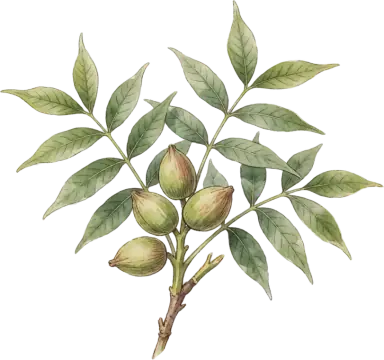
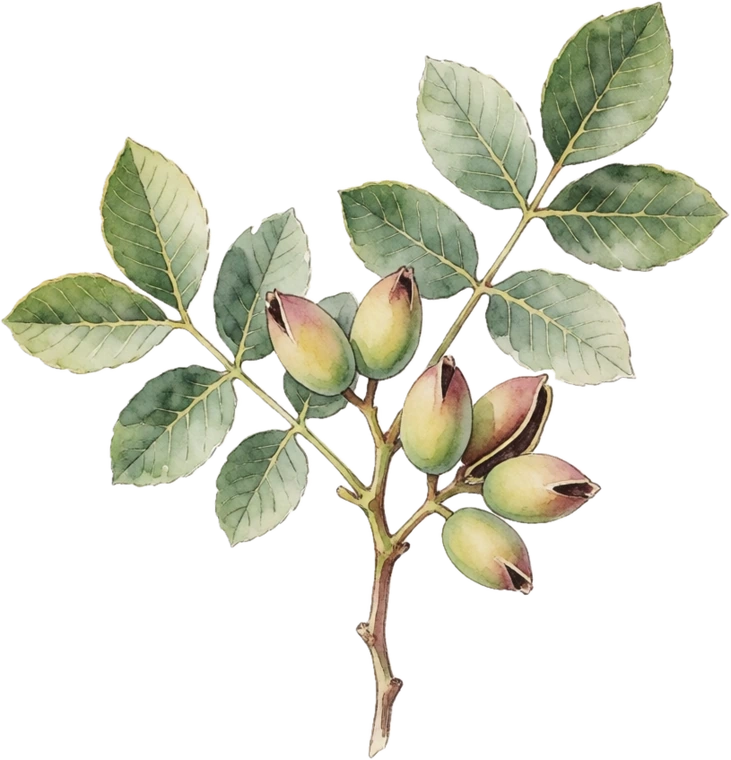
Botanical illustration of Pistachio
Tree · Pistacia vera

A true desert tree: it wants blazing dry heat, alkaline soil, and cold winters, which is why pistachios are a California/Arizona/New-Mexico crop and rot in the humid East. Dioecious, so you need a male for every cluster of females, and it makes you wait 5-7 years. Not for the Southeast at any price.

TreeFull SunLow waterSlow growthExcellent edible900+ winter chillNeeds a pollination partner

Where to buy the plant — 2 nurseries

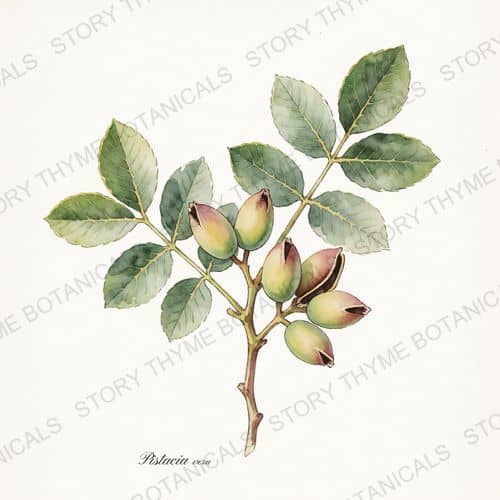
Pistachio — a print from the Nut Trees collection

From the print shop

Growing pistachio? Hang it.

Our Nut Trees collection carries pistachioPistacia vera, print Nº 8, “Pistachio.”

16 designsfrom $21.99white or black groundmatte poster, unframed

Shop Nut Trees botanical prints →

I

Overview

Will pistachio suit your garden, and what goes wrong.

Will it fruit where you are?

Enter your ZIP — we look up your USDA hardiness zone (2023 map) and check it against what pistachio actually needs.

Hardy inZones 7-10
Winter chill900+
PollinationPartner needed

Pistachio at a glance

HardinessUSDA 7–10
Mature size20-30 ft
PollinationDIOECIOUS + wind — one male per ~10 females, bloom-matched
Chill requirement900+
Bloom seasonSpring (inconspicuous)
Harvest seasonFall: hulls split and the shell splits; harvest and dry
Growth rateSlow (nuts in 5-7 yrs, full bearing ~10)

Common pistachio problems

  • Navel Orangeworm
  • Stink Bugs
  • Botryosphaeria
  • Verticillium
  • Alternaria (all worse in humidity)
  • Poor pollination → low fruit set (plant a partner)

II

Growing

Light, water, soil, propagation and the season’s jobs.

How to grow pistachio: light, water & soil

LightFull Sun
WaterLow — deep taproot, extremely drought-tough; HATES humidity/wet
SoilDeep, well-drained, tolerates alkaline/salt · pH 7.0 - 8.0
FertilizerLight
PruningWinter — Train scaffold young; alternate-bears (heavy/light years).
Spacing15-20 ft

How to plant & propagate pistachio

PropagateGrafted, or from cuttings/layering (seed won't come true)

When to spray pistachio

Growing season. Dry climate IS the disease program.

The pistachio growing playbook

Field-tested instructions for every job pistachio asks of you, compiled from university extension guidance — in the order the season brings them.

Watering

Dry the orchard floor as nuts mature

From the start of nut maturation through harvest, adjust irrigation so water is not standing and the canopy is not being wetted, and knock down tall dense weeds and cover crops under the trees. Alternaria late blight builds through the last weeks before harvest, and it runs on humidity and leaf wetness rather than on rain. Sprinkler and flood water plus a dense weedy floor hold that moisture against the leaves and stain the hulls black.

Cutting water this late trades against shell splitting, so reduce leaf wetness first rather than simply drying the tree down.

Feeding

Split the nitrogen across spring, then stop

Apply ammonium sulfate broadcast in two equal doses: the first half before the first irrigation as growth begins, the second half in June. On bearing trees figure roughly one-tenth to one-twentieth pound of actual nitrogen (about a half to one pound of ammonium sulfate) per inch of trunk diameter per year. Apply no nitrogen at all after June. Pistachio fills its kernels on nitrogen taken up early, and splitting the dose keeps it available without pushing it past the root zone. Nitrogen applied after June keeps the tree growing soft wood into fall, which delays dormancy and leaves it open to winter injury.

Pruning

Dormant pruning: open the canopy and renew fruiting woodJan – Dec

While the tree is leafless, train young trees to a modified open vase with three or four scaffolds spaced about 8 inches apart vertically, the lowest around 4 feet up. On bearing trees, cut back into older wood every three to four years to force new shoots. Finish any tipping cuts on Golden Hills and Lost Hills early in the dormant window, well before buds swell. Pistachio flowers on one-year-old wood, so a tree that stops making new shoots stops making nuts. Opening the canopy also dries the interior, which is how you starve Alternaria late blight of the humidity it needs.

Post-harvest sanitation: strip mummies and cut out blighted wood

After harvest, knock down and destroy every unharvested nut left in the tree and on the ground, and prune out blighted shoots, panicles and cankered wood, cutting 2 inches beyond the blighted margin. Get it done before the first rains. Mummy nuts are where navel orangeworm overwinters, and dead rachises and cankers keep producing Botryosphaeria spores for up to six years. Nuts pulled to the ground early rot away once soil moisture rises, but a mummy left in the canopy is next year's infestation.

Carry the pruned wood out of the orchard and destroy it - leaving the piles on site leaves the inoculum on site.

What to watch for

Count early split nuts as the crop starts to open

When the earliest nuts begin to split, pull a sample and count how many nuts per 100 have split early, and check those nuts for navel orangeworm eggs. Consider treating at early split only if BOTH are true: more than 2 early split nuts per 100 total nuts, and navel orangeworm eggs are consistently found. Count early split nuts, not damaged nuts - early splits measure how much of the crop is already exposed, which is what decides whether an extra spray is justified ahead of the main hull split treatment. The shell splits before harvest and that opening is the doorway navel orangeworm larvae use to reach the kernel. Nuts that split early are open early, so they take the pressure of a whole extra generation. Counting them tells you whether this year's exposure justifies an extra spray, instead of guessing - and pairing the count with an egg check keeps you from spraying when the moths are not actually there.

Spraying

Botryosphaeria blight: start fungicide at bloom, ahead of rain

Beginning at bloom, apply azoxystrobin or pyraclostrobin, timing each application ahead of a forecast rain and repeating at two to three week intervals for two or three sprays total. Botryosphaeria dothidea and Neofusicoccum mediterraneum splash from old rachises and cankers in rain and sprinkler water and infect buds, leaves and young fruit silently. The infections sit latent and only blight out once summer temperatures pass 86F, so spraying after you see symptoms is already too late.

Pre-harvest interval is 7 days for azoxystrobin, 14 for pyraclostrobin and 28 for trifloxystrobin. These are all FRAC group 11 - make no more than one application of a group 1, 4, 9, 11 or 17 fungicide before rotating to a different mode-of-action group, as group 11 resistance is already documented in this crop.

Navel orangeworm: the main spray at hull split

At hull split, roughly a month before harvest, spray methoxyfenozide or chlorantraniliprole. This is the one spray most orchards cannot skip. Hull split coincides with the third navel orangeworm flight, and it is the moment the whole new crop becomes vulnerable at once - the split hull and shell let larvae walk straight into the kernel.

Pre-harvest interval is 7 days for methoxyfenozide and 10 days for chlorantraniliprole. Both are chosen here because they spare natural enemies. Do not apply phosmet after hull split reaches 10 percent. Never apply an insecticide during bloom.

Harvesting

Harvest on hull slip, and do not dawdle

Harvest once the hull separates easily from the shell when rubbed. You have roughly a 7 to 10 day window. On Golden Hills and Lost Hills, go on hull slip alone - do not wait for the hulls to tatter the way Kerman's do, because waiting will not improve their split percentage. Tannins in the hull stain the shell once the hull starts breaking down, and every extra day on the tree is another day of navel orangeworm and Alternaria working on a nut that is already open.

III

The year

What pistachio asks for, month by month.

The pistachio year, month by month

MonthJanFebMarAprMayJunJulAugSepOctNovDec
Bloom
Prune
Harvest

What each band means

  • Bloomflowers open — pollinators working, frost on blossoms is the danger.
  • Pruneshape it now — cuts heal cleanly and structure is visible.
  • Harvestpicking time — check ripeness every few days.

The pistachio year as text

  • Jan pruning
  • Feb pruning
  • Mar bloom
  • Apr bloom
  • May bloom
  • Jun quiet month
  • Jul quiet month
  • Aug quiet month
  • Sep harvest
  • Oct harvest
  • Nov harvest
  • Dec pruning

These are the species' typical months — expect them a few weeks earlier in warm zones and later in cold ones. Watch the plant, not just the calendar.

IV

Ecology & uses

What it does for the garden, and what it is grown for.

Pistachio in the garden system

  • Canopy layer tree
HabitatDry/rocky
MoistureUpland / dry
DeerBrowsed — protect young plants
OriginIntroduced

What pistachio is grown for

✓ Commonly eatenNuts safe

UseSnacking
UseBaking
UseDesert orchards
Edible value4/5

Harvesting & storing pistachio

Fall: hulls split and the shell splits; harvest and dry.

Edibility, identification, and traditional-use notes here are general reference — not medical or veterinary advice, and not a claim that any plant treats or prevents anything. Medicinal ratings record how strongly a plant features in herbal tradition, nothing more. Never eat or dose a plant you have not positively identified. More on how to use this library.

V

Cultivars

Named varieties of pistachio, ruled as a catalogue.

Best pistachio varieties & cultivars

9 on file

Named varieties of pistachio differ in winter-chill needs, ripening time, hardiness, and whether they set fruit on their own — pick one that fits your climate.

Kerman

Needs a pollinizer
RipensEarly September in the San Joaquin Valley, the latest of the major cultivarsZones7-10SizeAveraged 20.7 nuts per ounce in UC trials
PollinationFemale. Pollinized by Famoso as primary male, with Randy earlier and Peters later

The industry standard since the 1960s and still about 255,000 California acres, so its behavior is known over 60 years in a way no other cultivar's is. Its weaknesses are real: only 69.8 percent inshell split nuts and 10.5 percent blanks in UC trials, and in low-chill winters like 2014 and 2015 it loses bloom synchrony with Peters. Needs more chill than Golden Hills or Lost Hills. Training mostly means removing sagging horizontal branches to keep it upright.

Where to buy ‘Kerman

Story Thyme Farms may earn a small commission from these links, at no cost to you — it never changes what we recommend.

Golden Hills

Needs a pollinizer
RipensAbout 11 days before Kerman, late August in the San Joaquin ValleyZones7-10SizeAveraged 21.0 nuts per ounce in UC trials
PollinationFemale. Pollinized by Randy as primary male (about 75 percent) with Tejon covering the early bloom (about 25 percent)

UC release blooming about 5 days ahead of Kerman. In UC trials it hit 86.9 percent inshell split nuts against Kerman's 69.8, with 4.1 percent blanks against Kerman's 10.5, and matched or beat Kerman on cumulative edible yield. Needs less chill than Kerman, which keeps foliation, bloom and nut fill more even in warm winters. Lowest pruning requirement of the UC cultivars, though training focuses on encouraging horizontal growth. Do not tip late in the dormant season. About 35 percent of all new California acreage 2009-2016.

Where to buy ‘Golden Hills

Story Thyme Farms may earn a small commission from these links, at no cost to you — it never changes what we recommend.

Lost Hills

Needs a pollinizer
RipensAhead of Kerman, close to Golden Hills - about two weeks earlier in UC trialsZones7-10SizeLargest individual nut weight of the cultivars UC compared
PollinationFemale. Pollinized by Randy as primary male (about 75 percent) with Tejon covering the early bloom (about 25 percent)

UC release from the same program as Golden Hills, blooming about the same time - roughly 3 to 6 days before Kerman, not a full week. Produces a higher percentage of split inshell nuts than Kerman, and showed less alternate bearing than the other cultivars at UC's Twisselman trial. Fairly upright with a modest pruning requirement. Do not tip late in the dormant season. Judge harvest by hull slip, not hull tatter. Planted on far less acreage than Golden Hills - under 4,000 acres against Golden Hills' 50,000 as of 2016.

Where to buy ‘Lost Hills

Story Thyme Farms may earn a small commission from these links, at no cost to you — it never changes what we recommend.

Gumdrop

Needs a pollinizer
RipensAbout 20 days before Kerman, around mid to late August in the San Joaquin ValleyZones7-10SizeAveraged 20.8 nuts per ounce in UC trials
PollinationFemale. Pollinized by Tejon as primary male (about 50 percent) with Zarand covering the early bloom (about 50 percent)

UC cultivar released in 2016, the earliest blooming female tested - about 10 days ahead of Kerman - which suggests a lower winter rest requirement, and it held up better than Kerman or Golden Hills in the low-chill years of 2014 and 2015. Hit 85.1 percent inshell split nuts in UC trials. Because it comes off so early it should miss most of the last and largest navel orangeworm flight. The catch: a timely early harvest is essential for quality, and delay costs it in staining and insect damage. Plant it only if you actually want the early harvest.

Where to buy ‘Gumdrop

Story Thyme Farms may earn a small commission from these links, at no cost to you — it never changes what we recommend.

Kalehghouchi

Needs a pollinizer
RipensAhead of KermanZones7-10
PollinationFemale. Pollinized by Randy as primary male (about 75 percent) with Tejon covering the early bloom (about 25 percent)

Grown in California since the mid-1980s but on under 2,000 acres. Blooms ahead of Kerman, in the same early group as Golden Hills and Lost Hills - UC ranks it alongside them rather than publishing a separate bloom date for it, so plan pollination on the Golden Hills schedule rather than on a precise day count. Has the heaviest pruning and training requirement of the cultivars UC compared - rated 5 where Golden Hills is 1 - which is the main reason to think twice about it. It also shows the most symptoms of inadequate winter rest of the five, so it is a poor bet where winters are warm.

Where to buy ‘Kalehghouchi

Story Thyme Farms may earn a small commission from these links, at no cost to you — it never changes what we recommend.

Peters

Needs a pollinizer
RipensMale - produces pollen, not nutsZones7-10
PollinationMale pollinizer. The traditional standard for Kerman, now best used as a late adjunct male alongside Famoso or Randy

The historic male for Kerman and still on roughly 255,000 California acres. Blooms about 4 days after Kerman at full bloom, which is the problem: in low-chill, warm winters it flowers too late to cover the front of Kerman's bloom, and many inflorescences desiccate or never push - especially on the sun-exposed south side. If your winters are reliably cold it still works with Kerman; if they are not, do not rely on it alone.

Where to buy ‘Peters

Story Thyme Farms may earn a small commission from these links, at no cost to you — it never changes what we recommend.

Randy

Needs a pollinizer
RipensMale - produces pollen, not nutsZones7-10
PollinationMale pollinizer. Primary male for Golden Hills, Lost Hills and Kalehghouchi; useful as an early male for Kerman

UC male release on about 53,000 California acres. Reaches full bloom around 2 days before Kerman, which puts it in step with Golden Hills and Lost Hills rather than with Kerman's peak - it is generally considered too early to carry Kerman on its own. Plant it as about 75 percent of the males in a Golden Hills or Lost Hills block.

Where to buy ‘Randy

Story Thyme Farms may earn a small commission from these links, at no cost to you — it never changes what we recommend.

Tejon

Needs a pollinizer
RipensMale - produces pollen, not nutsZones7-10
PollinationMale pollinizer. Early supplemental male for Golden Hills, Lost Hills and Kalehghouchi; primary male for Gumdrop

UC male release and the earliest male tested, reaching full bloom about 9 days before Kerman. That earliness is the whole point: it covers the front end of bloom on the early UC females, where Peters and even Randy arrive too late. Use it as roughly 25 percent of the males with Golden Hills or Lost Hills, or as half the males with Gumdrop.

Where to buy ‘Tejon

Story Thyme Farms may earn a small commission from these links, at no cost to you — it never changes what we recommend.

Famoso

Needs a pollinizer
RipensMale - produces pollen, not nutsZones7-10
PollinationMale pollinizer. Suggested primary male for Kerman, about 50 percent of males, with Randy earlier and Peters later

UC male release intended to solve the Kerman pollination problem in warm, low-chill winters where Peters blooms too late. UC's suggested Kerman male mix is Famoso at about 50 percent with Randy at 25 percent covering early bloom and Peters at 25 percent covering late.

Where to buy ‘Famoso

Story Thyme Farms may earn a small commission from these links, at no cost to you — it never changes what we recommend.

VI

Sources & plant ID

Where the care distinctions come from, and how the plant is filed.

Research basis

Sources behind this profile

No extension citations are attached to pistachioyet. The care figures below come from the library's own catalogue rather than a traced primary source.

Plant ID

BinomialPistacia vera
FamilyAnacardiaceae
TypeTree · Perennial
USDA symbolPIVE3
OriginIntroduced
Invasive riskLow

VII

Where to buy

Third-party nurseries — not Story Thyme Farms.

Third-party nurseries, not Story Thyme Farms. Prices are theirs.

Story Thyme Farms may earn a small commission from these links, at no cost to you — it never changes what we recommend.

Pistachio needs a pollination partner — plant two genetically distinct trees (two different cultivars, or a cultivar plus a seedling).

VIII

Questions

Pistachio questions, answered straight.

Why isn't my pistachio fruiting?

Most often: it has no genetically distinct partner nearby. Pistachio can't pollinate itself — dioecious + wind — one male per ~10 females, bloom-matched. Plant a second, unrelated one nearby; two different cultivars, or a cultivar plus a seedling, is the classic pairing.

Will pistachio fruit in a warm-winter climate?

Pistachio needs roughly 900+ hours of winter chill (hours between 32–45°F) to break dormancy and set fruit. Mild-winter growers should count their chill hours before planting.

Is pistachio safe for kids and pets?

Pistachio is commonly eaten and isn't considered toxic, but "commonly eaten" isn't a guarantee for any particular person or animal — allergies, quantity, and which part you eat all matter. One caveat on this one: Nuts safe. Never eat a plant you haven't positively identified, and check with a vet before letting pets or livestock graze anything new.

When do you harvest pistachio?

Fall: hulls split and the shell splits; harvest and dry.

IX

Elsewhere

Where pistachio sits in the library.

Where pistachio sits in the library

Grows in the same world