The illustrated growing guide

Amaranth

Amaranthus spp.

Family Amaranthaceae

Grown as an annual

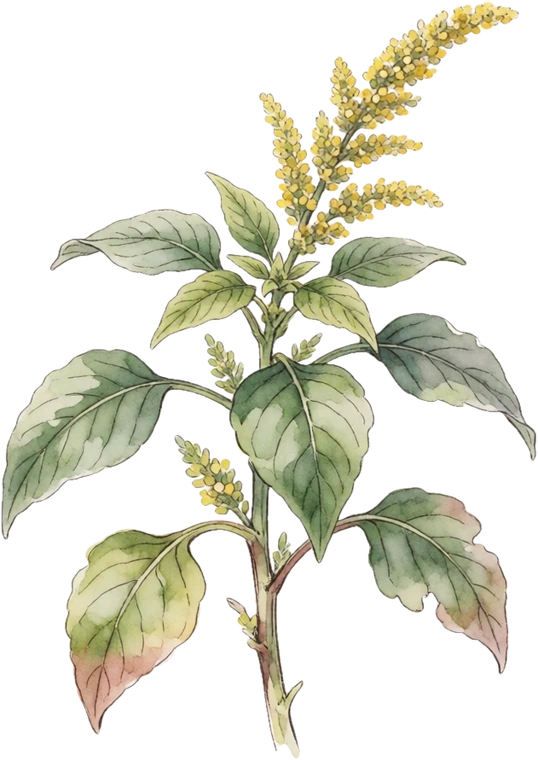
Botanical illustration of Amaranth
Annual · Amaranthus spp.

An ancient staple doing three jobs: spinach that loves August, a cup of protein-grain per plant, and plumes that carry the flower garden into frost. Self-sows enthusiastically — deadhead the ornamentals or welcome the volunteers.

AnnualFull SunLow waterVery Fast growthExcellent edibleAttracts beesNone winter chill

Where to buy the plant — 3 nurseries

Amaranth — a print from the Historic Crops collection

From the print shop

The closest print we make

We don’t print Amaranthus spp. The closest we have is Amaranthus cruentus (“Amaranth”) in the Historic Crops collection — the same genus, Amaranthus, not the same species.

16 designsfrom $21.99white or black groundmatte poster, unframed

Shop Historic Crops botanical prints →

I

Overview

Will amaranth suit your garden, and what goes wrong.

Will it fruit where you are?

Enter your ZIP — we look up your USDA hardiness zone (2023 map) and check it against what amaranth actually needs.

Life cycleAnnual
Winter chillNone

Amaranth at a glance

Life cycleAnnual
Mature size4-8 ft plumes
PollinationWind + self; finches raid seed heads all fall
Chill requirementNone (not chill-dependent)
Bloom seasonJuly - Frost (burgundy/gold ropes and plumes)
Harvest seasonGREENS at 6 in (better than spinach in heat); GRAIN: rub seed heads over a tarp in September, winnow in a breeze
Growth rateVery Fast

Common amaranth problems

II

Growing

Light, water, soil, propagation and the season’s jobs.

How to grow amaranth: light, water & soil

LightFull Sun
WaterLow once up — C4 heat machine
SoilAny decent · pH 6.0 - 7.5
FertilizerLittle; it forages
PruningNone — Thin hard (broadcast seed comes up like carpet); stake giants in windy sites.
Spacing10-18 in

How to plant & propagate amaranth

Maturity50 (greens); 100+ (grain)
From seedDirect-sow after frost; tiny seed, barely cover
PropagateFrom seed

The amaranth growing playbook

Field-tested instructions for every job amaranth asks of you, compiled from university extension guidance — in the order the season brings them.

Sowing

Sow after the last frost, once soil reaches 70 F

Wait until all danger of frost has passed and the soil has warmed to 70 F, then sow seed only an eighth to a quarter inch deep into a fine, firm, well-drained bed, in rows 12 to 18 inches apart. Keep the surface evenly moist until the seedlings are up, which takes about a week at 70 to 75 F. Amaranth is a warm-season annual with no frost tolerance at all, and germination slows badly or fails outright once soil is below 50 F. The seed is tiny and the seedlings are fragile, so a crusted or dried-out surface will thin the stand before it ever establishes.

Planting out

Set greenhouse transplants about 3 weeks from sowing

Sow 2 seeds per cell a quarter inch deep in a well-drained mix. Seedlings emerge in 2 to 3 days, are ready to harden off within 2 weeks, and can go to the field about 3 weeks from sowing. Set them 12 inches apart in rows 24 inches apart, and wet and fertilize the holes just before planting. Amaranth seedlings grow slowly for their first month even though they germinate fast, so in a short season that month is dead time. Starting under cover buys it back, and it sidesteps the poor field stands that the tiny seed so often gives.

Mulching

Mulch and cultivate early - no herbicide can rescue this crop

Mulch around transplants, or cultivate and hand weed until the plants stand 10 to 12 inches tall, after which they shade out later-emerging weeds on their own. Choose a bed that is not already carrying a heavy pigweed or lambsquarters population. Amaranth grows slowly for its first month and simply loses to weeds during that window. It is also a close relative of pigweed, waterhemp and Palmer amaranth, so the herbicides that would clear those weeds injure the crop right along with them.

No herbicides are registered for use on amaranth in the US. Cultivation, mulch and hand weeding are the only legal options - do not reach for a pigweed product.

Feeding

Nitrogen before planting, then sidedress on a schedule

Incorporate compost plus a complete N-P-K fertilizer before planting, then sidedress with N-P-K at about 10, 20 and 30 days after transplanting. Let a soil test set the actual rate rather than a default - compost or a cover crop will reduce what the crop needs. Amaranth is a low-management crop that will grow in poor soil, but it responds well to fertilizer, and a leaf crop that gets cut repeatedly draws on that feeding to power each regrowth. Note that UF/IFAS reports fertilizer has not been shown to dramatically increase yields, so treat the schedule as a ceiling, not a target.

Do not push inorganic nitrogen past the soil test recommendation. UF/IFAS HS1407 warns that excess inorganic nitrogen fertilization might result in a pale leaf and toxic nitrate accumulation in the plants - the very leaves you are eating.

Thinning

Thin seedlings to 6 inches apart

Sow with about an inch between seeds, then once the seedlings are a few inches tall thin the stand to roughly 6 inches apart, in rows 12 to 18 inches apart. Amaranth is seeded far heavier than the final stand because the dust-fine seed establishes unevenly. Opening the canopy back up keeps air moving through the planting, which matters because stem rot or wet rot (Choanephora cucurbitarum) is the main fungal disease of concern and it runs through crowded, humid stands.

What to watch for

Scout for blister beetles, webworm, tarnished plant bug and flea beetles

Walk the planting through summer and check growing tips and leaves for striped amaranth beetle, tarnished plant bug (Lygus), flea beetle, amaranth weevil, blister beetles and alfalfa webworm. Hand pick what you find, strip damaged leaves, and pull plants that are badly infested. Rotate the crop and clear debris rather than counting on a rescue treatment. Blister beetles and alfalfa webworm are the ones documented to cause economic losses (in Missouri); the rest mostly chew foliage. A crop grown for grain tolerates considerable insect leaf feeding without affecting yields, so chewed leaves alone are not a reason to act. Few diseases cause serious losses either.

No synthetic insecticides are labeled for this crop and no fungicides are labeled for use on amaranth - do not apply any pesticide whose label does not name this crop. Various organic compounds can be used. Low pest pressure plus the absence of registered synthetics is exactly why amaranth is a good candidate for organic production.

Harvesting

Cut greens at 6 inches, and stop once it flowers

Start cutting once plants reach a height of 6 inches or more; early varieties are ready as soon as one month after planting. Either cut about 3 inches above the ground so the plant regrows, or pull the entire plant with roots. Repeat cuts as the plant recovers, and cool the leaves to 45 to 55 F before delivery to hold quality. Per UF/IFAS, once the plant begins flowering the leaves become fewer and are not suitable for harvest, and repeated cutting both keeps new leaves tender and delays that bolt. Amaranth carries a greens harvest through the heat that has already finished off spinach and lettuce.

Take grain after a killing frost, once a dry week has cured it

Let the heads ripen and wait for a killing frost, then give the crop about a week of good drying weather before harvesting. Rub or thresh the heads over a tarp, winnow the seed in a breeze, clean the plant trash and foreign material out of the grain, and dry it below about 11 percent moisture before storing. Handle the heads gently - shattering during cutting is where the seed is lost. Amaranth does not dry down far enough on its own to thresh cleanly and there are no approved desiccants for it, so the killing frost plus a dry week is what kills and cures the plant. If stems and leaves are still wet the seed turns sticky and smears through the equipment, and plant trash left mixed in the seed is what raises the chance of molding in storage.

III

The year

What amaranth asks for, month by month.

The amaranth year, month by month

MonthJanFebMarAprMayJunJulAugSepOctNovDec
Bloom
Harvest

What each band means

  • Bloomflowers open — pollinators working, frost on blossoms is the danger.
  • Harvestpicking time — check ripeness every few days.

The amaranth year as text

  • Jan quiet month
  • Feb quiet month
  • Mar quiet month
  • Apr quiet month
  • May quiet month
  • Jun quiet month
  • Jul bloom
  • Aug quiet month
  • Sep harvest
  • Oct quiet month
  • Nov quiet month
  • Dec quiet month

These are the species' typical months — expect them a few weeks earlier in warm zones and later in cold ones. Watch the plant, not just the calendar.

IV

Ecology & uses

What it does for the garden, and what it is grown for.

Amaranth in the garden system

  • Herbaceous layer annual
  • Nectary/insectary
AttractsBees, Birds
MoistureUpland / dry
DeerBrowsed — protect young plants

What amaranth is grown for

✓ Commonly eatengreens + ancient grain

UseHeat-proof greens
UseAncient grain
UseDye + drama
Edible value4/5

Harvesting & storing amaranth

GREENS at 6 in (better than spinach in heat); GRAIN: rub seed heads over a tarp in September, winnow in a breeze. About 50 (greens); 100+ (grain) from planting.

Edibility, identification, and traditional-use notes here are general reference — not medical or veterinary advice, and not a claim that any plant treats or prevents anything. Medicinal ratings record how strongly a plant features in herbal tradition, nothing more. Never eat or dose a plant you have not positively identified. More on how to use this library.

V

Cultivars

Named varieties of amaranth, ruled as a catalogue.

Best amaranth varieties & cultivars

6 on file

Named varieties of amaranth differ in days to maturity, disease resistance, flavor, and habit — pick one that fits your season and space.

Plainsman

Self-fertile
RipensAbout 110 days from planting; grain taken after a killing frostZones2-11SizeAbout 5 feet on average (147 cm), but ranges 27 to 90 inches by site

Light-colored grain, mild — An interspecific hybrid of Amaranthus hypochondriacus (a gold-seeded Mexican selection) and A. hybridus (a black-seeded Pakistani selection), released in 1992 by Rodale Research Center with the University of Nebraska, bred for early maturity, light seed color and short stature. Expect a large amount of morphological variation: unbranched stems are only the most frequent condition (39% of plants), and height ranges from roughly 27 to 90 inches depending on site and irrigation.

Where to buy ‘Plainsman

Story Thyme Farms may earn a small commission from these links, at no cost to you — it never changes what we recommend.

Golden Giant

Self-fertile
RipensAbout 110 days to grain; young leaves usable along the wayZones2-11Size6-7 feet

Golden grain, cooks like quinoa or grinds to flour — Amaranthus hypochondriacus, organic open-pollinated. Thin to 12 to 18 inches apart if growing for seed and flower production. Needs roughly a 110-day frost-free season to make grain, so short-season growers should lean on it as a greens crop instead.

Where to buy ‘Golden Giant

Story Thyme Farms may earn a small commission from these links, at no cost to you — it never changes what we recommend.

Red Garnet · Garnet; Garnet Red; Red Callaloo; Red Leaf Vegetable Amaranth

Self-fertile
RipensCut from about 50 days, repeatedly until floweringZones2-11SizeCut at 12 inches for leaf; thin to 6 inches

Comparable to spinach, and milder than green leaf types, which tend toward bitter — Amaranthus tricolor. Round to heart-shaped leaves, medium green overlaid with burgundy red, with striking color on the undersides. Sold by Johnny's as Red Leaf Vegetable Amaranth or red callaloo; University of Kentucky extension names 'Garnet' as the red leaf variety carried by numerous seed sources. Also widely sold as microgreen seed under the name Garnet Red.

Where to buy ‘Red Garnet

Story Thyme Farms may earn a small commission from these links, at no cost to you — it never changes what we recommend.

Hopi Red Dye

Self-fertile
Ripens65-75 days to flower; foliage edible youngZones2-11Size40-48 inches

Edible seed; young foliage edible — Amaranthus cruentus, heirloom. Dark red flower spikes about 1-2 inches wide by 12-24 inches long. Space 12-15 inches, or 3-6 inches for tighter stems. Plant and flower parts make a natural red food dye.

Where to buy ‘Hopi Red Dye

Story Thyme Farms may earn a small commission from these links, at no cost to you — it never changes what we recommend.

Burgundy

Self-fertile
RipensYoung leaves early; seed at about 105 daysZones2-11SizeTall, over 24 inches

Beige seed that cooks like rice or pops like popcorn — Amaranthus hypochondriacus. Burgundy plumes followed by beige seed. Sow direct 1 to 2 weeks after the average last frost once soil is 65 to 75 F, in groups of 3 seeds every 18 inches, thinning to one plant per 18 inches at 3 inches tall. Drought tolerant and frost sensitive.

Where to buy ‘Burgundyverified

Story Thyme Farms may earn a small commission from these links, at no cost to you — it never changes what we recommend.

Tampala

Self-fertile
RipensAbout 30 days from planting, then every 2 weeksZones8-11SizeThin to 6 inches in rows 12-18 inches apart

Cooked like spinach — The vegetable amaranth cultivar University of Florida extension names as suitable for cultivation in the southern United States. In Florida it is sown in May in zone 8, April in zone 9, and December through February in zones 10-11.

Where to buy ‘Tampala

Story Thyme Farms may earn a small commission from these links, at no cost to you — it never changes what we recommend.

VI

Sources & plant ID

Where the care distinctions come from, and how the plant is filed.

Research basis

Sources behind this profile

No extension citations are attached to amaranthyet. The care figures below come from the library's own catalogue rather than a traced primary source.

Plant ID

BinomialAmaranthus spp.
Other namesAmaranthus (pigweed, callaloo)
FamilyAmaranthaceae
TypeAnnual
USDA symbolAMARA
Invasive riskLow

VII

Where to buy

Third-party nurseries — not Story Thyme Farms.

Third-party nurseries, not Story Thyme Farms. Prices are theirs.

Story Thyme Farms may earn a small commission from these links, at no cost to you — it never changes what we recommend.

VIII

Questions

Amaranth questions, answered straight.

Is amaranth safe for kids and pets?

Amaranth is commonly eaten and isn't considered toxic, but "commonly eaten" isn't a guarantee for any particular person or animal — allergies, quantity, and which part you eat all matter. One caveat on this one: greens + ancient grain. Never eat a plant you haven't positively identified, and check with a vet before letting pets or livestock graze anything new.

When do you harvest amaranth?

GREENS at 6 in (better than spinach in heat); GRAIN: rub seed heads over a tarp in September, winnow in a breeze. From planting, expect about 50 (greens); 100+ (grain) to maturity.

How do you propagate amaranth?

From seed.

IX

Elsewhere

Where amaranth sits in the library.

Where amaranth sits in the library

Grows in the same world