The illustrated growing guide

Corn

Zea mays

Family Poaceae

Grown as an annual

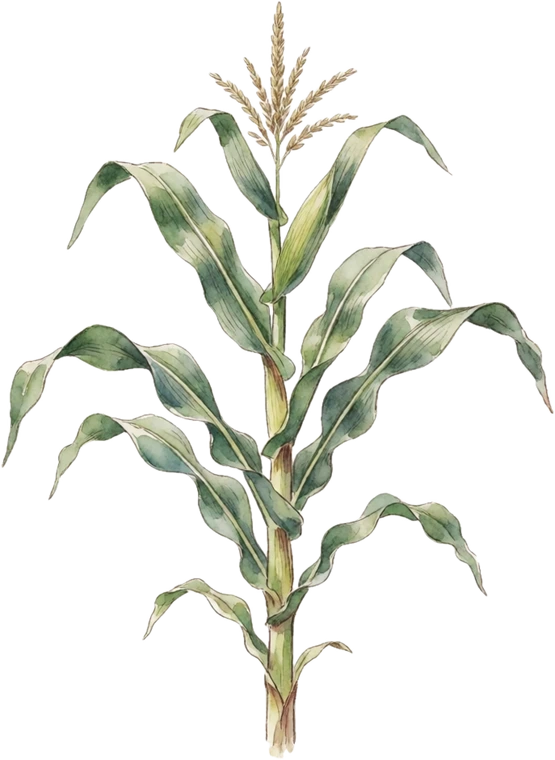
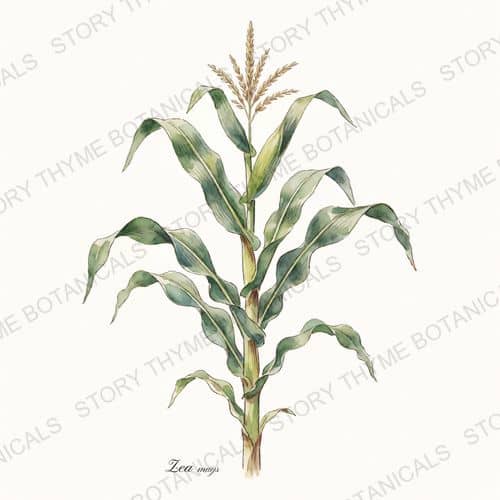
Botanical illustration of Corn
Annual · Zea mays

Ready when silks brown and kernels squirt milk. Sugar converts to starch within hours of picking — eat same day, or grow 'Honey Select' (holds longer).

AnnualFull SunHigh waterFast growthExcellent edibleNone winter chill

Where to buy the plant — 3 nurseries

Glass Gem Corn — a print from the Historic Crops collection

From the print shop

Growing corn? Hang it.

Our Historic Crops collection carries cornZea mays 'Glass Gem', print Nº 15, “Glass Gem Corn.”

16 designsfrom $21.99white or black groundmatte poster, unframed

Shop Historic Crops botanical prints →

I

Overview

Will corn suit your garden, and what goes wrong.

Will it fruit where you are?

Enter your ZIP — we look up your USDA hardiness zone (2023 map) and check it against what corn actually needs.

Life cycleAnnual
Winter chillNone

Corn at a glance

Life cycleAnnual
Mature size6-8 ft
PollinationWind-pollinated — plant blocks at least 4x4, never single rows. Isolate from field corn
Chill requirementNone (not chill-dependent)
Bloom seasonSummer
Harvest seasonJuly - September, 18-24 days after silk
Growth rateFast

Common corn problems

  • Corn Earworm
  • European Corn Borer
  • Raccoons (harvest week)
  • Smut
  • Rust

II

Growing

Light, water, soil, propagation and the season’s jobs.

How to grow corn: light, water & soil

LightFull Sun
WaterHigh at tasseling/silking — drought then costs the crop
SoilRich, Nitrogen-hungry · pH 6.0 - 6.8
FertilizerHeavy nitrogen feeder. Side-dress twice: knee-high and at tassel.
PruningNone (annual) — None.
Spacing8-12 inches, in blocks not rows

How to plant & propagate corn

Maturity65-95 days
From seedDirect-sow after frost, soil 60°F+; block-plant for pollination
PropagateFrom seed

When to spray corn

Growing season. Earworm: 5 drops mineral oil on silks 3-5 days after they show. Raccoons know ripeness better than you — pick the day before they would.

The corn growing playbook

Field-tested instructions for every job corn asks of you, compiled from university extension guidance — in the order the season brings them.

Sowing

Wait for warm soil, and sow in a block not a row

Once soil at 2 inches has reached 60F, sow seed 1 inch deep, 7-9 inches apart, in rows 24-30 inches apart. Hold supersweet (sh2) seed back until the soil hits 65F (UMN Extension, https://extension.umn.edu/vegetables/growing-sweet-corn). Plant at least three or four short rows side by side rather than one or two long ones. Corn is wind-pollinated and every kernel needs its own silk caught by a falling pollen grain, so a single long row sheds most of its pollen into the neighbours' yard and gives you gap-toothed ears. Shrunken sh2 seed carries a smaller starch reserve and rots in cold ground where standard su seed germinates fine.

Stagger the sowings, and keep the sweet corn types apart

Rather than planting the whole patch at once, sow again every 10 to 14 days, or when the previous planting has three to four leaves. If you are growing a supersweet alongside a standard or sugar-enhanced variety, separate them by about 400 yards or sow them two weeks apart so they do not shed pollen together. Each planting ripens in one week-long rush, so a single sowing means a glut and then nothing. The separation matters because pollen from a su or se plant landing on a supersweet silk turns that kernel starchy - the cross spoils this year's ears, not just next year's seed.

Watering

Do not let corn go dry at tasseling and silking

From the first tassel through silking and ear fill, keep the soil evenly moist. This is the stretch where corn must not dry out, whatever else in the garden has to wait. A silk only carries pollen down to its kernel while it is still turgid, so drought at this moment aborts kernels outright. Stress here cuts yield, kernel quality and flavour at once, and corn gets no second chance - the ear is made only once.

Feeding

Sidedress nitrogen when the corn is knee high

When plants are knee high with 8 to 10 leaves, work about half a pound of 21-0-0 per 100 square feet into the soil alongside the row and water it in. Add another quarter pound when the first tassels or silks appear. Corn is a grass and a heavy nitrogen feeder, and it decides ear size during the fast growth just before tasseling. Starve it in that stretch and you get short ears that no amount of later feeding will lengthen.

What to watch for

Check the whorls for corn borer before the tassel pushes out

In the late whorl stage, before the tassel emerges, examine 20 stalks at each of five spots across the patch. Look down into the whorl for tiny shot holes with a little light powdery frass beside them. Treat with a Bt product such as Dipel or XenTari if 30 or more of those 100 stalks are infested. For very early, high-value corn you may drop that threshold to 15. Borer larvae feed in the open whorl only briefly before tunnelling into the stalk, and once they are inside no spray can reach them. The late whorl is the single window where treatment still works, which is why you scout on a stage and not a date.

Below the threshold, do not spray - the scouting count exists precisely so you skip applications the patch does not need. Bt kills only caterpillars that eat it, so it has to go on while the larvae are still feeding in the whorl. This is a pre-tassel treatment - no pollen is shedding yet, which keeps it clear of foraging bees.

Spraying

Corn earworm: one oil drop per ear, once pollination is finished

Wait until the silks have reached full length and just begun to wilt and turn brown, about 5 or 6 days after half the patch has silked. Mix 1 part Btk with 20 parts vegetable oil and place 5 drops, about half a millilitre from an eyedropper, directly on the silk channel at the tip of each ear. The earworm moth lays on fresh silks and the larva crawls straight down the silk channel into the ear tip, feeding almost not at all on the outside of the plant - which is why broadcast sprays miss it. The oil sits in the channel the larva must pass through and carries the Btk to the one spot where it will actually be eaten.

Timing is the whole rule: oil on green silks interferes with pollination and gives you poorly filled ears, and once the silks are fully brown the worms are already inside and out of reach. Btk kills only caterpillars that ingest it, and this directed drop keeps it off the tassels that bees collect pollen from. Do not substitute a broadcast carbaryl or pyrethroid spray here - it would go on while pollen is still shedding and bees are working the tassels.

Harvesting

Pick at milk stage - the thumbnail decides, not the calendar

Start checking about 17 to 24 days after the first silks appeared. The ear is ready when the silks are dry and brown, the husk is still green, and the tip kernels are plump. Pull back a little husk and puncture a kernel with your thumbnail: clear juice means wait, milky juice means pick. The 17-to-24-day window swings with temperature, so the same variety ripens on a different date every year and in every zone - the calendar cannot tell you but the thumbnail can. Past milk stage the sugars turn to starch and the kernels go doughy.

Corn companion plants

Good companions

Avoid

Underlined names have their own growing guide in this library.

III

The year

What corn asks for, month by month.

The corn year, month by month

MonthJanFebMarAprMayJunJulAugSepOctNovDec
Bloom
Harvest

What each band means

  • Bloomflowers open — pollinators working, frost on blossoms is the danger.
  • Harvestpicking time — check ripeness every few days.

The corn year as text

  • Jan quiet month
  • Feb quiet month
  • Mar quiet month
  • Apr quiet month
  • May quiet month
  • Jun bloom
  • Jul bloom, harvest
  • Aug bloom, harvest
  • Sep harvest
  • Oct quiet month
  • Nov quiet month
  • Dec quiet month

These are the species' typical months — expect them a few weeks earlier in warm zones and later in cold ones. Watch the plant, not just the calendar.

IV

Ecology & uses

What it does for the garden, and what it is grown for.

Corn in the garden system

  • Herbaceous layer annual
MoistureFacultative / average
DeerBrowsed — protect young plants
OriginIntroduced

What corn is grown for

✓ Commonly eaten

UseFresh
UseFreezing
UseRoasting
Edible value4/5

Harvesting & storing corn

July - September, 18-24 days after silk. About 65-95 days from planting.

Edibility, identification, and traditional-use notes here are general reference — not medical or veterinary advice, and not a claim that any plant treats or prevents anything. Medicinal ratings record how strongly a plant features in herbal tradition, nothing more. Never eat or dose a plant you have not positively identified. More on how to use this library.

V

Cultivars

Named varieties of corn, ruled as a catalogue.

Best corn varieties & cultivars

10 on file

Named varieties of corn differ in days to maturity, disease resistance, flavor, and habit — pick one that fits your season and space.

Illini Xtra Sweet

Very sweet, crisp — TWO HARD RULES: isolate 500+ ft from any su/se corn tasseling at the same time or the kernels turn starchy like field corn; and do not sow until soil is about 65F, because sh2 seed is shrunken and rots in cold soil where su corn germinates fine at 55F.

Where to buy ‘Illini Xtra Sweet

Story Thyme Farms may earn a small commission from these links, at no cost to you — it never changes what we recommend.

How Sweet It Is

White, very sweet — Isolate 500+ ft from su/se corn tasseling at the same time or the crop goes starchy. Wait for ~65F soil - sh2 germinates poorly in cold ground. AAS winner.

Where to buy ‘How Sweet It Is

Story Thyme Farms may earn a small commission from these links, at no cost to you — it never changes what we recommend.

Early Xtra Sweet

Very sweet — The short-season supersweet - the sh2 option for northern growers. Still must be isolated 500+ ft from su/se corn, and still needs ~65F soil, which partly offsets its earliness.

Where to buy ‘Early Xtra Sweet

Story Thyme Farms may earn a small commission from these links, at no cost to you — it never changes what we recommend.

Silver Queen

White, classic creamy — Standard su: germinates in cooler soil (55F+) than supersweets and needs no isolation from other su/se corn. Sugar converts to starch fast after picking - eat or process the same day. Long season at 92 days.

Where to buy ‘Silver Queen

Story Thyme Farms may earn a small commission from these links, at no cost to you — it never changes what we recommend.

Golden Bantam

Old-fashioned corn flavour — Open-pollinated su, so unlike the hybrids you can save seed. Tolerates cooler soil (55F+) than sh2. Eat immediately - su types lose sugar within hours.

Where to buy ‘Golden Bantam

Story Thyme Farms may earn a small commission from these links, at no cost to you — it never changes what we recommend.

Earlivee

Yellow — At 58 days the shortest-season corn here - the pick for northern growers. As a su type it also germinates in cooler soil than any supersweet, so it can go in earlier.

Where to buy ‘Earlivee

Story Thyme Farms may earn a small commission from these links, at no cost to you — it never changes what we recommend.

Bodacious

Sweet and tender — The home-garden sweet spot: sweeter and longer-holding than su, but unlike sh2 it needs NO isolation from other su/se corn and tolerates cooler soil than supersweets. Isolate only from sh2 types.

Where to buy ‘Bodaciousverified

Story Thyme Farms may earn a small commission from these links, at no cost to you — it never changes what we recommend.

Sugar Buns

Very tender — Early se. Because se seed is not shrunken like sh2, it germinates far more reliably in cool spring soil - the practical reason to choose se over supersweet in the North.

Where to buy ‘Sugar Buns

Story Thyme Farms may earn a small commission from these links, at no cost to you — it never changes what we recommend.

Honey 'N Pearl · Honey and Pearl

Bicolor, very sweet — SOURCES CONFLICT and it MATTERS: Illinois lists this as sh2, UGA C905 lists it as se. That decides whether isolation is required. Verify on your seed packet before relying on the isolation rule.

Where to buy ‘Honey 'N Pearl

Story Thyme Farms may earn a small commission from these links, at no cost to you — it never changes what we recommend.

VI

Sources & plant ID

Where the care distinctions come from, and how the plant is filed.

Research basis

Sources behind this profile

No extension citations are attached to cornyet. The care figures below come from the library's own catalogue rather than a traced primary source.

Plant ID

BinomialZea mays
FamilyPoaceae
TypeAnnual
USDA symbolZEMA
OriginIntroduced
Invasive riskLow

VII

Where to buy

Third-party nurseries — not Story Thyme Farms.

Third-party nurseries, not Story Thyme Farms. Prices are theirs.

Story Thyme Farms may earn a small commission from these links, at no cost to you — it never changes what we recommend.

VIII

Questions

Corn questions, answered straight.

Is corn safe for kids and pets?

Corn is commonly eaten and isn't considered toxic, but "commonly eaten" isn't a guarantee for any particular person or animal — allergies, quantity, and which part you eat all matter. Never eat a plant you haven't positively identified, and check with a vet before letting pets or livestock graze anything new.

When do you harvest corn?

July - September, 18-24 days after silk. From planting, expect about 65-95 days to maturity.

What grows well with corn?

Proven companions include beans, squash (three sisters), cucumber — the full companion list, and what to keep away, is in the Growing tab above.

How do you propagate corn?

From seed.

IX

Elsewhere

Where corn sits in the library.

Where corn sits in the library

Grows in the same world