 MulchingIn April
Mulch your blueberries
Top up 3-4in of acidic mulch (pine bark sawdust or needles). Holds moisture and keeps the soil acidic they need.
Vaccinium spp.
Family Ericaceae
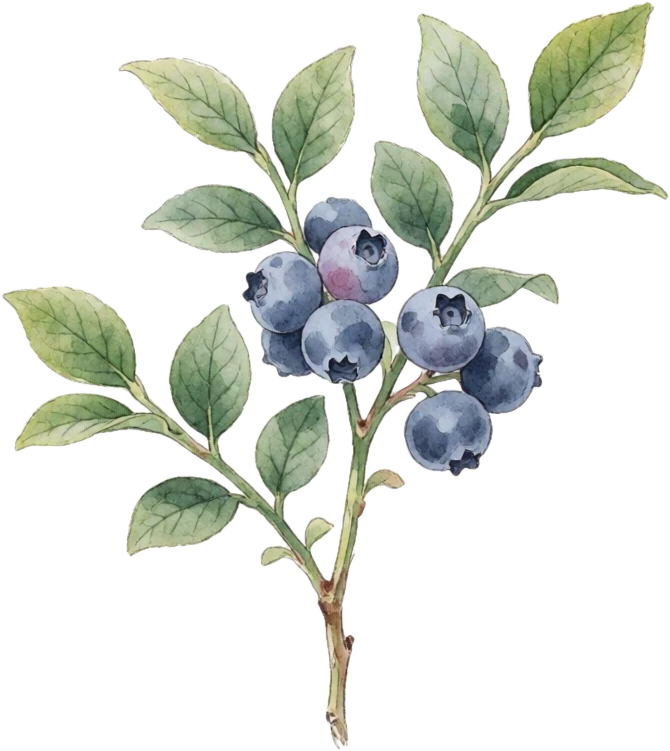
Homegrown blueberries in June and July are smaller-batch and bigger-flavored than anything in a clamshell, picked at full color instead of full firmness. A mature bush hangs heavy enough to fill the freezer, with muffins, pancakes, and handfuls straight off the branch along the way.
The bush itself is a tidy 4-6 feet with spring bells the bees adore and fall foliage that turns flame red — an ornamental that happens to feed you. Blueberries set best with a partner variety, so plant two different kinds and let them out-yield each other.
 Full Sun
 High water
 Slow-Moderate growth
 Excellent edible
 Attracts bees
 Attracts butterflies
 200-1000 winter chillNeeds a pollination partner
 Juglone-sensitive
From the print shop
Our Plant Library collection carries blueberry — Vaccinium, print Nº 66, “Blueberry.”
526 designsfrom $12.99white or black backgroundmatte poster, unframed
Will it fruit where you are?
Enter your ZIP — we look up your USDA hardiness zone (2023 map) and check it against what blueberry actually needs.
 Hardy inZones 4-7PollinationPartner needed
Blueberry · Common problems

6 problems on file

6 problems on file
Mummy BerryPhomopsis Twig BlightBotryosphaeria CankerCrown GallIron ChlorosisTransplant ShockPoor pollination → low fruit set (plant a partner)
Blueberry · Growing & propagation
LightWater Soil
Soil Fertilizer
NO NITRATES.
 Pruning
Remove oldest canes (>6 yrs), thin twiggy growth. aim for open vase.
 SpacingPropagate
Seed won't come true
Blueberry · Harvest & keeping
 Years to first harvestTypical yieldWhat you eat
 How to tell it is readyHow long it keeps
Freezes well
Blueberry · Seasonal care & spray guidance
Dormant season. Dormant Oil (Scale): Apply when temps >40°F. Lime Sulfur (Phomopsis): Delayed dormant.
Growing season. Green Tip/Bloom: Fungicide if Mummy Berry is history. Mummy Berry: Remove white mushrooms from soil.
early spring
4 jobsMulchingIn AprilTop up 3-4in of acidic mulch (pine bark sawdust or needles). Holds moisture and keeps the soil acidic they need.
FeedingAt green tipAt or just before bud swell, before the buds begin to break, band ammonium sulfate in a circle twelve to eighteen inches out from the crown, not against the stems. Give a first-year bush about one ounce and add another ounce each year until a mature bush is getting eight ounces annually. Do not feed a bush in its first four weeks in the ground. Blueberries take nitrogen up in the ammonium form, and ammonium sulfate is acidifying, so it feeds the bush while holding the soil near the pH 4.8 to 5.2 the roots need to work at all. Nitrate-form fertilizers have been shown to be toxic to blueberry and should be avoided.
PruningIn MarchRemove the oldest gray canes and thin twiggy tips; keep 6-8 productive canes. Renewal keeps berries big and plants vigorous.
SprayingAt green tipAt green tip, when the first leaf tissue is showing but no flowers are open, apply a labeled mummy berry fungicide such as a sterol inhibitor (for example fenbuconazole/Indar) and follow it with a second application 10 days later. Further applications can be made during bloom if wet weather continues and you saw shoot strikes. Check your state extension's current recommendations for products labeled in your area. Mummified berries lying on the ground push up little mushroom-like spore cups at bud break and fire ascospores at the only tissue that is vulnerable, the young expanding shoots. Those shoot strikes are what later produce the conidia that infect flowers, so stopping the shoot blight is most of the work of preventing mummified fruit.
at bloom
1 jobSprayingAt bloomIf blighted shoots with gray fuzz appeared this spring, or the weather is wet, apply a fungicide at mid bloom and repeat every seven to ten days through petal fall. Fenbuconazole (Indar), metconazole (Quash), prothioconazole (Proline) and pyraclostrobin plus boscalid (Pristine) are the usual choices; Regalia tank-mixed with Serenade or Double Nickel is the organic route. Skip this entirely if you found no shoot strikes. Conidia from the shoot strikes are carried to the flower stigmas by the pollinators themselves, and the fungus then grows down into the fruit unseen until the berry mummifies at ripening. A flower is most susceptible the day it opens and stays vulnerable only about four days, which is why the window is bloom and not later.
the growing season
1 job WateringIn summer
Give the bush roughly an inch of water a week through the growing season, wetting at least 50% of the ground under the canopy rather than a single spot at the trunk. Irrigate no more often than once every two days even in heat - go deeper, not more often. Keep the soil moist but never saturated. Blueberry roots are fine, shallow and fibrous with no root hairs, so they dry out fast in the top few inches and cannot chase water down; but the same shallow roots sit in whatever water does not drain. Watering daily encourages a shallow root system and invites root rot.
as it ripens, and picking
3 jobsWhat to watch forAs fruit ripensAs soon as berries start to soften and show color, hang a vinegar trap in the shaded interior of the canopy and check it weekly for the small fly with a dark spot on each wing. Traps tell you the fly has arrived, they do not control it. If you find them, pick clean every few days and either seal culled fruit in a bag or bury it at least six inches deep; spinosad and pyrethrins are the home-garden sprays, effective for about seven to ten days. Unlike ordinary vinegar flies, this one has a saw-like ovipositor and cuts into sound, ripening fruit rather than waiting for damage, so the maggots are inside berries that look perfect on the bush. Sprays only kill adult flies - nothing you apply reaches the eggs or larvae already inside the fruit, which is why the trap has to go up before you have a problem.
 ProtectionAs fruit ripens
As the first berries begin to color, drape plastic or cloth netting over the bushes or stretch it across a simple frame, and close it at the bottom so birds cannot walk in underneath. Leave it on until the last picking. Netting draped over the bushes or supported on a framework while the fruit is ripening is the only practical control for birds, which will strip a ripening bush faster than you will pick it.
HarvestingAt harvestPick highbush every 5 to 7 days depending on how hot it is, and rabbiteye about every 10 days - rabbiteye flavor improves when it is picked less often. A berry that is fully blue has usually not finished sweetening; give it a few more days and roll it off with your thumb rather than pulling. Take overripe and damaged berries off the bush as you go, and seal or bury them rather than dropping them underneath. Blueberries keep sweetening after they turn blue, so picking the moment the skin colors costs you flavor; but fruit left too long goes soft and becomes the breeding site that builds a spotted wing drosophila population for the rest of your harvest. The interval is a compromise between those two.
Blueberry · Calculators & field guides
Blueberry · Yearly calendar
No calendar activity is listed for this month.
 BloomPruneHarvest
BloomMarch to May
PruneFebruary to March
HarvestJune to July
These are the species' typical months — expect them a few weeks earlier in warm zones and later in cold ones. Watch the plant, not just the calendar.
Blueberry · Ecology & uses
Vaccinium spp.
AttractsMoisture Deer
DeerProtect young plants
JugloneThe toxin exuded by black walnut, butternut, and their relatives. Keep it 50+ ft from any walnut or hickory, or its leaves will yellow, wilt, and die back for no obvious reason.
✓ Commonly eaten
UseUseUseEdible valueJune - July.
Edibility, identification, and traditional-use notes here are general reference — not medical or veterinary advice, and not a claim that any plant treats or prevents anything. Medicinal ratings record how strongly a plant features in herbal tradition, nothing more. Never eat or dose a plant you have not positively identified. More on how to use this library.
Blueberry · Varieties & cultivars
Named varieties of blueberry differ in winter-chill needs, ripening time, hardiness, and whether they set fruit on their own — pick one that fits your climate.
26 varieties
Partly self-fertile
firm and tangy — Cross-pollinate a second variety for bigger yields
Story Thyme Farms may earn a small commission from these links, at no cost to you — it never changes what we recommend.
Partly self-fertile
pink and sweet — Pink berries; lower chill
Story Thyme Farms may earn a small commission from these links, at no cost to you — it never changes what we recommend.
Partly self-fertile
mild, firm, good fresh and for freezing — The go-to early-season highbush: blooms late to dodge spring frost yet ripens early with reliable, uniform crops.
Story Thyme Farms may earn a small commission from these links, at no cost to you — it never changes what we recommend.
Partly self-fertile
tart until fully ripe, very firm, excellent keeper — The latest-ripening highbush, ideal for stretching harvest into fall; leave fruit on the bush until fully ripe to avoid excess tartness.
Story Thyme Farms may earn a small commission from these links, at no cost to you — it never changes what we recommend.
Partly self-fertile
sweet, aromatic, large berries — One of the most cold-hardy highbush types (to Zone 3) and forgiving of imperfect soils, making it a strong choice for northern and challenging sites.
Story Thyme Farms may earn a small commission from these links, at no cost to you — it never changes what we recommend.
Partly self-fertile
rich, sweet, top-rated for fresh eating — A northern-southern hybrid with an unusually wide chill/climate range (roughly 500-1000 hrs) and outstanding flavor; semi-evergreen in mild winters.
Story Thyme Farms may earn a small commission from these links, at no cost to you — it never changes what we recommend.
Self-fertile
dark, sweet, wild-blueberry character — A University of Minnesota half-high bred to survive Zone 3-4 winters under snow, giving cold-climate growers a compact, productive bush.
Story Thyme Farms may earn a small commission from these links, at no cost to you — it never changes what we recommend.
Self-fertile
small, sweet, wild-type berries — A Michigan State dwarf (lowbush x highbush) that thrives in a patio pot and doubles as an ornamental with white spring bloom and red fall foliage; note it is high-chill (~1000 hrs) so it will not fruit in warm-winter regions.
Story Thyme Farms may earn a small commission from these links, at no cost to you — it never changes what we recommend.
Self-fertile
tangy-sweet, tolerates slightly higher soil pH — A low-chill, genuinely self-fertile dwarf perfect for warm-winter regions and containers where high-chill highbush will not fruit.
Story Thyme Farms may earn a small commission from these links, at no cost to you — it never changes what we recommend.
Also known as Oneal
Partly self-fertile
outstanding sweet, aromatic dessert quality — An NC State (1987) early southern highbush with some of the best flavor in its class; pair with another low-chill highbush to maximize its early crop. Chill estimates vary by source (~250-600 hrs).
Story Thyme Farms may earn a small commission from these links, at no cost to you — it never changes what we recommend.
Partly self-fertile
large, firm, mild-sweet berries — A University of Florida (1999) very-low-chill variety for the Deep South and mild-winter West; has documented low self-fertility, so a companion southern highbush is needed for a reliable crop.
Story Thyme Farms may earn a small commission from these links, at no cost to you — it never changes what we recommend.
Needs a pollinizer
large, sweet, high-quality berries — A dependable early rabbiteye for the Southeast, but like all rabbiteyes it is self-sterile and must be cross-pollinated by a second variety.
Story Thyme Farms may earn a small commission from these links, at no cost to you — it never changes what we recommend.
Also known as Powder Blue
Needs a pollinizer
firm, sweet, powdery-blue skin, ships well — A hardy, productive late rabbiteye that pairs naturally with Tifblue; requires a second variety to fruit.
Story Thyme Farms may earn a small commission from these links, at no cost to you — it never changes what we recommend.
Needs a pollinizer
firm, sweet when fully ripe, excellent keeper — The benchmark rabbiteye for the Southeast: extremely productive and long-lived, but self-sterile and must have a second rabbiteye for pollination.
Story Thyme Farms may earn a small commission from these links, at no cost to you — it never changes what we recommend.
Needs a pollinizer
medium to large, sweet — One of the lowest-chill rabbiteyes at roughly 350-400 hours, which extends rabbiteye culture into milder winters than Tifblue or Powderblue will tolerate. Prone to over-cropping, so prune for renewal, and the fruit may split in wet weather near harvest.
Story Thyme Farms may earn a small commission from these links, at no cost to you — it never changes what we recommend.
Needs a pollinizer
small to medium, concentrated ripening — Sets and ripens its whole crop in a tight window, which suits a grower who wants one or two big pickings rather than a long dribble. It is an early bloomer, and the newer UGA rabbiteyes bred around it - Vernon ripens before it, Alapaha flowers 7-10 days after it - are offered as alternatives where spring freezes are a risk. Chill is 400-450 hours per Mississippi State; Clemson lists it as 450.
Story Thyme Farms may earn a small commission from these links, at no cost to you — it never changes what we recommend.
Needs a pollinizer
medium, firm — A UGA release that blooms later than Climax while still ripening early, so it dodges spring freeze damage that costs early rabbiteyes their crop. Pair with Vernon, whose bloom overlaps it.
Story Thyme Farms may earn a small commission from these links, at no cost to you — it never changes what we recommend.
Needs a pollinizer
large, excellent firmness — Ripens ahead of Climax with noticeably larger, firmer fruit and is widely recommended as the Climax replacement. Chill estimates differ by source, Clemson puts it near 450 hours and Mississippi State at 500-550, so the range here is deliberately wide.
Story Thyme Farms may earn a small commission from these links, at no cost to you — it never changes what we recommend.
Needs a pollinizer
larger and firmer than Tifblue — A late, very productive rabbiteye with bigger fruit than Tifblue, useful for stretching a Southeastern harvest deep into summer. At 650-700 hours it is the highest-chill rabbiteye in common use, so it will not perform in the warmest winters.
Story Thyme Farms may earn a small commission from these links, at no cost to you — it never changes what we recommend.
Also known as Titan Rabbiteye
Needs a pollinizer
very large, quarter-sized berries — A UGA release grown for berry size - among the largest rabbiteye fruit available. The fruit may crack in wet conditions near harvest, so it rewards a site with good air movement.
Story Thyme Farms may earn a small commission from these links, at no cost to you — it never changes what we recommend.
Self-fertile
large, firm, sweet — A vigorous low-chill southern highbush, self-fertile and reliable in warm winters. Clemson gives its chilling requirement as 400 hours or less, so treat 400 as a ceiling rather than a target. Interplanting Rebel gives larger and earlier-ripening berries.
Story Thyme Farms may earn a small commission from these links, at no cost to you — it never changes what we recommend.
Self-fertile
large — A very early, large-fruited southern highbush for warm-winter regions. Flavor fades if the berries hang too long after ripening, so pick this one promptly rather than letting it sweeten on the bush.
Story Thyme Farms may earn a small commission from these links, at no cost to you — it never changes what we recommend.
Self-fertile
large, firm and flavorful — A UGA southern highbush at roughly 500 chill hours, filling the gap between true low-chill Deep South varieties and high-chill northern highbush. Large, firm, well-flavored fruit.
Story Thyme Farms may earn a small commission from these links, at no cost to you — it never changes what we recommend.
Partly self-fertile
medium, firm, light blue, small dry stem scar — The strongest mummy berry resistance among common northern highbush, resisting both the shoot-strike and flower-infection phases - worth choosing on a site where mummy berry is established and you would rather not spray at green tip every year. MSU rates its cold hardiness only neutral to poor, so despite the resistance it is not the pick for the coldest sites. Ripens early to mid-season and holds up to machine harvest for fresh market.
Story Thyme Farms may earn a small commission from these links, at no cost to you — it never changes what we recommend.
Partly self-fertile
large, sweet, very firm — A Michigan State release with the firmest fruit and best shelf life of the common northern highbush, plus anthracnose resistance that matters in a wet summer. Ripens in a concentrated burst, so the picking season is short. Cold hardiness is only middling - not a choice for the coldest sites.
Story Thyme Farms may earn a small commission from these links, at no cost to you — it never changes what we recommend.
Partly self-fertile
medium, very sweet, classic blueberry taste — A 1928 selection still planted for one reason: MSU rates it among the very hardiest highbush and the flavor is excellent. The fruit is soft with a very short shelf life, which is why it faded commercially and why it belongs in a home garden where it goes from bush to bowl. Very susceptible to stem gall wasp.
Story Thyme Farms may earn a small commission from these links, at no cost to you — it never changes what we recommend.
Sources & plant identity
Vaccinium spp.
Hardiness, size and timing vary with your cultivar, soil and climate.
University extension research, brought together with hands-on growing experience at Story Thyme Farms.
 Clemson University
 NC State Extension
 Penn State
 University of Florida
 University of Georgia
 University of Minnesota
 University of New Hampshire
 Mississippi State University
 Michigan State University
Publisher marks identify sources, not sponsorship or endorsement.
Blueberry questions, answered straight.
Most often: it has no genetically distinct partner nearby. Blueberry is only partly self-fertile, so a lone plant sets a light crop at best — plant 2+ varieties for best yield. Plant a second, unrelated one nearby; two different cultivars, or a cultivar plus a seedling, is the classic pairing.
Blueberry needs roughly 200-1000 hours of winter chill (hours between 32–45°F) to break dormancy and set fruit. Mild-winter growers should count their chill hours before planting.
Blueberry is commonly eaten and isn't considered toxic, but "commonly eaten" isn't a guarantee for any particular person or animal — allergies, quantity, and which part you eat all matter. Never eat a plant you haven't positively identified, and check with a vet before letting pets or livestock graze anything new.
June - July.
Where blueberry sits in the library.
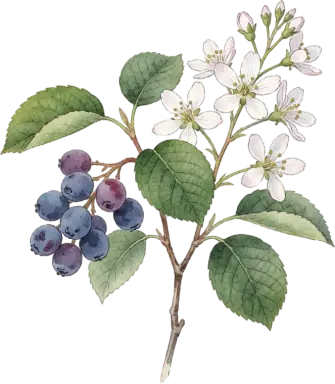 Serviceberry / Juneberry
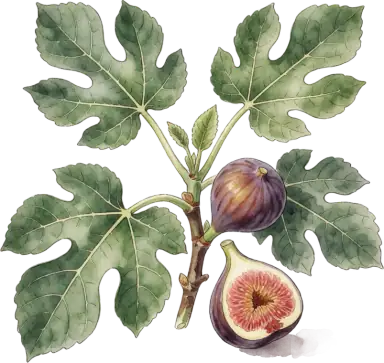 Fig
Fig Elderberry
 Blackberry