The illustrated growing guide

Buckwheat

Fagopyrum esculentum

Family Polygonaceae

Grown as an annual

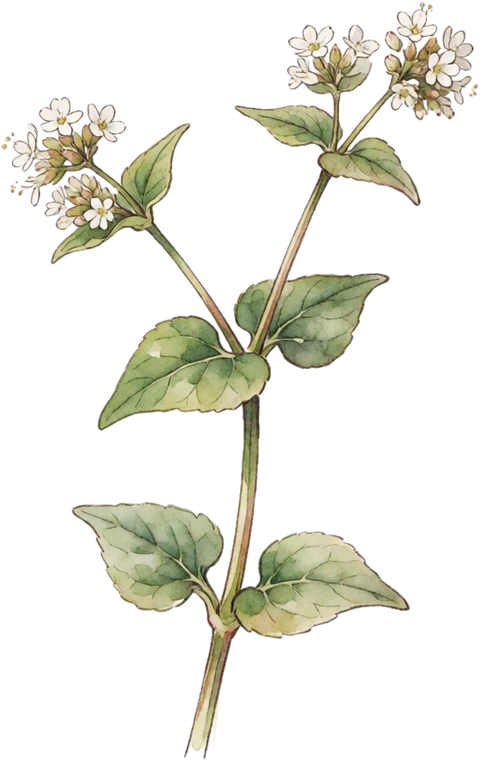
Botanical illustration of Buckwheat
Annual · Fagopyrum esculentum

The fastest, friendliest cover crop AND a grain: sow on bare dirt, smother weeds, feed the bees for a month, then till under to build soil or harvest groat for pancakes. Zero inputs, quick reward — the gateway to cover-cropping.

AnnualFull SunLow waterVERY Fast growthExcellent edibleAttracts beesNone winter chill

Where to buy the plant — 1 nursery

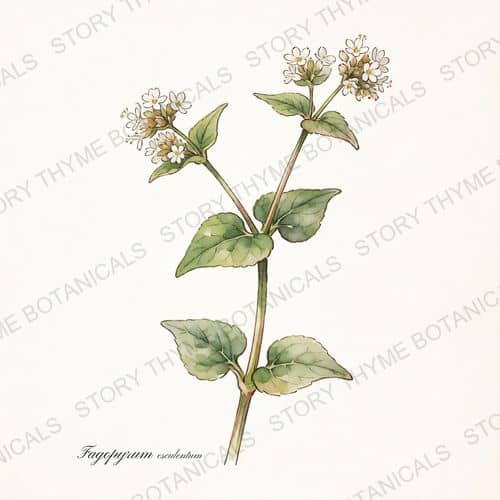
Buckwheat — a print from the Historic Crops collection

From the print shop

Growing buckwheat? Hang it.

Our Historic Crops collection carries buckwheatFagopyrum esculentum, print Nº 11, “Buckwheat.”

16 designsfrom $21.99white or black groundmatte poster, unframed

Shop Historic Crops botanical prints →

I

Overview

Will buckwheat suit your garden, and what goes wrong.

Will it fruit where you are?

Enter your ZIP — we look up your USDA hardiness zone (2023 map) and check it against what buckwheat actually needs.

Life cycleAnnual
Winter chillNone

Buckwheat at a glance

Life cycleAnnual
Mature size2-4 ft
PollinationBEE MAGNET — a top nectar/honey cover crop
Chill requirementNone (not chill-dependent)
Bloom seasonSummer (white haze, weeks of bloom)
Harvest seasonGrain: harvest when 75% of seeds brown, ~10-12 weeks; or till in as green manure
Growth rateVERY Fast (bloom in 4-5 weeks)

Common buckwheat problems

  • Almost none
  • Few

II

Growing

Light, water, soil, propagation and the season’s jobs.

How to grow buckwheat: light, water & soil

LightFull Sun
WaterLow
SoilPOOR soil is fine — a soil-builder · pH 5.0 - 7.0
FertilizerNone — thrives on neglect
PruningNone — Cut/till before it self-sows if using as cover crop; it smothers weeds fast.
SpacingBroadcast dense

How to plant & propagate buckwheat

Maturity70-90 days (grain); 30 (cover)
From seedDirect-sow after frost; fast cover crop or grain
PropagateFrom seed

The buckwheat growing playbook

Field-tested instructions for every job buckwheat asks of you, compiled from university extension guidance — in the order the season brings them.

Sowing

Sow only after every danger of frost has passed

Wait until the last spring frost is behind you and the soil is thoroughly warm, then drill seed 0.5 to 1.5 inches deep in 6 to 8 inch rows at 40 to 60 lb per acre. If you broadcast instead, use 70 to 100 lb per acre and rake, roll or cultipack it in to get seed-to-soil contact. In warm soil it germinates in 3 to 4 days. Buckwheat is a warm-season annual with no frost tolerance whatsoever, and its seedlings are the most sensitive part of its life. It also has a weak taproot and shallow surface roots, so a seed left lying on the surface without soil contact simply never establishes.

Do not sow buckwheat on ground that received atrazine, imazethapyr, halosulfuron or fomesafen on the previous crop, because the herbicide residue injures it. NRCS also advises against planting buckwheat in or next to commodity wheat ground in Colorado, Kansas, Minnesota, Montana, Nebraska, North Dakota, Oregon, South Dakota, Washington and Wyoming, and against wheat within 2 calendar years after buckwheat, because buckwheat is an allergen that contaminates wheat export shipments.

Midsummer catch crop: sow into the gap an early crop leaves

When an early vegetable or grain comes off and the bed would otherwise sit bare, buckwheat is the fastest cover you can establish. Sow any time the soil is around 70F or warmer and enough frost-free weeks remain for the growth you want, at 55 to 65 lb per acre drilled or 70 to 80 lb broadcast. Do not treat it as a fall cover crop. Buckwheat needs soil near 70F to germinate and covers warm ground faster than any other cover crop, so a midsummer bed can grow a smother crop instead of a weed crop. But it has no frost tolerance, so a sowing made too late grows little and is killed outright by the first light frost, and later sowings make shorter plants with an abbreviated bloom.

Watering

Keep water to it through bloom and seed fill

From the first flowers through seed set, do not let buckwheat go dry. This is the one window where irrigation pays, and it lasts several weeks because the crop flowers continuously rather than all at once. Hot drying winds during this stretch are as damaging as drought itself. Dry soil, hot winds and heat stress during bloom make buckwheat abort flowers and seed at high rates, which cuts yield drastically even though the plant still looks healthy. Its root system is small, only about 3 percent of the plant's weight against 6 to 14 percent in cereal grains, so it has very little stored moisture to coast on.

Feeding

Feed it less than you think, especially nitrogen

Fertilize from a soil test when you prepare the bed, and keep nitrogen low. Nitrogen rates above about 50 lb per acre can cause lodging in wet years, and after a legume or on ground with good organic matter buckwheat often needs no nitrogen at all. Phosphate is the nutrient it actually responds to. Buckwheat outperforms small grains on poor soil and is built for low fertility, carrying a root system that is only about 3 percent of the plant's weight against 6 to 14 percent in cereal grains. Extra nitrogen buys tall succulent stems on that small anchor, and wind or heavy rain lays the crop flat, which makes it hard to harvest and costs yield outright.

Pruning

Green manure: mow it within 10 days of the first flowers

If you are growing buckwheat as a green manure or weed smother rather than for grain, mow or till it under no more than 10 days after the plants begin to flower, which is roughly 4 to 7 weeks after sowing. It is killed easily by mowing, and the residue breaks down fast, so get the next crop or cover planted promptly rather than leaving bare soil. Seed matures only about 10 days after flowering and shatters off the plant almost as soon as it is ripe. Let the crop get past that point and you have not grown a cover crop, you have sown a weed that volunteers in whatever you plant next.

If you are growing buckwheat for pollinators and beneficial insects instead, it needs at least 20 days of bloom for minute pirate bugs to complete a generation, which runs past the 10-day reseeding threshold. Take that tradeoff deliberately and still kill the stand before the earliest seed hardens, or accept that you will be fighting volunteers.

What to watch for

Check the stand a week after sowing and patch the gaps

Walk the planting about one week after seeding and look for bare gaps more than a foot across, then reseed them. Where deer and turkeys are thick, expect them to browse young buckwheat hard, since those are the worst pests it has in the Northeast. Buckwheat controls weeds by one mechanism only, closing a dense canopy fast. A gap wider than about a foot never closes over, and weeds take that ground for the rest of the season, which is why Bjorkman's team recommends inspecting and replanting at exactly one week.

Harvesting

Cut for grain when about three quarters of the seed has turned brown

Swath when flowering is nearly finished and about three quarters of the seed is brown and hard, leaving roughly a quarter still green. Green seed finishes ripening in the windrow. Cut in the morning while the crop is wet with dew, or during damp weather, because dry stems shatter seed as you cut them. Stems are succulent and need a good while to dry before threshing. Buckwheat is indeterminate: the top of the plant is still flowering while seed at the base is already ripe and dropping. There is no moment when the whole crop is ready, so waiting on the last seed just costs you the first, and the crop keeps flowering until freeze-up if you let it.

Get it swathed ahead of a killing frost. Frost on a standing crop causes considerable harvest difficulty plus yield loss from shattering and lodging. Set the combine cylinder to 600 to 800 rpm or lower and widen the concave clearance if seed cracks or hulls. Store at 13 percent moisture for long-term storage, and dry at no more than 110F.

III

The year

What buckwheat asks for, month by month.

The buckwheat year, month by month

MonthJanFebMarAprMayJunJulAugSepOctNovDec
Bloom

What each band means

  • Bloomflowers open — pollinators working, frost on blossoms is the danger.

The buckwheat year as text

  • Jan quiet month
  • Feb quiet month
  • Mar quiet month
  • Apr quiet month
  • May quiet month
  • Jun bloom
  • Jul bloom
  • Aug bloom
  • Sep quiet month
  • Oct quiet month
  • Nov quiet month
  • Dec quiet month

These are the species' typical months — expect them a few weeks earlier in warm zones and later in cold ones. Watch the plant, not just the calendar.

IV

Ecology & uses

What it does for the garden, and what it is grown for.

Buckwheat in the garden system

  • Herbaceous layer annual
  • Dynamic accumulator
  • Nectary/insectary
AttractsBees
MoistureUpland / dry
DeerBrowsed — protect young plants
OriginIntroduced

What buckwheat is grown for

✓ Commonly eatenthe buckwheat of pancakes/soba — not wheat, gluten-free

UseCover crop
UseBee forage
UseGluten-free grain
Edible value4/5

Harvesting & storing buckwheat

Grain: harvest when 75% of seeds brown, ~10-12 weeks; or till in as green manure. About 70-90 days (grain); 30 (cover) from planting.

Edibility, identification, and traditional-use notes here are general reference — not medical or veterinary advice, and not a claim that any plant treats or prevents anything. Medicinal ratings record how strongly a plant features in herbal tradition, nothing more. Never eat or dose a plant you have not positively identified. More on how to use this library.

V

Cultivars

Named varieties of buckwheat, ruled as a catalogue.

Best buckwheat varieties & cultivars

8 on file

Named varieties of buckwheat differ in days to maturity, disease resistance, flavor, and habit — pick one that fits your season and space.

Koto

Needs a pollinizer
Zones2-11

Released in 2002 by Cornell University and Kade Research in a project funded by Birkett Mills. Cornell's New York trials put it about 13 percent over Manisoba with better stress tolerance. Standing ability is its consistent trait: it made the best lodging score in NDSU's 2001 Carrington trial at 1.5 on a 0-9 scale where 0 is upright and 9 is flat, against a trial mean of 3.0 and a least significant difference of 1.5, so it stood significantly better than Manor at 4.5 — and it held that rank across NDSU's 2006-2010 six-location average (A687 Table 1), where it was again the best stander of the four varieties tested at 3.0. Do not read a test-weight edge into it: its 46.0 lb/bu was highest at Carrington in 2001, but across 2006-2010 it averaged 41.9 lb/bu, below Koma's 42.9 and level with Manor's 41.7. Its 1,407 lb/ac 2001 grain yield was numerically highest but the 2001 yield differences were not statistically significant, so the yield edge is unproven from that trial alone.

Where to buy ‘Koto

Story Thyme Farms may earn a small commission from these links, at no cost to you — it never changes what we recommend.
Mancan

Needs a pollinizer
Zones2-11

USDA NRCS describes Mancan as a large-seeded variety commonly grown throughout the United States, so it is usually what a seed dealer has on hand. Note that cover-crop buckwheat is often sown as common seed with no specified variety, and because buckwheat is cross-pollinated NDSU warns that variety designations may not be valid except in certified seed lots. Standing ability is the open question: it scored 1.8 for lodging on the 0-9 scale in NDSU's 2001 Carrington trial, well under that trial's 3.0 mean, but that trial's lodging C.V. was 33.1 percent and NDSU's 2006-2010 average across six North Dakota locations (A687 Table 1) puts Mancan at 4.0, the worst of the four varieties tested, against Koma 3.9, Manor 3.6 and Koto 3.0. Treat the single-year Carrington score as noise and expect average-to-poor standing. It was the latest to bloom in the 2001 trial at 36.5 days.

Where to buy ‘Mancan

Story Thyme Farms may earn a small commission from these links, at no cost to you — it never changes what we recommend.

Koban

Needs a pollinizer
Zones2-11

In NDSU's 2001 Carrington trial Koban was among the earliest to bloom at 35.0 days, significantly earlier than Mancan at 36.5 given the least significant difference of 1.0, though not separable from Manor at 35.3. It scored 2.5 for lodging on the 0-9 scale where lower is better, below the 3.0 trial mean, with 44.2 lb/bu test weight. Koto was later bred with higher test weight than Koban.

Where to buy ‘Koban

Story Thyme Farms may earn a small commission from these links, at no cost to you — it never changes what we recommend.

Manisoba · AC Manisoba

Needs a pollinizer
Zones2-11

One of the most commonly grown varieties in the Northeast, where Cornell trials put it about 10 percent over Manor. In NDSU's 2001 Carrington trial it scored 3.8 for lodging on the 0-9 scale where lower is better, worse than the 3.0 trial mean, and its 43.6 lb/bu test weight was significantly below Koto's 46.0 given the least significant difference of 1.5.

Where to buy ‘Manisoba

Story Thyme Farms may earn a small commission from these links, at no cost to you — it never changes what we recommend.

Manor

Needs a pollinizer
Zones2-11

USDA NRCS records Manor as the dominant variety grown in the Northeast throughout the 1990s, still grown because its large seed is what some processors require. It was the worst lodger in NDSU's 2001 Carrington trial at 4.5 on the 0-9 scale, significantly worse than Koto at 1.5, Mancan at 1.8 and Koban at 2.5 given the least significant difference of 1.5, and it posted that trial's lowest 2001 grain yield at 970 lb/ac and lowest three-year average at 1,267 lb/ac — though the 2001 yield differences were not statistically significant. Do not read that single site-year as the variety's character: NDSU's 2006-2010 average across six North Dakota locations (A687 Tables 1 and 3) puts Manor at 3.6 for lodging, better than Mancan at 4.0 and Koma at 3.9, and yielding 1,916 and 1,794 lb/ac in 2009 and 2010, above Koma in both years. Middling on standing ability, not exceptionally bad.

Where to buy ‘Manor

Story Thyme Farms may earn a small commission from these links, at no cost to you — it never changes what we recommend.

Springfield · AC Springfield

Needs a pollinizer
Zones2-11

A large-seeded variety that USDA NRCS reports as yielding well in North Dakota trials. In NDSU's own 2001 Carrington trial it landed mid-pack at 1,068 lb/ac, scored 4.0 for lodging on the 0-9 scale where lower is better against a 3.0 mean, and had the lowest test weight in the trial at 42.0 lb/bu, significantly under Koto's 46.0 given the least significant difference of 1.5.

Where to buy ‘Springfield

Story Thyme Farms may earn a small commission from these links, at no cost to you — it never changes what we recommend.

Koma

Needs a pollinizer
Zones2-11

USDA NRCS describes Koma as a large-seeded variety that often yields higher than Mancan. It is a real named release carried by seed trade, but this is a comparative claim without the trial numbers behind it in the sources consulted, so treat the yield edge as indicative rather than measured.

Where to buy ‘Koma

Story Thyme Farms may earn a small commission from these links, at no cost to you — it never changes what we recommend.
Horizon

Needs a pollinizer
Zones2-11

USDA NRCS describes Horizon as a large-seeded variety that has produced high yields in trials in North Dakota and Canada. A real named release, but the sources consulted give no trial table for it, so the yield claim is reported rather than verified here.

Where to buy ‘Horizon

Story Thyme Farms may earn a small commission from these links, at no cost to you — it never changes what we recommend.

VI

Sources & plant ID

Where the care distinctions come from, and how the plant is filed.

Research basis

Sources behind this profile

No extension citations are attached to buckwheatyet. The care figures below come from the library's own catalogue rather than a traced primary source.

Plant ID

BinomialFagopyrum esculentum
FamilyPolygonaceae
TypeAnnual
USDA symbolFAES2
OriginIntroduced
Invasive riskLow

VII

Where to buy

Third-party nurseries — not Story Thyme Farms.

Third-party nurseries, not Story Thyme Farms. Prices are theirs.

Story Thyme Farms may earn a small commission from these links, at no cost to you — it never changes what we recommend.

VIII

Questions

Buckwheat questions, answered straight.

Is buckwheat safe for kids and pets?

Buckwheat is commonly eaten and isn't considered toxic, but "commonly eaten" isn't a guarantee for any particular person or animal — allergies, quantity, and which part you eat all matter. One caveat on this one: the buckwheat of pancakes/soba — not wheat, gluten-free. Never eat a plant you haven't positively identified, and check with a vet before letting pets or livestock graze anything new.

When do you harvest buckwheat?

Grain: harvest when 75% of seeds brown, ~10-12 weeks; or till in as green manure. From planting, expect about 70-90 days (grain); 30 (cover) to maturity.

How do you propagate buckwheat?

From seed.

IX

Elsewhere

Where buckwheat sits in the library.

Where buckwheat sits in the library

Grows in the same world