
Chicory

Cichorium intybus

Family Asteraceae

PerennialZones 3-9

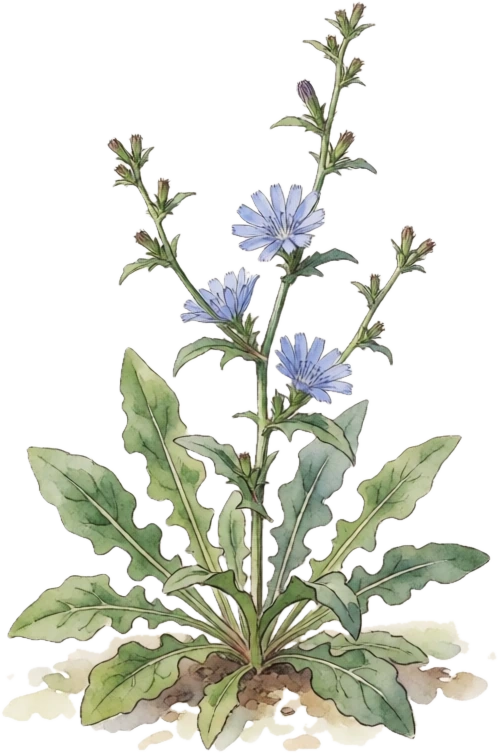
Botanical illustration of Chicory

Chicory is three crops wearing one roadside disguise: bitter greens for braising, roots that roast into the classic caffeine-free coffee, and — forced in the dark — those same roots become gourmet Belgian endive. The sky-blue flowers that open with the dawn are the free fourth act.

Tough is an understatement — a deep-taprooted perennial, hardy zones 3 to 9, that shrugs at drought and keeps bees in nectar through summer and fall. It stands 3 to 5 feet and stays put for years. Sow it once along the sunny margin and decide later which of its careers to cash in.

Where to buy chicory — 2 nurseries compared

  • Full Sun
  • Drought-tolerant · low water
  • Fast growth
  • Excellent edible
  • Salt-tolerant
  • Attracts bees
Chicory — a print from the Plant Library collection

From the print shop

Growing chicory? Hang it.

Our Plant Library collection carries chicory — Cichorium intybus, print Nº 109, “Chicory.”

526 designsfrom $12.99white or black backgroundmatte poster, unframed

Shop Plant Library botanical prints →

✓

Will it fruit where you are?

Enter your ZIP — we look up your USDA hardiness zone (2023 map) and check it against what chicory actually needs.

Hardy inZones 3-9

Chicory · Common problems

Common chicory problems

Pests, diseases and weather to keep an eye on.

Pests

1 problem on file

  • Almost none

Diseases

1 problem on file

  • Few

Chicory · Growing & propagation

Growing chicory

Light, water, soil, propagation and the season’s jobs.
What it needsThe details
Light
Full Sun
Water
Low

Deep taproot, drought-proof

Soil
Any · pH 5.5 - 7.5
Fertilizer
None
Pruning
Cut back after bloom

Force roots in a dark cellar for winter 'chicons' (endive); or dig and roast for coffee.

Spacing
10-12 in

How to plant & propagate chicory

Propagate
Division or seed

Chicory · Seasonal care & spray guidance

The chicory growing playbook

Field-tested instructions for every job chicory asks of you, compiled from university extension guidance — in the order the season brings them.

While it is dormant

winter, before growth starts

1 job
Planting outIn winter

Force stored roots in the dark for chicons

Through winter, replant trimmed roots upright in damp sand in a bucket or box and hold them near 60 degrees in complete darkness. Radicchio types head up in roughly three weeks, Belgian endive closer to six. Force a few roots at a time rather than all of them. A root cut off from light drives its stored sugars into a blanched head instead of leaves, and any light leak turns that head green and punishingly bitter.

As growth begins

early spring

1 job
FeedingIn spring

Feed the patch at spring green-up

Fertilize a standing perennial chicory patch as it greens up in spring, and split the season's nitrogen rather than dumping it at once. Keep soil pH above 5.5, phosphorus near 25 ppm and potassium near 110 ppm, correcting from a soil test rather than by guess. Chicory is a heavy nitrogen feeder that regrows from the crown after each cutting, and the spring flush is where the plant rebuilds the taproot reserves it spent overwintering.

While it flowers

at bloom

1 job
PruningAt bloom

Deadhead the blue flowers before seed sets

If you are not saving seed, cut the flowering stems down while the blue flowers are still open and before seed matures. Do not let a cultivated patch shed seed into surrounding ground. Chicory is naturalized across most of North America and self-seeds freely into fields and roadsides, and because its seed has no pappus to fly, it spreads exactly where soil, machinery and feet carry it out of your bed.

Through summer

the growing season

3 jobs
SowingIn summer

Sow in early summer for fall roots and heads

Sow chicory seed a quarter to a half inch deep in deep, well-drained fertile soil about a hundred days before your first hard frost. Count back from your own average first hard frost date rather than a calendar week borrowed from somewhere else: in the upper Midwest that lands in late June or early July, but in the warm end of the range it can be as late as September. Chicory grown for forcing or for roots wants that full run of long days. Forcing chicories are long-day crops that need 100-plus days to build the fat taproot the crop actually depends on, and a root that never sized up will not force a head no matter how you treat it later.

ThinningIn summer

Thin seedlings to 10 to 15 inches apart

Once seedlings are up and handleable, thin or set plants every 10 to 15 inches, with rows about 12 to 14 inches apart. Pull the extras rather than crowding them along. Chicory heads and taproots both size up on the room they are given, and crowded plants trade head weight and root diameter for leaf that never makes a crop.

What to watch forIn summer

Watch young rosettes for slugs, snails and cutworms

Check the young rosettes through the summer for slugs, snails and cutworms, looking under leaves and at the soil line where cutworms sever seedlings at night. Chicory has no serious pest problems, so hand-picking and cleaning up damp hiding places is usually the whole job. Chicory has no serious pest problems, and slugs, snails and cutworms are only occasional visitors - but they do their damage at the seedling stage, where losing a growing point costs you the entire plant rather than a few leaves. That asymmetry is why a low-probability pest is still worth a look.

After harvest

autumn, and putting it to bed

1 job
HarvestingIn autumn

Dig the roots after a hard frost

Dig chicory roots in fall once a hard frost has knocked the tops back. Cut the green leaves off cleanly, leaving just the growing tip on the crown, and either roast the roots for a caffeine-free coffee or hold them for forcing at 32 to 35 degrees and 95 percent or higher humidity, where they will keep for months. The frost is the signal that the plant has finished pulling its sugars down into the taproot, which is both what makes the roasted root taste like coffee and what fuels the leafless head during forcing.

Chicory · Calculators & field guides

A little help in the garden.

Calculators for the figures. Field guides for the hands-on work.

Chicory · Yearly calendar

The chicory year, month by month

What chicory asks for, month by month.

Jan

No calendar activity is listed for this month.

MonthJanFebMarAprMayJunJulAugSepOctNovDec
Bloom

BloomJune to November

What each band means

  • Bloom — flowers open — pollinators working, frost on blossoms is the danger.

These are the species' typical months — expect them a few weeks earlier in warm zones and later in cold ones. Watch the plant, not just the calendar.

Chicory · Ecology & uses

Ecology & uses

What it does for the garden, and what it is grown for.
Botanical illustration of Chicory

Cichorium intybus

Chicory in the garden system

  • Herbaceous layer perennial
  • Dynamic accumulator
  • Nectary/insectary
Attracts
Bees
Moisture
Upland / dry
Salt
Salt-tolerant

Fine near roads and coasts

Deer
Browsed

Protect young plants

Origin
Introduced

What chicory is grown for

✓ Commonly eaten

Use
Coffee substitute
Use
Belgian endive
Traditional use
Bitter greens
Use
Bee forage
Edible value
4/5
Traditional use rating
3/5 in herbal tradition

Harvesting & storing chicory

Leaves (bitter salad/braising); ROOTS roasted = caffeine-free coffee; forced roots = Belgian endive.

Edibility, identification, and traditional-use notes here are general reference — not medical or veterinary advice, and not a claim that any plant treats or prevents anything. Medicinal ratings record how strongly a plant features in herbal tradition, nothing more. Never eat or dose a plant you have not positively identified. More on how to use this library.

Chicory · Varieties & cultivars

Best chicory varieties & cultivars

There are far more than these — the ones below are the named varieties of chicory people actually plant.

Named varieties of chicory differ in winter-chill needs, ripening time, hardiness, and whether they set fruit on their own — pick one that fits your climate.

9 varieties

Palla Rossa

Ripens
Fall
Zones
3-9

Bitter, crisp — A nonforcing radicchio: dark green outer leaves wrap a head of elongated red leaves with pure white ribs. Zones are the species range from UW-Madison Extension; radicchio is grown as an annual crop, not gated by winter hardiness.

Where to buy ‘Palla Rossa’

Story Thyme Farms may earn a small commission from these links, at no cost to you — it never changes what we recommend.

Sources & plant identity

Know what you’re growing.
See where the knowledge comes from.

Botanical illustration of Chicory

Chicory

Cichorium intybus

The plant, at a glance.

Botanical name
Cichorium intybus
Plant family
Asteraceae
Growth habit
Perennial
Origin
Introduced
USDA plant symbol
CIIN
Invasive risk
Low
Every garden is different.

Hardiness, size and timing vary with your cultivar, soil and climate.

Rooted in research.

University extension research, brought together with hands-on growing experience at Story Thyme Farms.

Explore Chicory’s sources5 reference links
for Chicory

Research from these sources

Publisher marks identify sources, not sponsorship or endorsement.

Questions

Chicory questions, answered straight.

Is chicory safe for kids and pets?

Chicory is commonly eaten and isn't considered toxic, but "commonly eaten" isn't a guarantee for any particular person or animal — allergies, quantity, and which part you eat all matter. Never eat a plant you haven't positively identified, and check with a vet before letting pets or livestock graze anything new.

When do you harvest chicory?

Leaves (bitter salad/braising); ROOTS roasted = caffeine-free coffee; forced roots = Belgian endive.

How do you propagate chicory?

Division or seed.

Elsewhere

Where chicory sits in the library.

Where chicory sits in the library

Grows in the same world