The illustrated growing guide

Chokeberry

Aronia melanocarpa

Family Rosaceae

Est. zones 3-8

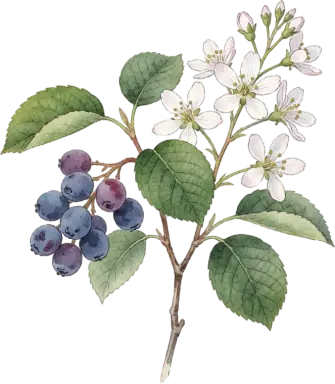
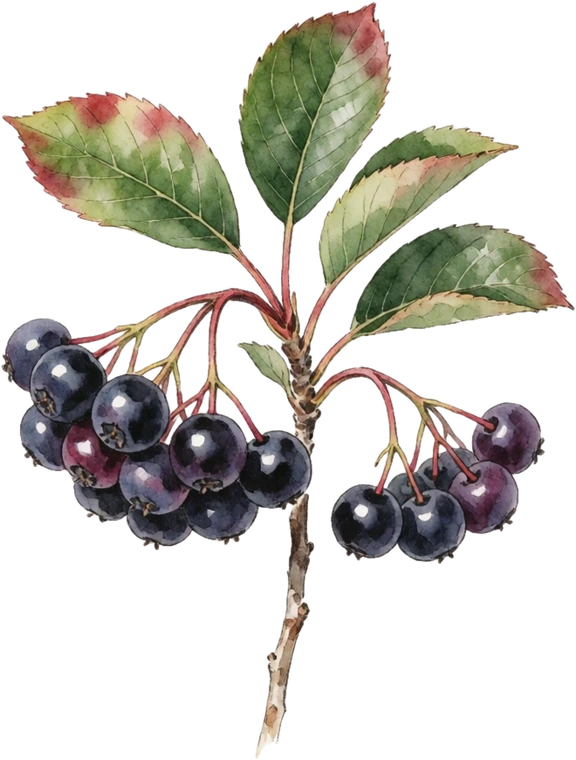
Botanical illustration of Chokeberry
Shrub · Aronia melanocarpa

Very astringent fresh (hence 'choke'). Superfood antioxidant levels. Beautiful fall color.

Shrub · NativeFull Sun to Part ShadeModerate waterModerate growthNative to North AmericaExcellent edibleAttracts beesAttracts butterflies1000+ winter chill

Where to buy the plant — 3 nurseries

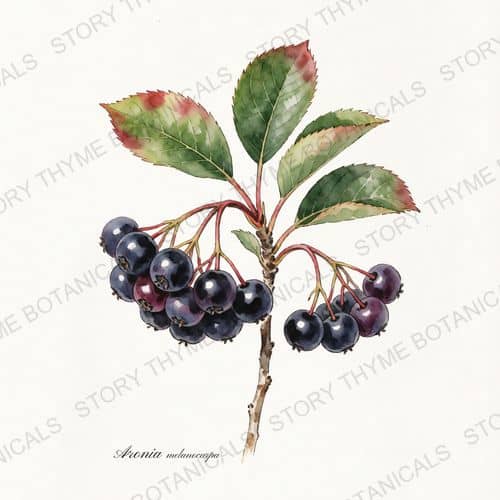
Aronia — a print from the Berry Plants collection

From the print shop

The closest print we make

Our Berry Plants collection carries Aronia melanocarpa — the same species as chokeberry — but the print shows “Aronia,” a different cultivar of it, not chokeberry itself.

16 designsfrom $21.99white or black groundmatte poster, unframed

Shop Berry Plants botanical prints →

I

Overview

Will chokeberry suit your garden, and what goes wrong.

Will it fruit where you are?

Enter your ZIP — we look up your USDA hardiness zone (2023 map) and check it against what chokeberry actually needs.

Hardy inZones 3-8
Winter chill1000+
PollinationSelf-fertile

Chokeberry at a glance

HardinessUSDA 3–8
Mature size3-6 ft
PollinationSelf-Fertile
Chill requirement1000+
Bloom seasonSpring
Harvest seasonLate Summer/Fall
Growth rateModerate

Common chokeberry problems

II

Growing

Light, water, soil, propagation and the season’s jobs.

How to grow chokeberry: light, water & soil

LightFull Sun to Part Shade
WaterAdaptable (Wet or Dry)
SoilAdaptable · pH 6.0 - 6.5
FertilizerLow
PruningWinter — Thinning older canes to encourage new growth.
Spacing4-6 ft

How to plant & propagate chokeberry

PropagateGrafted, or from cuttings/layering (seed won't come true)

The chokeberry growing playbook

Field-tested instructions for every job chokeberry asks of you, compiled from university extension guidance — in the order the season brings them.

Watering

Drip-irrigate through the first two seasons

Run drip irrigation for the first two growing seasons while the roots take hold. On sandy ground give short runs of fifteen to thirty minutes several times a day, and on clay a single or double fifteen to thirty minute run is enough. After the second year, water only through genuinely dry spells. Aronia is drought-tolerant once established, but a new plant has no root system to draw on, and the difference between a shrub that fruits in year two and one that sulks is almost always water in those first seasons. Sandy soil drains faster than the roots can drink, which is why it wants many short runs rather than one long soak.

Feeding

Feed a quarter to half ounce of nitrogen per plantMar – Oct

Spread a quarter to a half ounce of actual nitrogen per plant, once a year, in early March or in October. Take the dead and diseased wood out while you are working down the row. Maryland trials doubled yield at the half-ounce rate over an eighth of an ounce, and fruit quality held steady, so the extra nitrogen buys fruit rather than watery berries. Aronia is not a hungry plant, and pushing rates past this mostly buys leafy growth that shades out your own fruit.

Pruning

Renewal-prune chokeberry before bud breakFeb – Mar

While the shrub is still dormant, cut the oldest canes right down at the base of the crown, taking out canes that have reached about five years old. Leave the young and middle-aged canes standing, and keep enough one-year shoots to carry next year's crop. Aronia canes hit peak productivity at about three years old and fall off steadily after that, so cutting the five-year canes at the crown keeps forcing fresh replacements. Next season's flower buds form on the current season's growth, so stripping too much shoot wood trades away the crop.

What to watch for

Watch for Japanese beetles once the fruit is sizing

From the beetles' first emergence through their flight, walk the planting as often as you can and look for skeletonized leaves and beetles clustered on the fruit. Knock light infestations into soapy water. Treat only if defoliation is spreading across the planting, not for a handful of beetles. Japanese beetles arrive well after aronia has finished blooming, and they chew both foliage and fruit fast, so a single flight can strip enough canopy to cut the crop. Their feeding also opens fruit to fungal rot and leaves contamination in the harvest.

Very few insecticides are labeled on aronia. A product is only legal here if its label carries IR-4 crop group 13-07B, bushberry and small fruits, and names the pest. Check the label's pre-harvest interval against your picking date before you spray anything.

Spraying

Dormant oil for lace bug as buds break

If lace bugs discolored the leaves last season, spray horticultural oil as the buds swell and green tip shows, while the first generation is still developing. Cover the undersides of the shoots and old leaf litter thoroughly, since that is where the insects sit. Lace bugs feed on the undersides of aronia leaves and stipple them pale, and heavy feeding pulls the canopy down before the fruit finishes filling. Hitting the first generation early is the one window where oil can smother them before populations compound across the summer.

Spray on a dry day above 40F and never in freezing weather. Aronia falls under IR-4 crop group 13-07B, bushberry and small fruits, so the oil label must list that group for the use to be legal.

Potassium bicarbonate if powdery mildew shows in the canopy

Once the canopy has filled in after bloom, check the shaded interior for white powdery patches on the leaves, especially through humid stretches. If you find it, spray potassium bicarbonate and open the shrub up at the next dormant pruning so light and air get inside. Aronia powdery mildew takes hold where humidity stays high and light and air movement are poor, and a bad case defoliates the plant while the berries are still filling. Crowded, unpruned crowns make their own still, damp microclimate, which is why thinning the canes is half the cure.

Any fungicide used here must carry IR-4 crop group 13-07B, bushberry and small fruits, on its label to be legal on aronia. Follow the label's pre-harvest interval.

Protection

Fence against deer and rabbits before winter

Get fencing up around the planting ahead of winter. Deer browse aronia year-round and will strip dormant buds in the off season, and rabbits work on any plant still under two feet tall. Fencing is the control that actually holds; repellents are a stopgap. Deer eating dormant buds in winter removes next spring's flowers outright, so the damage is invisible until the plant fails to set a crop months later. Small plants are the vulnerable ones, because a rabbit can girdle or behead a shrub that has not yet grown out of reach.

Harvesting

Pick when the berries are fully black and Brix has stabilized

Pick when the fruit has gone completely black and a refractometer reads a steady 16 to 18 percent Brix, and get it off before the berries wrinkle on the bush. The fruit hangs well, so you have a four to six week window to work with. Refrigerate the berries promptly after picking. Yield tops out earlier than flavor does, and anthocyanins keep accumulating for a couple of weeks past maximum yield, so picking on color and Brix together is what separates a bland crop from a rich one. Waiting past the point where fruit shrivels loses both weight and quality.

III

The year

What chokeberry asks for, month by month.

The chokeberry year, month by month

MonthJanFebMarAprMayJunJulAugSepOctNovDec
Bloom
Prune
Harvest

What each band means

  • Bloomflowers open — pollinators working, frost on blossoms is the danger.
  • Pruneshape it now — cuts heal cleanly and structure is visible.
  • Harvestpicking time — check ripeness every few days.

The chokeberry year as text

  • Jan pruning
  • Feb pruning
  • Mar bloom
  • Apr bloom
  • May bloom
  • Jun quiet month
  • Jul quiet month
  • Aug harvest
  • Sep harvest
  • Oct harvest
  • Nov harvest
  • Dec pruning

These are the species' typical months — expect them a few weeks earlier in warm zones and later in cold ones. Watch the plant, not just the calendar.

IV

Ecology & uses

What it does for the garden, and what it is grown for.

Chokeberry in the garden system

  • Shrub layer shrub
AttractsBees, Birds, Butterflies
MoistureFacultative / average
DeerBrowsed — protect young plants
OriginNative to North America

What chokeberry is grown for

✓ Commonly eaten

UseJuice
UseBlending
UseJelly
Edible value4/5
Traditional use rating3/5 in herbal tradition

Harvesting & storing chokeberry

Late Summer/Fall.

Edibility, identification, and traditional-use notes here are general reference — not medical or veterinary advice, and not a claim that any plant treats or prevents anything. Medicinal ratings record how strongly a plant features in herbal tradition, nothing more. Never eat or dose a plant you have not positively identified. More on how to use this library.

V

Cultivars

Named varieties of chokeberry, ruled as a catalogue.

Best chokeberry varieties & cultivars

6 on file

Named varieties of chokeberry differ in winter-chill needs, ripening time, hardiness, and whether they set fruit on their own — pick one that fits your climate.

Viking

Self-fertile
RipensLate August-early SeptemberZones3-8Size6-8 ft multi-stemmed shrub

astringent, high anthocyanin — Selected in Russia for commercial fruit production and one of the two most widely planted aronia in the US. Reaches six to eight feet with multiple shoots per plant, and colors red in fall.

Where to buy ‘Vikingverified

Story Thyme Farms may earn a small commission from these links, at no cost to you — it never changes what we recommend.

Nero

Self-fertile
RipensLate August-early SeptemberZones3-8Size3-5 ft, shorter than Viking

astringent, relatively sweet for aronia — Like Viking, selected in Russia for fruit and introduced to the US in the last twenty-five years. Shorter habit than Viking with dark blue-black berries.

Where to buy ‘Nero

Story Thyme Farms may earn a small commission from these links, at no cost to you — it never changes what we recommend.

Galicjanka · Galicianka

Self-fertile
RipensLate August-early SeptemberZones3-8Size4-8 ft shrub

astringent — The dominant commercial cultivar in Poland, where most of the world's aronia is grown. Productive, but harder to source from US nurseries than Viking or Nero.

Where to buy ‘Galicjanka

Story Thyme Farms may earn a small commission from these links, at no cost to you — it never changes what we recommend.

McKenzie

Self-fertile
RipensLate August-SeptemberZones3-8Size6-12 ft, largest of the cultivars

astringent — Released in 2008 for conservation and windbreak plantings, not for commercial fruit. Extension guidance is explicit that it should not be planted for commercial fruit production, though its size and hardiness make it a strong hedgerow or wildlife plant. Commonly seen in windbreaks across the upper Midwest.

Where to buy ‘McKenzie

Story Thyme Farms may earn a small commission from these links, at no cost to you — it never changes what we recommend.

Autumn Magic

Self-fertile
RipensAugust-SeptemberZones3-8Size3-6 ft shrub

astringent — An ornamental selection grown for its brilliant red fall foliage. Readily available in the US, but extension guidance places it outside the cultivars suited to commercial fruit production.

Where to buy ‘Autumn Magic

Story Thyme Farms may earn a small commission from these links, at no cost to you — it never changes what we recommend.

Morton · Iroquois Beauty

Self-fertile
RipensAugust-SeptemberZones3-8Sizeabout 3 ft, dwarf

astringent — Sold under the Iroquois Beauty trademark. A dwarf ornamental holding around three feet, which is the shortest of the widely available aronia. Not a commercial fruiting cultivar.

Where to buy ‘Morton

Story Thyme Farms may earn a small commission from these links, at no cost to you — it never changes what we recommend.

VI

Sources & plant ID

Where the care distinctions come from, and how the plant is filed.

Research basis

Sources behind this profile

No extension citations are attached to chokeberryyet. The care figures below come from the library's own catalogue rather than a traced primary source.

Plant ID

BinomialAronia melanocarpa
FamilyRosaceae
TypeShrub · Perennial
USDA symbolARME6
OriginNative to North America
Invasive riskLow

VII

Where to buy

Third-party nurseries — not Story Thyme Farms.

Third-party nurseries, not Story Thyme Farms. Prices are theirs.

Story Thyme Farms may earn a small commission from these links, at no cost to you — it never changes what we recommend.

VIII

Questions

Chokeberry questions, answered straight.

Do I need two chokeberry plants to get fruit?

No — chokeberry is self-fertile, so a single plant will set a crop. A second one usually improves yields, but it isn't required.

Will chokeberry fruit in a warm-winter climate?

Chokeberry needs roughly 1000+ hours of winter chill (hours between 32–45°F) to break dormancy and set fruit. Mild-winter growers should count their chill hours before planting.

Is chokeberry safe for kids and pets?

Chokeberry is commonly eaten and isn't considered toxic, but "commonly eaten" isn't a guarantee for any particular person or animal — allergies, quantity, and which part you eat all matter. Never eat a plant you haven't positively identified, and check with a vet before letting pets or livestock graze anything new.

When do you harvest chokeberry?

Late Summer/Fall.

IX

Elsewhere

Where chokeberry sits in the library.