The illustrated growing guide

Pineapple Guava (Feijoa)

Feijoa sellowiana

Family Myrtaceae

Est. zones 8-11

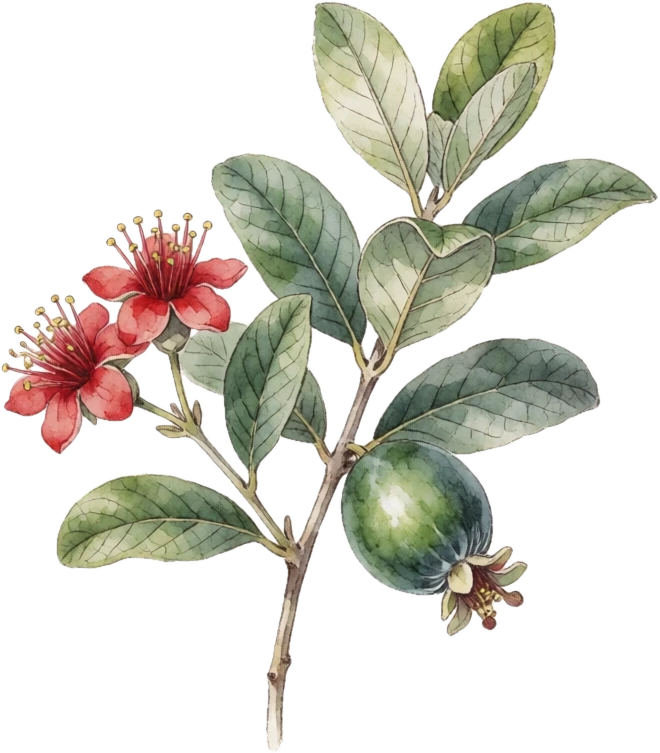
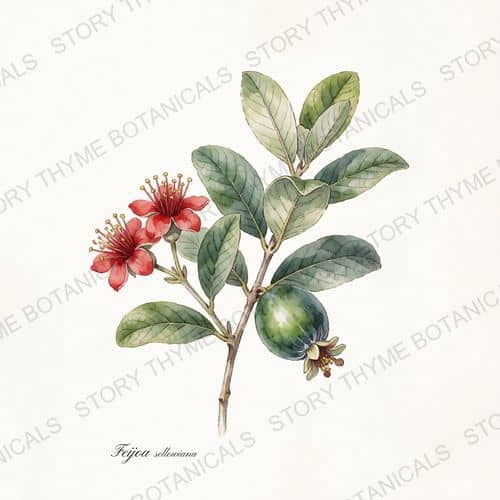
Botanical illustration of Pineapple Guava (Feijoa)
Shrub · Feijoa sellowiana

The gorgeous, tough, low-spray fruit shrub the West Coast loves and the rest of the country forgets: silver evergreen leaves, edible marshmallow-sweet flower petals, and fall fruit that tastes of pineapple-mint-guava. Hardy to zone 8, hedgeable, and pollinator-friendly. Plant two unless the variety is self-fertile.

ShrubFull Sun to Part ShadeLow waterModerate growthExcellent edibleAttracts bees50-200 winter chillNeeds a pollination partner

Where to buy the plant — 1 nursery

I

Overview

Will pineapple guava (feijoa) suit your garden, and what goes wrong.

Will it fruit where you are?

Enter your ZIP — we look up your USDA hardiness zone (2023 map) and check it against what pineapple guava (feijoa) actually needs.

Hardy inZones 8-11
Winter chill50-200
PollinationPartner needed

Pineapple Guava (Feijoa) at a glance

HardinessUSDA 8–11
Mature size10-15 ft; hedgeable
PollinationMost need TWO cultivars (a few self-fertile); the edible flower petals attract pollinators
Chill requirement50-200
Bloom seasonLate Spring (stunning red-and-white petals — the PETALS are edible, sweet)
Harvest seasonFall: fruit DROPS when ripe — gather the green egg-shaped fruits off the ground
Growth rateModerate

Common pineapple guava (feijoa) problems

  • Scale
  • Fruit Fly (mild)
  • Very few — a low-spray fruit
  • Poor pollination → low fruit set (plant a partner)

II

Growing

Light, water, soil, propagation and the season’s jobs.

How to grow pineapple guava (feijoa): light, water & soil

LightFull Sun to Part Shade
WaterLow-Moderate once established
SoilAdaptable, well-drained · pH 5.5 - 7.0
FertilizerLight spring feed
PruningLate Winter to after bloom — Shear as a hedge or prune open; fruits on new and old wood.
Spacing8-10 ft

How to plant & propagate pineapple guava (feijoa)

PropagateGrafted, or from cuttings/layering (seed won't come true)

The pineapple guava (feijoa) growing playbook

Field-tested instructions for every job pineapple guava (feijoa) asks of you, compiled from university extension guidance — in the order the season brings them.

Planting out

Plant a second variety within bee and bird range

Unless you are growing 'Unique', set a second, different feijoa cultivar close enough that pollinators move freely between the two. 'Precocious' flowers profusely over a long season and makes a dependable pollen parent for whatever else is blooming. If you have room for only one plant, you can instead graft a second cultivar onto the same rootstock. Feijoa pollen is small and poorly carried by wind, so the crop depends on bees and birds moving pollen between plants. Self-incompatible trees preferentially outcross, and honeybees are weak pollinators here because they tend to work flowers within a single tree rather than travel between them. Apart from 'Unique', every named variety is at best partially self-fertile and sets a larger crop when pollinated by another variety.

Watering

Water through dry spells while fruit is sizing

An established feijoa needs no routine irrigation in a normal year, but once fruit is on the plant, water it through any prolonged dry period. Water deeply and infrequently rather than lightly and often. Feijoa is drought tolerant but responds to a long dry spell by shedding both fruit and leaves, so a drought during fruit development costs you the crop outright rather than merely shrinking it. Consistent soil moisture is what carries fruit through to good size and quality.

Feeding

Feed small amounts on a 4-to-6 week cycle

Starting in late winter and continuing through fall, apply a complete fertilizer such as 10-10-10 or 8-3-9 every 4 to 6 weeks. Keep each dose small: 0.5 to 1 lb per plant for young plants, and no more than 2 lb per plant for mature ones. Feijoa also wants magnesium and sulfur plus the micronutrients boron, nickel, manganese, copper, zinc, and iron, which you can supply granularly, through fertigation, or as a foliar feed. Feijoa grows slowly and takes up nutrients steadily rather than in a flush, so many light doses spread across the season suit it far better than one heavy spring application.

Keep individual applications within the stated per-plant limits rather than scaling up for convenience; feijoa is shallow-rooted and a concentrated dose sits directly in the feeder-root zone.

Pruning

Prune lightly for structure, not for shape

Prune only enough to build and hold the form you want, whether that is a hedge, a multi-stemmed shrub, or a single-trunk small tree. Shorten individual shoots to check spread or to open up a crowded canopy, and take out dead or crossing wood. Repeat lightly in summer if the plant is outgrowing its space. Resist the urge to shear it into a formal outline. Feijoa needs very little pruning beyond structural training. It does tolerate heavy pruning and shearing, but every cut takes off the wood that would have carried flowers, so a tightly sheared plant trades its crop for a neat outline.

What to watch for

Check for scale and fruit flies, but do not spray on a schedule

Look over the stems and leaf undersides for black scale, and watch ripening fruit for fruit fly stings and soft breakdown around the puncture. In the southeastern US expect to find nothing most years. Where the rainy season overlaps bloom and fruit development, an occasional fungicide for anthracnose fruit rot may be warranted, but treat only in response to a problem you have actually found. Feijoa has no consistent pest or pathogen threats reported in the southeastern United States. Black scale and fruit flies turn up in California, and scale, thrips, fruit flies, and anthracnose rot are reported in New Zealand and South America, but none of these are dependable enough anywhere in the US to justify a calendar spray.

There is no routine pesticide program for feijoa, and no insecticide should ever be applied while the plant is in bloom, since the crop depends on bees and birds working the flowers. Any product you do use must be labeled for feijoa or pineapple guava; follow the label's pre-harvest interval.

Protection

Guard against hard freezes at the cold edge of the range

Feijoa is hardy through zones 8 to 11. In zone 8, where winter lows can reach the plant's limit, site it against a south wall or other sheltered spot, mulch the root zone, and cover or wrap young plants when a hard freeze is forecast. Late-hanging fruit is the first thing to lose. The wood itself is injured below about 20 F, but fruit is damaged at 28 F, so a freeze that leaves the plant untouched can still take a crop that is still hanging. Established plants shrug off brief dips that would kill an unprotected young one.

Harvesting

Let the first fruits fall, then shake the rest down

Wait until the first fruits drop on their own; that is your signal the crop has begun to mature. From then on, spread a tarp under the plant and shake the branches lightly, or pick only fruit that detaches with almost no force. Some softening and a color change to a lighter green also indicate ripeness. Feijoa ripens unevenly over a long stretch, so plan on repeated passes rather than one harvest. To eat, halve the fruit and scoop the pulp. Feijoa lets go of its fruit when it is ready, and detachment with minimal force is the cue commercial growers harvest by. Fruit pulled before it will release is astringent and gritty, so the plant's own abscission is the most trustworthy indicator — softening and a lighter green are supporting signs.

Chill the crop immediately or plan to use it within a week

Move mature fruit into cold storage at 32 to 40 F as soon as you gather it, where it will hold for 4 to 7 weeks. Fruit left at room temperature is good for only about a week. Sort out any bruised or split fruit before storing and use it first. A whole feijoa crop matures across a couple of months but each fruit has a short shelf life once it drops, so cold storage is what turns a glut into a supply. At room temperature the pulp browns and breaks down within days.

III

The year

What pineapple guava (feijoa) asks for, month by month.

The pineapple guava (feijoa) year, month by month

MonthJanFebMarAprMayJunJulAugSepOctNovDec
Bloom
Prune
Harvest

What each band means

  • Bloomflowers open — pollinators working, frost on blossoms is the danger.
  • Pruneshape it now — cuts heal cleanly and structure is visible.
  • Harvestpicking time — check ripeness every few days.

The pineapple guava (feijoa) year as text

  • Jan quiet month
  • Feb pruning
  • Mar pruning
  • Apr quiet month
  • May bloom
  • Jun quiet month
  • Jul quiet month
  • Aug quiet month
  • Sep harvest
  • Oct harvest
  • Nov harvest
  • Dec quiet month

These are the species' typical months — expect them a few weeks earlier in warm zones and later in cold ones. Watch the plant, not just the calendar.

IV

Ecology & uses

What it does for the garden, and what it is grown for.

Pineapple Guava (Feijoa) in the garden system

  • Shrub layer shrub
  • Nectary/insectary
AttractsBees
HabitatWetland
MoistureWetland / wet-tolerant
DeerBrowsed — protect young plants
OriginIntroduced

What pineapple guava (feijoa) is grown for

✓ Commonly eatenflowers and fruit both edible

UseFresh eating
UseEdible flowers
UseEvergreen hedge
Edible value4/5

Harvesting & storing pineapple guava (feijoa)

Fall: fruit DROPS when ripe — gather the green egg-shaped fruits off the ground.

Edibility, identification, and traditional-use notes here are general reference — not medical or veterinary advice, and not a claim that any plant treats or prevents anything. Medicinal ratings record how strongly a plant features in herbal tradition, nothing more. Never eat or dose a plant you have not positively identified. More on how to use this library.

V

Cultivars

Named varieties of pineapple guava (feijoa), ruled as a catalogue.

Best pineapple guava (feijoa) varieties & cultivars

14 on file

Named varieties of pineapple guava (feijoa) differ in winter-chill needs, ripening time, hardiness, and whether they set fruit on their own — pick one that fits your climate.

Coolidge

Self-fertile
RipensOct-NovZones8-11Diseasegenerally pest- and disease-freeSize10-15 ft shrub/small tree (prunable to hedge)

deep pineapple-mint, good fresh — A long-established (California, 1913) fully self-fertile cultivar and a reliable single-plant choice; sets somewhat larger fruit with a cross-pollinizer but does not require one.

Where to buy ‘Coolidgeverified

Story Thyme Farms may earn a small commission from these links, at no cost to you — it never changes what we recommend.
Unique

Self-fertile
RipensSept-Oct (early)Zones8-11Diseasegenerally pest- and disease-freeSize8-12 ft, compact and precocious

sweet, soft juicy pulp, good fresh — Often described (e.g. by CRFG) as the most reliably self-fertile feijoa; it fruits young, making it the surest single-plant option for a small yard.

Where to buy ‘Unique

Story Thyme Farms may earn a small commission from these links, at no cost to you — it never changes what we recommend.

Apollo

Partly self-fertile
RipensOct (mid-late)Zones8-11Diseasegenerally pest- and disease-freeSize10-15 ft, upright
Pollinationpartly self-fertile; a second variety boosts yield

deep pineapple flavor, slightly gritty pulp — A large-fruited New Zealand cultivar; some sources rate it self-fertile, but it also serves as an excellent pollen source for other varieties (e.g. Gemini) in a hedgerow.

Where to buy ‘Apollo

Story Thyme Farms may earn a small commission from these links, at no cost to you — it never changes what we recommend.

Mammoth

Partly self-fertile
RipensSept-Oct (early-mid)Zones8-11Diseasegenerally pest- and disease-freeSize10-15 ft
Pollinationneeds a second variety (e.g. Triumph or Apollo) for full crops

rich, hint of strawberry, slightly gritty — Produces some of the largest fruit (up to about half a pound); self-fruitful but yields and sizes markedly better with a pollinizer nearby.

Where to buy ‘Mammoth

Story Thyme Farms may earn a small commission from these links, at no cost to you — it never changes what we recommend.

Triumph

Partly self-fertile
RipensOct-NovZones8-11Diseasegenerally pest- and disease-freeSize10-15 ft
Pollinationpartly self-fertile; needs a second variety for heavy crops (pairs well with Mammoth)

tangy, firm, somewhat gritty; excellent keeper — A firm, long-storing New Zealand cultivar. Only weakly self-fruitful, so it crops poorly on its own and should be planted with a cross-pollinizer such as Mammoth.

Where to buy ‘Triumph

Story Thyme Farms may earn a small commission from these links, at no cost to you — it never changes what we recommend.

Nazemetz

Partly self-fertile
RipensOct-Dec (late)Zones8-11Diseasegenerally pest- and disease-freeSize10-15 ft
Pollinationpartly self-fertile; bears most heavily with a pollinizer (e.g. Trask)

large pear-shaped fruit, excellent sweet flavor — A San Diego selection (raised by Alexander Nazemetz) prized for late, high-quality fruit; self-fruitful but cropping improves with a second variety.

Where to buy ‘Nazemetz

Story Thyme Farms may earn a small commission from these links, at no cost to you — it never changes what we recommend.

Nikita

Partly self-fertile
RipensSept-Oct (early)Zones8-11Diseasegenerally pest- and disease-freeSize6-8 ft, compact
Pollinationpartly self-fertile; cross-pollination increases yield and fruit size

sweet, aromatic, medium-large fruit — An early-ripening, notably cold-hardy selection from the Nikita Botanical Garden (Yalta, Crimea); useful at the cooler edge of feijoa's range and in containers.

Where to buy ‘Nikita

Story Thyme Farms may earn a small commission from these links, at no cost to you — it never changes what we recommend.
Pineapple Gem

Partly self-fertile
RipensOct-Nov (late)Zones8-11Diseasegenerally pest- and disease-freeSize8-12 ft
Pollinationpartly self-fertile; bears heavier crops with cross-pollination

small round fruit, good to very good quality — A Monrovia Nursery selection from Azusa, California. Needs a warm summer to ripen well and performs poorly in cool coastal areas, so it is best for hot-summer inland gardens. (Note: 'Gemini' is a separate cultivar, not an alias.)

Where to buy ‘Pineapple Gem

Story Thyme Farms may earn a small commission from these links, at no cost to you — it never changes what we recommend.

Edenvale

Partly self-fertile
Zones8-11Sizelarge fruit
Pollinationpartially self-fertile; crops larger with a second variety

excellent — A Santa Cruz, California selection carrying large fruit of excellent flavor. UF/IFAS lists it as both precocious and self-fertile, meaning it starts bearing young, which makes it a good choice if you want fruit sooner than the usual 2-to-4-year wait. The same publication is explicit that outside 'Unique' every variety is at best partially self-fertile, so pair it with another cultivar for a full crop.

Where to buy ‘Edenvale

Story Thyme Farms may earn a small commission from these links, at no cost to you — it never changes what we recommend.

Trask

Partly self-fertile
RipensearlyZones8-11Sizemedium to large fruit
Pollinationpartially self-fertile; crops larger with a second variety

very good — A bud sport of 'Coolidge' with medium-to-large fruit of very good flavor that ripens early. Because it arose from 'Coolidge' it shares that variety's constitution while running earlier, which is useful where the season shuts down before late feijoas finish. Listed as self-fertile by UF/IFAS, though the publication notes all varieties but 'Unique' crop better with a pollinizer.

Where to buy ‘Trask

Story Thyme Farms may earn a small commission from these links, at no cost to you — it never changes what we recommend.

Robert

Partly self-fertile
RipensearlyZones8-11Sizemedium fruit
Pollinationpartially self-fertile; crops larger with a second variety

juicy, mild — A New Zealand cultivar with early-ripening, juicy fruit of mild flavor. UF/IFAS singles it out as highly drought tolerant, which is the reason to choose it: on an unirrigated site, where other feijoas answer a dry spell by dropping fruit and leaves, 'Robert' is the one most likely to hold its crop.

Where to buy ‘Robert

Story Thyme Farms may earn a small commission from these links, at no cost to you — it never changes what we recommend.

Precocious

Partly self-fertile
Zones8-11Sizemedium fruit
Pollinationpartially self-fertile; valued mainly as a pollen parent for other varieties

An Oregon selection that flowers early and profusely across a longer season than other feijoas. That extended bloom is the whole point of it: because nearly every feijoa needs foreign pollen to crop well, a variety still throwing flowers when its neighbors open is the one that guarantees overlap. UF/IFAS states its long flowering habit lets it serve as a pollen parent throughout the flowering season of other cultivars. Plant it as the partner in a hedgerow rather than as your main fruiting plant. Note that its 'early' reputation refers to bloom, not ripening — the source gives no harvest season for it.

Where to buy ‘Precocious

Story Thyme Farms may earn a small commission from these links, at no cost to you — it never changes what we recommend.

Superba

Partly self-fertile
Zones8-10Sizemedium, rounded fruit
Pollinationthe cultivar most clearly dependent on cross-pollination; must have a partner

good — An Australian cultivar with rounded fruit of good flavor on a straggly, open plant. Of all the named feijoas this is the one both UF/IFAS and NC State flag as genuinely needing another cultivar planted with it for good fruit set, so never plant it alone. The loose habit means it wants structural pruning if you care how it looks.

Where to buy ‘Superba

Story Thyme Farms may earn a small commission from these links, at no cost to you — it never changes what we recommend.

Choicesana

Partly self-fertile
RipensmidseasonZones8-11Sizesmall to medium fruit
Pollinationpartially self-fertile; needs a second variety for a full crop

good — A vigorous California cultivar ripening midseason with small-to-medium fruit of good flavor. The vigor suits it to hedge use, where you want the plant to fill in. Only partially self-fertile, so give it a partner.

Where to buy ‘Choicesana

Story Thyme Farms may earn a small commission from these links, at no cost to you — it never changes what we recommend.

VI

Sources & plant ID

Where the care distinctions come from, and how the plant is filed.

Research basis

Sources behind this profile

No extension citations are attached to pineapple guava (feijoa)yet. The care figures below come from the library's own catalogue rather than a traced primary source.

Plant ID

BinomialFeijoa sellowiana
FamilyMyrtaceae
TypeShrub · Perennial
USDA symbolFESE2
OriginIntroduced
Invasive riskLow

VII

Where to buy

Third-party nurseries — not Story Thyme Farms.

Third-party nurseries, not Story Thyme Farms. Prices are theirs.

Story Thyme Farms may earn a small commission from these links, at no cost to you — it never changes what we recommend.

Pineapple Guava (Feijoa) needs a pollination partner — plant two genetically distinct plants (two different cultivars, or a cultivar plus a seedling).

VIII

Questions

Pineapple Guava (Feijoa) questions, answered straight.

Why isn't my pineapple guava (feijoa) fruiting?

Most often: it has no genetically distinct partner nearby. Pineapple Guava (Feijoa) can't pollinate itself — most need two cultivars (a few self-fertile); the edible flower petals attract pollinators. Plant a second, unrelated one nearby; two different cultivars, or a cultivar plus a seedling, is the classic pairing.

Will pineapple guava (feijoa) fruit in a warm-winter climate?

Pineapple Guava (Feijoa) needs roughly 50-200 hours of winter chill (hours between 32–45°F) to break dormancy and set fruit. Mild-winter growers should count their chill hours before planting.

Is pineapple guava (feijoa) safe for kids and pets?

Pineapple Guava (Feijoa) is commonly eaten and isn't considered toxic, but "commonly eaten" isn't a guarantee for any particular person or animal — allergies, quantity, and which part you eat all matter. One caveat on this one: flowers and fruit both edible. Never eat a plant you haven't positively identified, and check with a vet before letting pets or livestock graze anything new.

When do you harvest pineapple guava (feijoa)?

Fall: fruit DROPS when ripe — gather the green egg-shaped fruits off the ground.

IX

Elsewhere

Where pineapple guava (feijoa) sits in the library.

Where pineapple guava (feijoa) sits in the library

Grows in the same world