The illustrated growing guide

Garlic

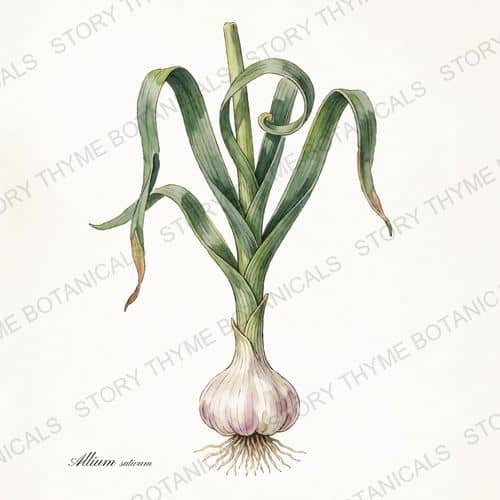
Allium sativum

Family Amaryllidaceae

Est. zones 3-9

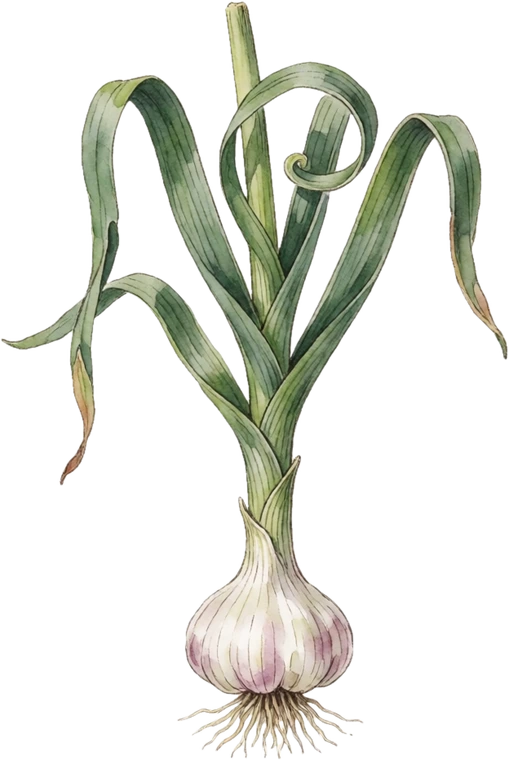
Botanical illustration of Garlic
Bulb · Allium sativum

Plant cloves mid-October (after first frost), mulch heavy. Harvest when 5-6 green leaves remain. Cure whole plants 3 weeks shaded and airy. 'Music' repays the wait.

BulbFull SunModerate waterSlow growthExcellent edible

Where to buy the plant — 2 nurseries

Hardneck Garlic — a print from the Roots & Alliums collection

From the print shop

Growing garlic? Hang it.

Our Roots & Alliums collection carries garlicAllium sativum var. ophioscorodon, print Nº 6, “Hardneck Garlic.”

16 designsfrom $21.99white or black groundmatte poster, unframed

Shop Roots & Alliums botanical prints →

I

Overview

Will garlic suit your garden, and what goes wrong.

Will it fruit where you are?

Enter your ZIP — we look up your USDA hardiness zone (2023 map) and check it against what garlic actually needs.

Hardy inZones 3-9

Garlic at a glance

HardinessUSDA 3–9
Mature size18-24 inches
PollinationNone (clonal from cloves)
Chill requirementNot yet established
Bloom seasonScapes in June (hardneck)
Harvest seasonScapes June, bulbs July
Growth rateSlow (9 months)

Common garlic problems

II

Growing

Light, water, soil, propagation and the season’s jobs.

How to grow garlic: light, water & soil

LightFull Sun
WaterModerate spring; STOP watering 2 weeks before harvest
SoilRich, Well-drained · pH 6.0 - 7.0
FertilizerNitrogen in early spring (blood meal); stop by May.
PruningNone — Cut scapes when they curl once — bulb size increases 20-30%.
Spacing6 inches

How to plant & propagate garlic

Maturity240 days (fall-planted)
From seedPlant cloves in fall; harvest the following summer
PropagateFrom seed or division

The garlic growing playbook

Field-tested instructions for every job garlic asks of you, compiled from university extension guidance — in the order the season brings them.

Sowing

Plant garlic nowOct

Set cloves 2in deep pointy end up 6in apart in rich soil then mulch. Fall planting roots before winter for big summer bulbs.

Watering

An inch of water a week while the leaves are growing

Soak the soil thoroughly rather than sprinkling it, giving at least one inch of water per week through the growing season. Leaf growth in spring sets how large the bulb can get, and shallow-rooted garlic cannot chase water down the profile the way a deeper-rooted crop can.

Stop watering two weeks before you lift

Cut off irrigation about two weeks ahead of harvest and let the bed dry down. Wet soil in the last two weeks stains and rots the papery wrappers that protect the bulb in storage, and damp bulbs going into curing invite disease.

Mulching

Mulch the bed right after planting

Lay 2 to 4 inches of straw or shredded leaves over the bed as soon as the cloves are in. Use straw free of weed seed. You can pull the mulch back in spring or leave it in place to hold down weeds. The cloves root through late fall and need stable soil. Mulch keeps freeze-thaw cycles from heaving the cloves out of the ground, blunts cold damage to emerging shoots, and holds moisture.

Feeding

Feed nitrogen twice in early spring, then stop

Side-dress nitrogen as soon as the shoots push through, then once more two to three weeks later. Stop feeding nitrogen once the plants start to bulb in late spring - do not keep feeding into the bulbing period. Garlic builds its leaves first and every leaf becomes a bulb wrapper, so early nitrogen sizes the bulb. Nitrogen applied after bulbing has begun pushes leaf growth instead and delays bulbing.

Pruning

Cut the scape as soon as it appears

On hardneck garlic, cut off the curling flower stalk as soon as you can see it. Softneck types do not make one, so there is nothing to cut. The scapes are good eating - do not throw them out. Left on the plant, the scape competes with the bulb for nutrients and you get a measurably smaller, poorer bulb. Cutting it redirects that energy underground.

What to watch for

Inspect your seed cloves before you plant them

Before planting, dissect a few cloves where the roots meet the bulb and look for bulb mites - creamy white, bulb-shaped mites with a bulbous rear end and many long fine hairs, clustered under the scales. Reject any lot whose basal plate separates easily from the bulb or whose cloves are shrunken and soft. Plant only clean seed from a clean field. Bulb mites ride into the ground on infested seed cloves, and there is little that can be done chemically once they are there - the wounds they cause also open the door to Fusarium dry rot, Botrytis, and soft rot. Starting with clean bulbs is the control.

Hot water treatment of seed cloves at 130F for 10 to 20 minutes is an option but it will decrease germination - sourcing clean seed is the better path. Separately, per UMaine Extension Bulletin #1205 (https://extension.umaine.edu/publications/1205e/): if bloat nematode has been confirmed in a field, do not replant any garlic from that field, because bulbs from an infested field may look symptomless yet still harbor low levels of the nematode.

Watch for white rot and pull suspect plants

Walk the bed in spring looking for stunted plants or yellowing lower leaves. Tug a suspect plant - if the roots have rotted it lifts out easily. Check the base of the bulb and stem for fluffy white growth and tiny black specks. Remove suspect plants, keep tools and boots out of the rest of the garden, and contact your extension office to confirm. Do not till infected plants under and do not compost them - dispose of them off-site. White rot sclerotia survive in soil for as long as 40 years even with no onion or garlic present, and as little as one to two sclerotia per pound of soil will infect every plant. The fungus also grows straight through the soil from one plant to its neighbor, so a small patch spreads outward.

There is no fungicide for white rot in the home garden - do not spray for it. If it is confirmed, stop planting garlic and onions in that ground; crop rotation is of limited use because the sclerotia outlast any rotation. Sanitize tools and equipment with an approved quaternary ammonia product.

Harvesting

Harvest garlicJul

Lift when the lower 3-4 leaves have browned then cure in shade 2-3 weeks. Pulled too late the bulbs split and won't store.

Cure the bulbs until the outer two leaves are dry

Put the lifted plants on racks with good airflow, out of direct sunlight and out of the weather, for about three to four weeks - until the outer two leaves are completely dry. Then trim the tops half an inch to an inch above the bulb, cut the roots close to the base, and clean the remaining soil off. Store the cured bulbs in clean cardboard boxes or burlap bags at 32 to 35F and 65 to 75 percent relative humidity. Curing seals the neck and dries the wrappers, which is what keeps a bulb sound for months. Bulbs stored damp or bruised go to blue mold, black mold, and neck rot, and warm humid storage accelerates all three.

Do not trim the tops too close to the cloves and handle the bulbs gently - trimming injuries and bruises are exactly where blue mold and black mold get in.

Garlic companion plants

Good companions

Underlined names have their own growing guide in this library.

III

The year

What garlic asks for, month by month.

The garlic year, month by month

MonthJanFebMarAprMayJunJulAugSepOctNovDec
Bloom
Harvest

What each band means

  • Bloomflowers open — pollinators working, frost on blossoms is the danger.
  • Harvestpicking time — check ripeness every few days.

The garlic year as text

  • Jan quiet month
  • Feb quiet month
  • Mar quiet month
  • Apr quiet month
  • May quiet month
  • Jun bloom, harvest
  • Jul harvest
  • Aug quiet month
  • Sep quiet month
  • Oct quiet month
  • Nov quiet month
  • Dec quiet month

These are the species' typical months — expect them a few weeks earlier in warm zones and later in cold ones. Watch the plant, not just the calendar.

IV

Ecology & uses

What it does for the garden, and what it is grown for.

Garlic in the garden system

  • Root layer bulb
MoistureFacultative / average
DeerBrowsed — protect young plants
OriginIntroduced

What garlic is grown for

! Some parts toxic — see notesToxic to dogs, cats and horses — organosulfur compounds cause Heinz-body haemolytic anaemia; also toxic to cattle, sheep and goats. Cats are the most sensitive. Garlic is 3-5 times more toxic than onion by weight.

UseCulinary
UseStorage
UseScape pesto
Edible value4/5
Traditional use rating3/5 in herbal tradition

Harvesting & storing garlic

Scapes June, bulbs July. About 240 days (fall-planted) from planting.

Edibility, identification, and traditional-use notes here are general reference — not medical or veterinary advice, and not a claim that any plant treats or prevents anything. Medicinal ratings record how strongly a plant features in herbal tradition, nothing more. Never eat or dose a plant you have not positively identified. More on how to use this library.

V

Cultivars

Named varieties of garlic, ruled as a catalogue.

Best garlic varieties & cultivars

12 on file

Named varieties of garlic differ in winter-chill needs, ripening time, hardiness, and whether they set fruit on their own — pick one that fits your climate.

Music

Excellent, pungent but not too hot — Hardneck: it WILL send up a scape, and cutting it once it curls is the difference between a big bulb and a small one - the scape competes with the bulb for nutrients. Four to six large cloves means fewer, bigger cloves to plant and peel. Does not braid. Fall-plant; wants a cold winter.

Where to buy ‘Music

Story Thyme Farms may earn a small commission from these links, at no cost to you — it never changes what we recommend.

German White

Strong, pungent, hot — Hardneck: cut the scape when it curls to keep bulb size up. Six to eight large cloves per bulb. Needs a cold winter; fall-plant. Will not braid.

Where to buy ‘German White

Story Thyme Farms may earn a small commission from these links, at no cost to you — it never changes what we recommend.

Spanish Roja · Spanish Roja Rocambole

Rich, classic garlic — Hardneck rocambole: the curled scape must be cut for a good bulb. Hardnecks do NOT store as well as softnecks - use within a few months rather than counting on winter-long storage. Cannot be braided.

Where to buy ‘Spanish Roja

Story Thyme Farms may earn a small commission from these links, at no cost to you — it never changes what we recommend.

German Red

Strong, spicy — Hardneck: cut scapes when they curl. Shorter storage than softnecks. Fall-plant.

Where to buy ‘German Red

Story Thyme Farms may earn a small commission from these links, at no cost to you — it never changes what we recommend.

Asian Tempest

Hot — Hardneck: scapes must be cut. Shorter storage than softnecks; does not braid.

Where to buy ‘Asian Tempest

Story Thyme Farms may earn a small commission from these links, at no cost to you — it never changes what we recommend.

Merrifield Rocambole

Rich — Hardneck rocambole: the curled scape must be cut. Rocamboles are the shortest-storing garlic - eat these first and plant the rest.

Where to buy ‘Merrifield Rocambole

Story Thyme Farms may earn a small commission from these links, at no cost to you — it never changes what we recommend.

German Extra Hardy · Northern White

Strong — Hardneck selected for extreme winter hardiness - the pick for the coldest zones where softnecks fail. Cut the scape. Fall-plant and mulch over winter.

Where to buy ‘German Extra Hardy

Story Thyme Farms may earn a small commission from these links, at no cost to you — it never changes what we recommend.

Chesnok Red · Chesnok Red Purple Stripe

Sweet when roasted — Hardneck purple stripe: sends up scapes that need cutting. Cold-hardy. Does not braid; stores less well than softnecks.

Where to buy ‘Chesnok Red

Story Thyme Farms may earn a small commission from these links, at no cost to you — it never changes what we recommend.

Inchelium Red · Inchellium Red

Mild at harvest, gains heat in storage — Softneck: NO scape to cut, so the care year is simpler than a hardneck. Many cloves per bulb (8-22 across 4-5 layers). Braids well and stores far longer than hardnecks - braid the foliage right after harvest and hang it.

Where to buy ‘Inchelium Red

Story Thyme Farms may earn a small commission from these links, at no cost to you — it never changes what we recommend.

California Early · California Early White

Mild — Softneck artichoke: no scape to remove. 10-22 cloves per bulb. Braids well, long storage. The standard choice for Southern growers, where hardnecks fail for lack of winter cold.

Where to buy ‘California Early

Story Thyme Farms may earn a small commission from these links, at no cost to you — it never changes what we recommend.

Susanville

Mild — Softneck: no scapes to cut. More productive and easier to store than hardnecks. Braid after harvest and hang.

Where to buy ‘Susanville

Story Thyme Farms may earn a small commission from these links, at no cost to you — it never changes what we recommend.

Silverskin

Strong — Softneck silverskin: no scape to cut. VERY long storage - this is the supermarket type and the classic braiding garlic. 12-20 cloves per bulb.

Where to buy ‘Silverskin

Story Thyme Farms may earn a small commission from these links, at no cost to you — it never changes what we recommend.

VI

Sources & plant ID

Where the care distinctions come from, and how the plant is filed.

Research basis

Sources behind this profile

No extension citations are attached to garlicyet. The care figures below come from the library's own catalogue rather than a traced primary source.

Plant ID

BinomialAllium sativum
FamilyAmaryllidaceae
TypeBulb · Perennial
USDA symbolALSA2
OriginIntroduced
Invasive riskLow

VII

Where to buy

Third-party nurseries — not Story Thyme Farms.

Third-party nurseries, not Story Thyme Farms. Prices are theirs.

Story Thyme Farms may earn a small commission from these links, at no cost to you — it never changes what we recommend.

VIII

Questions

Garlic questions, answered straight.

Is garlic safe for kids and pets?

With care. Toxic to dogs, cats and horses — organosulfur compounds cause Heinz-body haemolytic anaemia; also toxic to cattle, sheep and goats. Cats are the most sensitive. Garlic is 3-5 times more toxic than onion by weight. Site it accordingly if children or pets roam the garden. This is general reference, not medical or veterinary advice — call a vet or poison control if something has actually been eaten.

When do you harvest garlic?

Scapes June, bulbs July. From planting, expect about 240 days (fall-planted) to maturity.

What grows well with garlic?

Proven companions include roses, fruit trees, brassicas — the full companion list, and what to keep away, is in the Growing tab above.

How do you propagate garlic?

From seed or division.

IX

Elsewhere

Where garlic sits in the library.

Where garlic sits in the library

Grows in the same world