The illustrated growing guide

Potato

Solanum tuberosum

Family Solanaceae

Grown as an annual

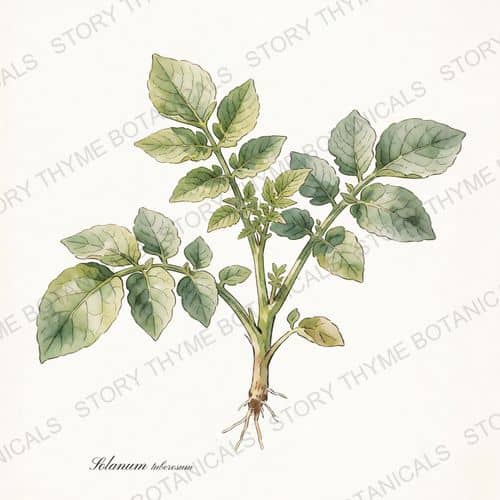
Botanical illustration of Potato
Annual · Solanum tuberosum

Plant 2-4 weeks before last frost. Cure storage crop 2 weeks dark at 60°F. Never store near apples (ethylene sprouts them).

AnnualFull SunModerate waterModerate growthExcellent edibleAttracts beesNone winter chill

☤ Juglone-sensitivePotato is sensitive to juglone — the toxin exuded by black walnut, butternut, and their relatives. Keep it 50+ ft from any walnut or hickory, or its leaves will yellow, wilt, and die back for no obvious reason.

Where to buy the plant — 2 nurseries

Potato Plant — a print from the Vegetables Vol. 2 - In the Garden collection

From the print shop

Growing potato? Hang it.

Our Vegetables Vol. 2 - In the Garden collection carries potatoSolanum tuberosum, print Nº 12, “Potato Plant.”

16 designsfrom $21.99white or black groundmatte poster, unframed

Shop Vegetables Vol. 2 - In the Garden botanical prints →

I

Overview

Will potato suit your garden, and what goes wrong.

Will it fruit where you are?

Enter your ZIP — we look up your USDA hardiness zone (2023 map) and check it against what potato actually needs.

Life cycleAnnual
Winter chillNone

Potato at a glance

Life cycleAnnual
Mature size2-3 ft
PollinationNone needed (grown from seed potatoes)
Chill requirementNone (not chill-dependent)
Bloom seasonEarly Summer
Harvest seasonJune (new), September (storage)
Growth rateModerate

Common potato problems

  • Colorado Potato Beetle
  • Flea Beetle
  • Wireworm
  • Scab
  • Early/Late Blight

II

Growing

Light, water, soil, propagation and the season’s jobs.

How to grow potato: light, water & soil

LightFull Sun
WaterEven moisture at tuber set (flowering). Stop watering when vines yellow
SoilLoose, Sandy Loam, never fresh manure · pH 5.0 - 6.0
FertilizerBalanced at planting. Avoid excess N (all vine no tuber).
PruningNone (annual) — Hill soil up stems twice — tubers in light turn green/toxic.
Spacing12 inches

How to plant & propagate potato

Maturity70-120 days
From seedPlant seed potatoes 2-4 wks before last frost
PropagateFrom seed

The potato growing playbook

Field-tested instructions for every job potato asks of you, compiled from university extension guidance — in the order the season brings them.

Sowing

Plant certified seed once the soil reaches 50F

Buy certified seed potatoes, never grocery-store tubers. Warm them at room temperature for about a week until the eyes just begin to sprout, then cut them into blocky pieces with at least one eye each, sterilizing the knife between tubers with 10 percent household bleach. Let the cut pieces heal and cork over for three days somewhere warm and moist, then plant them 3 to 4 inches deep, 12 inches apart, in rows 2 to 3 feet apart, once the soil is at least 50F. Do not use barnyard manure on ground going into potatoes. Cold wet soil stalls the seed piece before it can sprout, and that is exactly when blackleg bacteria and soft rot move in through the cut surface, so the corked-over skin and warm soil let the piece grow away from decay instead of feeding it. Certified seed is inspected for ring rot, which a cutting knife can carry from one infected tuber to the next twenty healthy ones. Manure is the wrong soil amendment here because the common scab organism passes through livestock digestive tracts unharmed and is spread in the manure itself.

Grocery-store potatoes are treated with a sprout inhibitor and will not grow. Household bleach is corrosive to metal, so wash and oil tools after sterilizing them.

Watering

Hold the water steady from flowering through bulking

From the time blossoms form, give the patch about an inch of water a week, delivered as one or two thorough soakings rather than a daily sprinkle. Keep the soil moist but never soggy, and do not let it swing between bone dry and flooded. Flowering is roughly when the tubers begin to bulk, and that is the window in which moisture stress deforms the crop: a dry spell followed by a surge of water restarts growth unevenly and produces knobby tubers and hollow heart. Soggy soil is its own failure, since saturated ground swells the lenticels the tuber breathes through and leaves it open to soft rot in storage.

Mulching

Hill soil over the tubers before they ever see daylight

Start mounding soil along the row once the stems are about a foot tall, and repeat once or twice more as the plants grow until six to eight inches of soil has been hilled around them in total. Any tuber shoulder that works its way to the surface later needs covering again. Tubers form on stolons just under the surface, and any that catch light turn green and build solanine, a bitter alkaloid that is poisonous in quantity. The same ridge of soil earns its keep twice more: it gives new stolons room to set tubers, and it puts depth between the leaves above and the tubers below, since rain carries late blight spores down through cracks in the soil to infect the crop.

Excessively green potatoes should not be eaten. Small green portions can be cut out before cooking.

Feeding

Side-dress nitrogen at hilling, then again two weeks later

About four weeks after planting, as you hill, side-dress roughly 0.15 pounds of actual nitrogen per 50 feet of row. Repeat the same side-dressing two weeks after that. Potatoes require more fertilizer than most vegetables, and the demand peaks while the plant is building the canopy that will later fill the tubers. Feeding at hilling puts the nitrogen in reach of roots exactly when the vines are expanding, rather than after the crop has already decided how much leaf it can afford.

What to watch for

Colorado potato beetle: hand-pick first, and mind the wait if you spray

Hand-pick the adults and crush the orange egg masses on the leaf undersides - on a garden-sized planting this genuinely works. If you spray, Bt tenebrionis and neem hit only small larvae (under 1/4 inch), so scout early; spinosad is the stronger option. Beetles and larvae can strip a plant to stems in days, and the population rebuilds from eggs laid on the undersides of leaves.

BEES: potato flowers when the beetles are worst, and spinosad and carbaryl are both toxic to bees - hand-pick rather than spray while it is in flower, or spray at dusk once the blossoms close. WAIT 7 DAYS after spinosad or carbaryl before digging - the label PHI applies even though you spray the leaves and eat the tubers. Bt and neem are 0 days, so they can be used right up to harvest. NOTE the number is crop-specific: spinosad is 7 days on potato but only 1 on onion. Many beetle populations are already resistant to carbaryl, so you may take the wait and still get poor control.

Spraying

Early blight: spray only if it reaches the lower leaves by flowering

As the plants come into flower, check the oldest and lowest leaves for dark target-like spots. If early blight is already showing before or at flowering, spray a chlorothalonil product to protect the healthy leaves above it. If the spotting only turns up on the vines as they mature late in the season, leave it alone. Alternaria solani starts on the oldest foliage and works upward, so an outbreak arriving before the tubers have bulked steals the very canopy that fills them. Early blight almost always shows on maturing vines late in the season, and that late infection does not reduce yield, so spraying then is expense and residue for nothing.

Do not apply chlorothalonil within 7 days of harvest. It is a protectant with no systemic movement, so it shields healthy tissue but cannot cure lesions that are already there. Copper fungicides give only fair control of early blight.

Late blight: shield the canopy through cool, wet spells

Once the rows close and the canopy starts holding moisture, watch the weather rather than the calendar. When temperatures sit near 65 to 70F with long dews or rain and humidity close to saturation, apply chlorothalonil before any symptoms appear and repeat every 5 to 7 days for as long as the wet weather lasts, covering both leaf surfaces. Pull and destroy any plant carrying greasy, water-soaked lesions. Phytophthora infestans needs a continuous film of water on the leaf to establish, and a closed canopy stays wet long after the open row has dried. Its spores blow in on the wind from tens of miles away, so the first infection is usually not one you could have prevented by sanitation alone. Chlorothalonil has no systemic movement, which is why it only works as a shield laid down before the spores land.

Do not apply chlorothalonil within 7 days of harvest. It is a protectant only and cannot cure established lesions, so remove infected plants rather than trying to spray them clean.

Harvesting

Kill the vines two weeks before you dig

For any potatoes you mean to store, kill or remove the vines by frost, pulling, or simply cutting them off at the soil line, and leave the tubers in the ground for two weeks before digging. Then dig a test hill and rub a tuber with your thumb: mature skin stays firmly attached, immature skin rubs away. Handle the crop gently and get it out of the light straight away. Those two weeks are when the skin hardens and sets, and set skin is what holds water in and storage diseases out. Cutting the vines also stops a blighted canopy from washing spores down soil cracks onto the tubers below. Do not stretch the wait much beyond two weeks, though, because a longer hardening period increases the black scurf that develops on the tubers.

Skin that rubs off easily means the crop is immature and will not store, so eat those potatoes fresh instead. Bruises and cuts made during digging are the entry sites storage rots use.

Cure warm for two weeks, then store cold and dark

Hold the harvested potatoes at about 65F for the first two weeks so cuts and bruises can heal, then move them to 35 to 40F in the dark for the rest of storage. If the storage space is not fully dark, keep them in paper bags, which block light while still letting air move. Sort the bin periodically and take out any tuber that has begun to decay. Clear the leftover potato debris out of the garden, and never let cull tubers overwinter there. The curing fortnight lets wounds cork over before soft rot and dry rot can use them as entry points, and the cold that follows slows sprouting and water loss. Darkness is not optional, since even low household light turns tubers pale green and builds solanine. Culls matter beyond the bin: late blight survives on discarded and volunteer tubers, and those piles are the source of next season's first infection.

Discard heavily greened tubers rather than eating them. One rotting potato left in the bin will spread the decay to its neighbours.

Potato companion plants

Underlined names have their own growing guide in this library.

III

The year

What potato asks for, month by month.

The potato year, month by month

MonthJanFebMarAprMayJunJulAugSepOctNovDec
Bloom
Harvest

What each band means

  • Bloomflowers open — pollinators working, frost on blossoms is the danger.
  • Harvestpicking time — check ripeness every few days.

The potato year as text

  • Jan quiet month
  • Feb quiet month
  • Mar quiet month
  • Apr quiet month
  • May quiet month
  • Jun bloom, harvest
  • Jul quiet month
  • Aug quiet month
  • Sep harvest
  • Oct quiet month
  • Nov quiet month
  • Dec quiet month

These are the species' typical months — expect them a few weeks earlier in warm zones and later in cold ones. Watch the plant, not just the calendar.

IV

Ecology & uses

What it does for the garden, and what it is grown for.

Potato in the garden system

  • Root layer annual
AttractsBees
MoistureFacultative / average
DeerBrowsed — protect young plants
OriginIntroduced

What potato is grown for

! Some parts toxic — see notesGreen tubers and foliage toxic

UseStorage
UseBaking
UseFrying
Edible value4/5

Harvesting & storing potato

June (new), September (storage). About 70-120 days from planting.

Edibility, identification, and traditional-use notes here are general reference — not medical or veterinary advice, and not a claim that any plant treats or prevents anything. Medicinal ratings record how strongly a plant features in herbal tradition, nothing more. Never eat or dose a plant you have not positively identified. More on how to use this library.

V

Cultivars

Named varieties of potato, ruled as a catalogue.

Best potato varieties & cultivars

11 on file

Named varieties of potato differ in days to maturity, disease resistance, flavor, and habit — pick one that fits your season and space.

Yukon Gold

DiseaseResistant to mild mosaic; susceptible to common scab and hollow heart

Yellow flesh, holds up baked, boiled or fried — Midseason: will not clear the bed as early as Norland. Scab-susceptible, so avoid fresh manure and high-pH soil; hollow-heart susceptible, so water evenly rather than boom-and-bust.

Where to buy ‘Yukon Gold

Story Thyme Farms may earn a small commission from these links, at no cost to you — it never changes what we recommend.
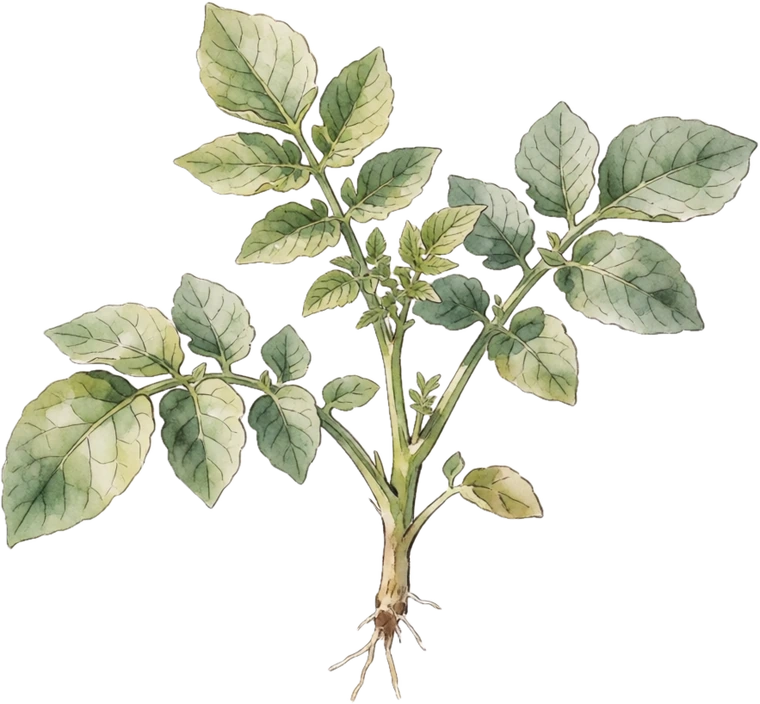
Kennebec

DiseaseR1 late blight resistance; highly susceptible to Verticillium wilt

Excellent boiled, baked, chipped or fried — Late: plant in the first round and leave it in. Do not lift on an early schedule and do not choose it for a short season. Verticillium susceptibility means rotating out of potato/tomato/eggplant ground for several years.

Where to buy ‘Kennebec

Story Thyme Farms may earn a small commission from these links, at no cost to you — it never changes what we recommend.

Norland

DiseaseModerately resistant to scab and Rhizoctonia; highly susceptible to silver scurf

Very good boiled or fried; best at harvest — Early: the new-potato pick. Clears the bed in time for a succession crop. Silver scurf susceptibility makes it a poor keeper - eat it fresh rather than binning it for winter. Red Norland and Dark Red Norland are line selections and share this timing.

Where to buy ‘Norland

Story Thyme Farms may earn a small commission from these links, at no cost to you — it never changes what we recommend.

Russet Burbank

DiseaseModerately resistant to scab; susceptible to Verticillium wilt and late blight

Excellent baked or fried — Indeterminate, and it changes everything: the vines keep growing after flowering, so flowering is NOT a harvest cue. Needs a genuinely long season and steady late water and nitrogen. The one case where continued hilling has something to work with.

Where to buy ‘Russet Burbank

Story Thyme Farms may earn a small commission from these links, at no cost to you — it never changes what we recommend.

Superior

DiseaseModerately resistant to scab; highly susceptible to Verticillium wilt

Excellent fresh chipper — Early-to-mid: a safe pick for a short season with more bulk than a pure early. More forgiving of imperfect soil than Yukon Gold. Cure cut seed before planting - it is prone to seed-piece decay in cold wet ground.

Where to buy ‘Superior

Story Thyme Farms may earn a small commission from these links, at no cost to you — it never changes what we recommend.

Red Pontiac

DiseaseModerately drought tolerant; susceptible to air cracking and scab

Good boiled, baked or chipped — Mid-to-late - do not treat it as an early red. Susceptible to air cracking, so consistent moisture is the whole game: wet/dry swings during bulking split the tubers. Moderately drought tolerant, hence its Southern popularity.

Where to buy ‘Red Pontiac

Story Thyme Farms may earn a small commission from these links, at no cost to you — it never changes what we recommend.

All Blue

DiseaseModerately resistant to late blight, hollow heart and several viruses

Specialty tablestock, blue flesh — Late-season heirloom: plant early and give it the full season - it is not a quick novelty despite being sold as one. Tall and vigorous, so it wants spacing and can lodge. Unusually clean on disease, which suits low-spray beds.

Where to buy ‘All Blue

Story Thyme Farms may earn a small commission from these links, at no cost to you — it never changes what we recommend.

German Butterball

DiseaseResistant to scab; susceptible to Rhizoctonia, blights and wilts

Buttery, all purpose; holds together when cooked — The source gives a RANGE, 95-135 days, so no single figure is recorded here. Longest season in this set: it must go in with the first planting and is a poor fit for short seasons. Do not follow tomatoes or potatoes with it.

Where to buy ‘German Butterball

Story Thyme Farms may earn a small commission from these links, at no cost to you — it never changes what we recommend.
Purple Majesty

Dark purple skin and flesh — Early per its breeder, which contradicts the retail listings that call it midseason at 85-95 days. Trust the breeder: it lifts early and suits a short season. Parentage is ND2008-2 x All Blue but, unlike late All Blue, it does not need the full season. Under Plant Variety Protection - saving seed to resell is restricted.

Where to buy ‘Purple Majesty

Story Thyme Farms may earn a small commission from these links, at no cost to you — it never changes what we recommend.

GoldRush · Gold Rush; ND1538-1RUSS

RipensmidseasonDiseaseGood resistance to common scab; highly resistant to hollow heart; moderately resistant to Verticillium wilt, silver scurf and blackspot; susceptible to early blight, late blight, soft rot, Fusarium dry rot and most common viruses including PVYSizeOblong to long, dark brown russet skin with very shallow, well-distributed eyes

Very white flesh; adequate baked, mashed, microwaved or boiled — The scab pick: NDSU names GoldRush and Russet Norkotah as the resistant varieties to plant where common scab has already spoiled a crop, and scab lives in the soil, so variety choice is the lever once the ground is infested. Highly resistant to hollow heart too, which forgives uneven watering. Medium maturity and a good keeper. Its weakness is everything fungal - susceptible to both blights and to Fusarium dry rot, so handle it gently at harvest and cure it properly before binning it.

Where to buy ‘GoldRush

Story Thyme Farms may earn a small commission from these links, at no cost to you — it never changes what we recommend.

Russet Norkotah

Ripensearly to midseasonDiseaseResistant to hollow heart and Columbia root-knot nematode; moderately resistant to common scab, silver scurf, potato leafroll virus and PVY; susceptible to late blight, early blight, Verticillium wilt, potato wart and most virusesSizeLong to slightly oblong, smooth dark tan russet skin with numerous shallow golden eyes

White flesh; good baked, poor to moderate boiled with some after-cooking darkening, poor for chipping — The other scab-resistant russet NDSU names, and unlike GoldRush it is early to mid-season, so it suits a short season where Russet Burbank never finishes. Also resistant to hollow heart and to Columbia root-knot nematode. Do not choose it for a wet unsprayed bed or for ground recently in tomato: it is susceptible to both blights and to Verticillium wilt. It can carry PVY without showing any symptom, which is exactly how saved seed degrades unnoticed - buy certified seed rather than replanting your own.

Where to buy ‘Russet Norkotah

Story Thyme Farms may earn a small commission from these links, at no cost to you — it never changes what we recommend.

VI

Sources & plant ID

Where the care distinctions come from, and how the plant is filed.

Research basis

Sources behind this profile

No extension citations are attached to potatoyet. The care figures below come from the library's own catalogue rather than a traced primary source.

Plant ID

BinomialSolanum tuberosum
FamilySolanaceae
TypeAnnual
USDA symbolSOTU
OriginIntroduced
Invasive riskLow

VII

Where to buy

Third-party nurseries — not Story Thyme Farms.

Third-party nurseries, not Story Thyme Farms. Prices are theirs.

Story Thyme Farms may earn a small commission from these links, at no cost to you — it never changes what we recommend.

VIII

Questions

Potato questions, answered straight.

Is potato safe for kids and pets?

With care. Green tubers and foliage toxic Site it accordingly if children or pets roam the garden. This is general reference, not medical or veterinary advice — call a vet or poison control if something has actually been eaten.

When do you harvest potato?

June (new), September (storage). From planting, expect about 70-120 days to maturity.

What grows well with potato?

Proven companions include beans, corn, cabbage — the full companion list, and what to keep away, is in the Growing tab above.

How do you propagate potato?

From seed.

IX

Elsewhere

Where potato sits in the library.

Where potato sits in the library

Grows in the same world