The illustrated growing guide

Collard Greens

Brassica oleracea var. viridis

Family Brassicaceae

Est. zones 2-11

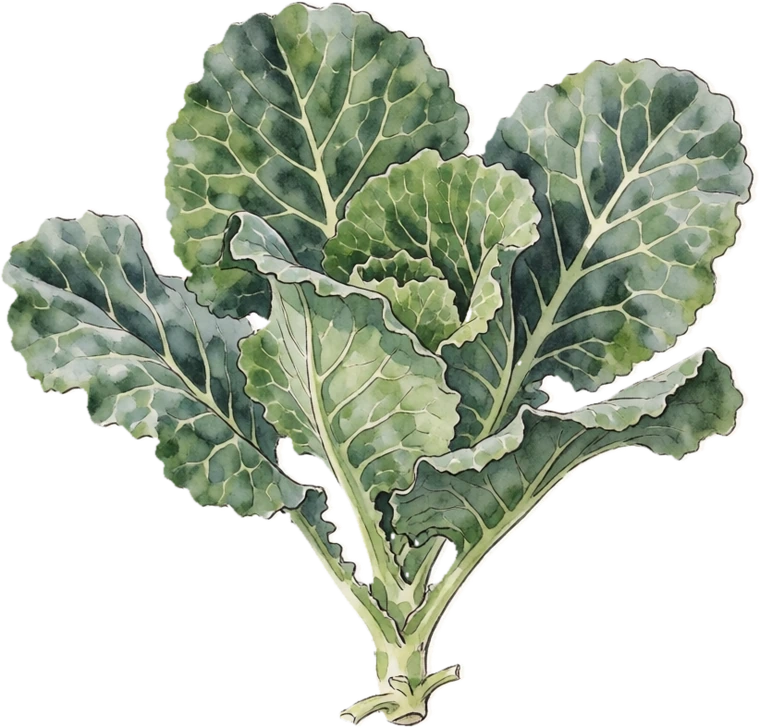
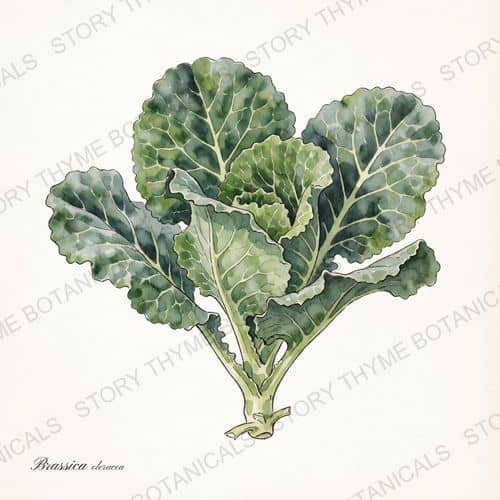
Botanical illustration of Collard Greens
Annual · Brassica oleracea var. viridis

Tougher than kale in both heat AND cold — the last green standing in January. A mess of frost-kissed collards with the New Year's black-eyed peas is non-negotiable in half the country.

AnnualFull SunModerate waterModerate growthExcellent edibleAttracts beesAttracts butterflies

Where to buy the plant — 1 nursery

Kale — a print from the Vegetables Vol. 1 collection

From the print shop

The closest print we make

Our Vegetables Vol. 1 collection carries Brassica oleracea — the same species as collard greens — but the print shows “Kale,” a different cultivar of it, not collard greens itself.

16 designsfrom $21.99white or black groundmatte poster, unframed

Shop Vegetables Vol. 1 botanical prints →

I

Overview

Will collard greens suit your garden, and what goes wrong.

Will it fruit where you are?

Enter your ZIP — we look up your USDA hardiness zone (2023 map) and check it against what collard greens actually needs.

Life cycleBiennial, grown as an annual

Collard Greens at a glance

Life cycleBiennial, grown as an annual
Mature size2-3 ft
PollinationN/A
Chill requirementNot yet established
Bloom seasonN/A
Harvest seasonJune - February — the whole cold half of the year; frost = sweetness
Growth rateModerate

Common collard greens problems

II

Growing

Light, water, soil, propagation and the season’s jobs.

How to grow collard greens: light, water & soil

LightFull Sun
WaterModerate
SoilRich, limed · pH 6.5 - 7.5
FertilizerNitrogen at planting and monthly
PruningNone — Harvest bottom leaves up the stalk ('cropping'); the palm-tree look means you're doing it right.
Spacing18-24 in

How to plant & propagate collard greens

Maturity60-75 days
From seedDirect-sow spring or midsummer; very heat/cold tolerant
PropagateFrom seed

When to spray collard greens

Growing season. Bt program; harlequin bugs hand-picked in fall.

The collard greens growing playbook

Field-tested instructions for every job collard greens asks of you, compiled from university extension guidance — in the order the season brings them.

Sowing

Direct sow as soon as the soil is workable

Sow seed a quarter to a half inch deep in rows 18 to 30 inches apart as soon as the soil can be worked in spring. Once the seedlings are up, thin them to stand 8 to 12 inches apart, or as close as 4 inches if you only want baby leaves. Collards are a cool-season brassica that builds its best leaves in cool weather, so a spring sowing needs the whole cool window ahead of it before summer heat turns the leaves tough and bitter.

Sow the fall crop about three months before your first frost

Count back roughly three months from your average first fall frost and direct sow then, or start transplants indoors in midsummer to set out in late summer. Do not wait for cool weather to arrive - the plants need to reach size while it is still warm. The fall crop is the better crop: the plants size up in late summer and then sweeten as the weather cools, and they keep producing well beyond the first frosts rather than bolting the way a spring crop does when heat arrives.

Planting out

Use transplants for the spring crop, started 6 to 8 weeks ahead

Start seed indoors 6 to 8 weeks before you intend to set plants out, and transplant into rows 18 to 36 inches apart with plants 6 to 18 inches apart in the row - the wider spacing if you want full-sized plants, the tighter if you will cut them half-grown. Transplants are the preferred planting material for a spring crop because seed germinates slowly in cool spring soil, and a head start is what lets the crop finish before heat forces it to bolt.

Watering

Give an inch of water a week and never let growth stall

Aim for about one inch of rainfall or irrigation per week. Check with a trowel rather than by eye, and water more often on sandy soils, which dry from the top down faster than the leaves show. Leaf quality comes from fast, unchecked growth - a plant stalled by heat or drought stress makes tough, strong-flavored leaves, and no amount of later watering makes them tender again.

Feeding

Side-dress nitrogen three to four weeks after planting, then again

Three to four weeks after planting, side-dress with calcium nitrate (15.5-0-0) at about 5 pounds per 1,000 square feet, placing it 4 to 6 inches away from the plants, and repeat once more. Do the same for a fall planting. Keep soil pH between 6.0 and 6.5. Collards are grown for leaves alone, so nitrogen is the yield - it drives the deep green color and the tender growth, and a plant that runs short of it makes small, pale, leathery leaves.

Keep side-dressed fertilizer 4 to 6 inches off the plants - banding it against the stems burns the roots.

What to watch for

Scout leaf undersides weekly for caterpillars before you spray

Once a week, check the undersides of leaves on at least 25 plants chosen at random, looking for larvae, frass and feeding holes, and note which species you have. Collards are a leafy green, so treat when 10 percent of plants are infested; cross-striped cabbageworm warrants treatment at 5 percent because it feeds in groups. Better still, lay fine-mesh row cover immediately after planting and bury the edges - but skip row cover on unrotated ground, where the pests overwinter underneath it. Imported cabbageworm, cabbage looper and diamondback moth all feed on the undersides of leaves where you will not see them from above, and on a leaf crop the damage is the harvest - a threshold catches them while the larvae are still small enough for Bt to kill.

Black rot: pull infected plants and stay out of wet foliage

Watch for yellow V-shaped lesions running in from the leaf margins with blackened veins, especially in warm wet spells around 80 to 86 F. Remove infected plants immediately, avoid overhead irrigation, do not handle or harvest plants while the leaves are wet, and rotate to a non-host for at least three years. Start with certified disease-free seed. Black rot is a seed-borne bacterium that enters through the hydathodes at the leaf margins and then plugs the water-conducting vessels, and splashing water or wet hands move it plant to plant faster than the symptoms appear.

Spraying

Caterpillars: spray Bt while the larvae are still small

When scouting hits the threshold, spray Bacillus thuringiensis, covering the undersides of the leaves thoroughly. Use the aizawai strain rather than kurstaki where diamondback moth is the problem, as it holds up better against resistant populations. Spinosad is the stronger alternative if Bt is not holding. Only treat active larvae - pupae and adults do no further damage. Bt has to be eaten to work and it kills young caterpillars far more reliably than large ones, so the spray is only worth making while the larvae are small and still feeding on the leaf surface you can reach.

Bt carries a 0-day harvest interval and spinosad a 1-day interval on cole crops - check your own label. Spinosad is toxic to bees until the spray dries, so never spray a plant that has bolted into flower, and rotate materials to slow resistance in diamondback moth.

Harvesting

Pick outer leaves from the bottom up and let frost sweeten them

Start harvesting around 60 to 80 days when the outer leaves reach 8 to 10 inches, taking no more than a third of the lower leaves at a time and working from the bottom up so the growing point keeps producing. Alternatively cut whole plants half-grown or full-grown. Keep picking through the first frosts and freezes. Cold converts the plant's stored starches to sugars, so the leaves taken after a frost are genuinely sweeter than the same leaves in September - and stripping only the bottom third leaves the crown enough leaf area to rebuild the next picking.

III

The year

What collard greens asks for, month by month.

The collard greens year, month by month

MonthJanFebMarAprMayJunJulAugSepOctNovDec
Harvest

What each band means

  • Harvestpicking time — check ripeness every few days.

The collard greens year as text

  • Jan harvest
  • Feb harvest
  • Mar quiet month
  • Apr quiet month
  • May quiet month
  • Jun harvest
  • Jul harvest
  • Aug harvest
  • Sep harvest
  • Oct harvest
  • Nov harvest
  • Dec harvest

These are the species' typical months — expect them a few weeks earlier in warm zones and later in cold ones. Watch the plant, not just the calendar.

IV

Ecology & uses

What it does for the garden, and what it is grown for.

Collard Greens in the garden system

  • Herbaceous layer annual
AttractsBees, Butterflies
MoistureFacultative / average
DeerBrowsed — protect young plants
OriginIntroduced

What collard greens is grown for

✓ Commonly eaten

UseBraised greens
UseSouthern tradition
UseWinter harvest
Edible value4/5

Harvesting & storing collard greens

June - February — the whole cold half of the year; frost = sweetness. About 60-75 days from planting.

Edibility, identification, and traditional-use notes here are general reference — not medical or veterinary advice, and not a claim that any plant treats or prevents anything. Medicinal ratings record how strongly a plant features in herbal tradition, nothing more. Never eat or dose a plant you have not positively identified. More on how to use this library.

V

Cultivars

Named varieties of collard greens, ruled as a catalogue.

Best collard greens varieties & cultivars

9 on file

Named varieties of collard greens differ in winter-chill needs, ripening time, hardiness, and whether they set fruit on their own — pick one that fits your climate.

Georgia Southern · Creole; Georgia

Zones2-11

Excellent flavor; tender large leaves — Open-pollinated heirloom listed by Clemson and named by NC State as a variety that performed consistently well in North Carolina trials.

Where to buy ‘Georgia Southernverified

Story Thyme Farms may earn a small commission from these links, at no cost to you — it never changes what we recommend.

Vates

Zones2-11SizeCompact, about 2 feet tall

Blue-green, slightly crumpled leaves on a compact plant. Heirloom listed by Clemson and among the varieties NC State reports as consistently good in North Carolina trials.

Where to buy ‘Vates

Story Thyme Farms may earn a small commission from these links, at no cost to you — it never changes what we recommend.

Champion

Zones2-11DiseaseImproved disease resistance per UF/IFAS; specific pathogens not stated

A Vates-type selection. Clemson lists it among bolt-resistant, productive and hardy cultivars; UF/IFAS credits it with improved cold tolerance and disease resistance.

Where to buy ‘Champion

Story Thyme Farms may earn a small commission from these links, at no cost to you — it never changes what we recommend.

Morris Heading · Carolina Cabbage; Carolina Improved Heading

Zones2-11

Cabbage-like flavor — Heirloom heading-type collard with dark green leaves and a cabbage-like flavor. Listed by Clemson as a recommended heirloom, described by the NC State Plant Toolbox as an heirloom with dark green leaves and cabbage-like flavor also known as Carolina Cabbage, and reported by NC State among the varieties that have consistently done well in North Carolina trials under the name Carolina Improved Heading.

Where to buy ‘Morris Heading

Story Thyme Farms may earn a small commission from these links, at no cost to you — it never changes what we recommend.

Top Bunch · Top Bunch 2.0

Zones2-11

Hybrid with medium-green, slightly savoyed leaves. NC State describes it as early-maturing; UF/IFAS notes it replenishes quickly after harvest. Clemson lists Top Bunch 2.0 among recommended hybrids.

Where to buy ‘Top Bunchverified

Story Thyme Farms may earn a small commission from these links, at no cost to you — it never changes what we recommend.

Blue Max

Zones2-11SizeCompact

Hybrid with blue-green foliage on a compact plant. Listed by Clemson as a recommended hybrid and named by NC State among varieties that performed consistently well in North Carolina trials.

Where to buy ‘Blue Max

Story Thyme Farms may earn a small commission from these links, at no cost to you — it never changes what we recommend.

Alabama Blue

Zones2-11

Heirloom with bluish leaves and purple streaking, listed by UF/IFAS partly for its ornamental appeal in an edible bed.

Where to buy ‘Alabama Blue

Story Thyme Farms may earn a small commission from these links, at no cost to you — it never changes what we recommend.

Flash · Flash F1

Zones2-11

Vates-type F1 hybrid listed by Clemson among its recommended collard hybrids for South Carolina. Widely sold claims of very slow bolting come from seed catalogs rather than extension trials, so they are not recorded here.

Where to buy ‘Flash

Story Thyme Farms may earn a small commission from these links, at no cost to you — it never changes what we recommend.

Heavi Crop

Zones2-11

Named by NC State Extension as one of the collard varieties that performed consistently well in North Carolina variety trials.

Where to buy ‘Heavi Crop

Story Thyme Farms may earn a small commission from these links, at no cost to you — it never changes what we recommend.

VI

Sources & plant ID

Where the care distinctions come from, and how the plant is filed.

Research basis

Sources behind this profile

No extension citations are attached to collard greensyet. The care figures below come from the library's own catalogue rather than a traced primary source.

Plant ID

BinomialBrassica oleracea var. viridis
FamilyBrassicaceae
TypeAnnual · Biennial
USDA symbolBROL
OriginIntroduced
Invasive riskLow

VII

Where to buy

Third-party nurseries — not Story Thyme Farms.

Third-party nurseries, not Story Thyme Farms. Prices are theirs.

Story Thyme Farms may earn a small commission from these links, at no cost to you — it never changes what we recommend.

VIII

Questions

Collard Greens questions, answered straight.

Is collard greens safe for kids and pets?

Collard Greens is commonly eaten and isn't considered toxic, but "commonly eaten" isn't a guarantee for any particular person or animal — allergies, quantity, and which part you eat all matter. Never eat a plant you haven't positively identified, and check with a vet before letting pets or livestock graze anything new.

When do you harvest collard greens?

June - February — the whole cold half of the year; frost = sweetness. From planting, expect about 60-75 days to maturity.

How do you propagate collard greens?

From seed.

IX

Elsewhere

Where collard greens sits in the library.

Where collard greens sits in the library

Grows in the same world