The illustrated growing guide

Kohlrabi

Brassica oleracea var. gongylodes

Family Brassicaceae

Est. zones 2-11

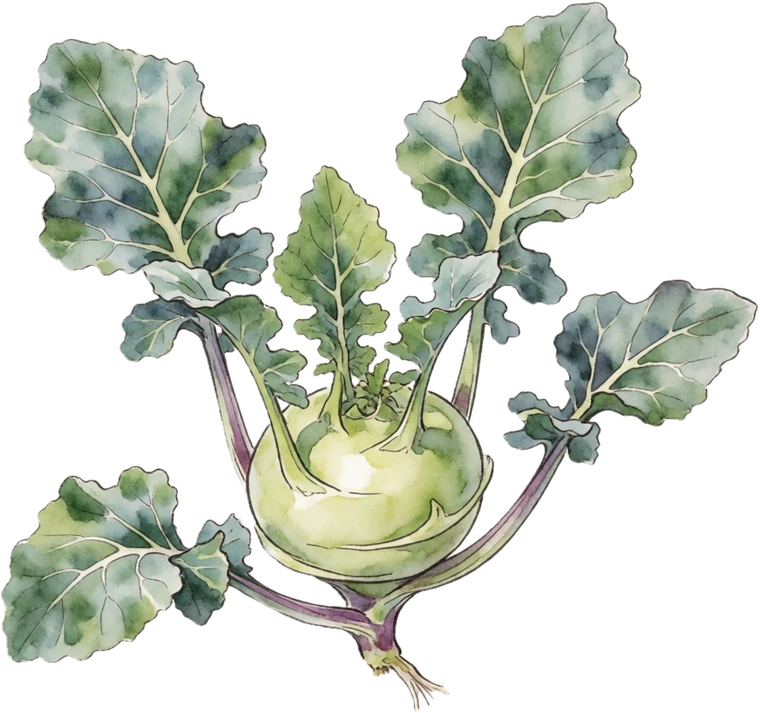
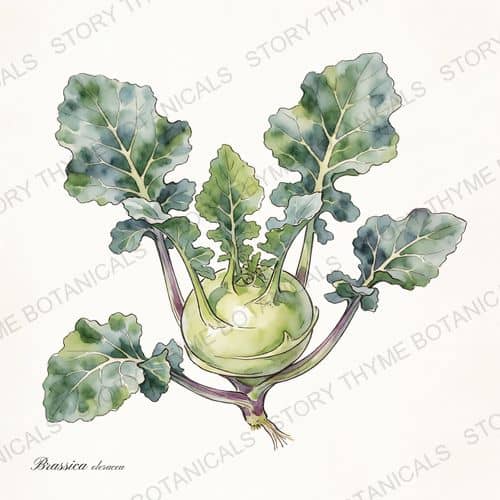
Botanical illustration of Kohlrabi
Annual · Brassica oleracea var. gongylodes

The alien sputnik that tastes like sweet crisp broccoli-stem apple. Peel and eat raw with salt — most never even cook it. Oversized ones go wooden, except 'Kossak'.

AnnualFull SunModerate waterFast growthExcellent edible

Where to buy the plant — 2 nurseries

Kale — a print from the Vegetables Vol. 1 collection

From the print shop

The closest print we make

Our Vegetables Vol. 1 collection carries Brassica oleracea — the same species as kohlrabi — but the print shows “Kale,” a different cultivar of it, not kohlrabi itself.

16 designsfrom $21.99white or black groundmatte poster, unframed

Shop Vegetables Vol. 1 botanical prints →

I

Overview

Will kohlrabi suit your garden, and what goes wrong.

Will it fruit where you are?

Enter your ZIP — we look up your USDA hardiness zone (2023 map) and check it against what kohlrabi actually needs.

Life cycleBiennial, grown as an annual

Kohlrabi at a glance

Life cycleBiennial, grown as an annual
Mature size12-18 in
PollinationN/A
Chill requirementNot yet established
Bloom seasonN/A
Harvest seasonJune; fall crop October - November — harvest at TENNIS BALL size, no bigger
Growth rateFast (45-60 days)

Common kohlrabi problems

II

Growing

Light, water, soil, propagation and the season’s jobs.

How to grow kohlrabi: light, water & soil

LightFull Sun
WaterSteady — the sputnik swells fast with even water
SoilRich, limed · pH 6.5 - 7.5
FertilizerCompost at planting suffices for a 6-week crop
PruningNone — None.
Spacing6-8 in

How to plant & propagate kohlrabi

Maturity45-60 days
From seedDirect-sow or start; harvest at tennis-ball size
PropagateFrom seed

When to spray kohlrabi

Growing season. Standard brassica program: cover or Bt.

The kohlrabi growing playbook

Field-tested instructions for every job kohlrabi asks of you, compiled from university extension guidance — in the order the season brings them.

Sowing

Direct sow the spring crop 1-2 weeks before your last frost

Sow seed a quarter to a half inch deep, about an inch apart, in rows 12 to 24 inches apart, starting one to two weeks before your average last frost date. Sow a short row every 2 to 3 weeks for a run of harvests rather than one glut. Do not plant where cabbage, broccoli, kale, or other brassicas have grown in the last four years. Kohlrabi sizes up best between 65F and 75F and turns tough and woody once sustained heat arrives, so the crop has to do its growing in the cool window on the front end of the season. The rotation matters because clubroot, black rot, and blackleg all survive in soil and debris from previous brassica crops.

Sow the fall crop about 50 days before you want to harvest

Direct sow a fall planting so it matures roughly 50 days later, counting back from your first hard freeze date and using your variety's days to maturity. In most of the country that lands in mid to late summer. Pick a variety noted for holding in the field rather than the fastest one. The fall crop finishes as the weather cools, and cool nights are when kohlrabi is at its sweetest and most tender. It also sidesteps the summer heat that makes spring plantings turn woody, and light frost does not hurt it.

Planting out

Set out transplants once they have 4-6 true leaves

Start seed indoors 5 to 6 weeks ahead at cool room temperature, 60F to 70F, and set plants out one to two weeks before your last frost date once they carry 4 to 6 mature leaves and a well developed root system. Space them 4 to 6 inches apart in the row and plant at the same depth they grew in the pot. Transplants started too warm or held too long in the cell get checked, and a checked brassica seedling that then meets a cold snap is the classic recipe for bolting straight to flower instead of swelling a stem.

Mulching

Mulch and keep water steady once it turns hot

Once temperatures climb above 80F, put down 3 to 4 inches of weed free straw or herbicide free grass clippings around the plants, and give the bed 1 to 2 inches of water a week counting rainfall. Drip irrigation is better than overhead. Check moisture with a trowel rather than guessing, and water more often on sandy soil. Heat and dry spells are what turn the stem tough, woody, and bitter. Mulch cools the soil and evens out the moisture swings, and uninterrupted growth is the only thing that keeps the texture crisp.

Use only grass clippings from lawns that have not been treated with herbicide. Broadleaf weed killers carry over in clippings and will damage the crop.

Feeding

Side-dress with nitrogen about 3 weeks after thinning

Roughly 3 weeks after thinning or transplanting, when plants are around 4 inches tall, band a half cup of a nitrogen fertilizer such as 21-0-0 per 10 feet of row. Place it about 6 inches to the side of the plants, not against the stems, and water it into the soil. Kohlrabi has a short season and only gets one shot at bulking up. A steady nitrogen supply during that stretch is what keeps the stem swelling fast, and fast growth is exactly what makes it sweet and tender rather than fibrous.

Keep dry fertilizer off the leaves and stems. Banding it against the plant burns roots and foliage.

Thinning

Thin seedlings to 4-6 inches at the 3-4 leaf stage

When direct sown seedlings have 3 to 4 true leaves, thin them to stand 4 to 6 inches apart, or a full 12 inches apart for the giant storage varieties. The seedlings you pull can be transplanted elsewhere rather than composted. Thin fall sowings the same way. The edible part is a swollen stem, not a root, and it simply cannot expand to size against its neighbors. Crowded plants produce small fibrous bulbs no matter how well you feed and water them.

What to watch for

Check both leaf surfaces weekly for caterpillars

Starting right after planting, look over both sides of the leaves at least once a week, and more often as the season warms. You are looking for imported cabbageworm, cabbage looper, and diamondback moth larvae plus the ragged holes and dark frass they leave behind. Also watch for the tiny shot holes of flea beetles on young seedlings. All three caterpillars are far easier to kill while small, and finding them early is the whole game. Flea beetles matter most at the seedling stage, when a plant has few enough leaves that the feeding actually sets growth back.

Spraying

Treat cabbageworms with Bt while the larvae are still small

Once scouting turns up small caterpillars, spray Bacillus thuringiensis subspecies kurstaki, covering both sides of the leaves since the larvae have to eat the material for it to work. Spinosad is a second low risk option. Repeat as the label directs while new larvae keep appearing. Bt is a bacterium that only poisons the gut of caterpillars that swallow it, and it works dramatically better on early instar larvae than on big ones. Waiting until the caterpillars are large means both a failed spray and a chewed crop.

Bt and spinosad are caterpillar and chewing insect specific and spare bees and natural enemies, unlike broad spectrum choices such as permethrin or lambda-cyhalothrin. Follow your product label's days to harvest interval before picking. Kohlrabi is harvested long before it flowers, but if plants bolt and open flowers, stop spraying anything that is not Bt while bees are working them.

Protection

Float a row cover over the bed at seeding or transplanting

Lay lightweight garden fabric over the row the day you seed or transplant and bury or anchor the edges all the way around, so it is in place before cabbage maggot flies begin flying. Leave it on through the first weeks of growth to keep cabbage maggot flies and cabbageworm moths from ever reaching the plants. Cabbage maggot flies lay their eggs at the base of the stem and in nearby cracks in the soil right as brassicas go into the garden, and the larvae then feed on the roots and root hairs below ground. There are no rescue treatments once maggots are already feeding, so excluding the adult is the only reliable control, and the same fabric stops the moths that would otherwise start the caterpillar problem.

Do not use a row cover on ground where brassicas, onions, or other root crops grew last year. Maggots overwinter as pupae in that soil, and the cover will trap the emerging adults underneath with your plants instead of keeping them out.

Harvesting

Cut at 2-3 inches across, no bigger

Harvest standard varieties when the swollen stem is 2 to 3 inches in diameter, about the size of a tennis ball, roughly 40 to 60 days from sowing depending on variety. Cut the stem just below the bulb. Check the planting every few days once it approaches size, and trim the leaves off before storing. Past about 3 inches the stem goes tough, woody, and bitter, and there is no getting the texture back. Size is the signal, not the calendar, and it arrives fast in warm weather. The giant storage varieties are the exception and hold their quality to 8 inches or more.

III

The year

What kohlrabi asks for, month by month.

The kohlrabi year, month by month

MonthJanFebMarAprMayJunJulAugSepOctNovDec
Harvest

What each band means

  • Harvestpicking time — check ripeness every few days.

The kohlrabi year as text

  • Jan quiet month
  • Feb quiet month
  • Mar quiet month
  • Apr quiet month
  • May quiet month
  • Jun harvest
  • Jul quiet month
  • Aug quiet month
  • Sep harvest
  • Oct harvest
  • Nov harvest
  • Dec quiet month

These are the species' typical months — expect them a few weeks earlier in warm zones and later in cold ones. Watch the plant, not just the calendar.

IV

Ecology & uses

What it does for the garden, and what it is grown for.

Kohlrabi in the garden system

  • Herbaceous layer annual
MoistureFacultative / average
DeerBrowsed — protect young plants
OriginIntroduced

What kohlrabi is grown for

✓ Commonly eaten

UseRaw slaw
UseSnacking
UseFall storage
Edible value4/5

Harvesting & storing kohlrabi

June; fall crop October - November — harvest at TENNIS BALL size, no bigger. About 45-60 days from planting.

Edibility, identification, and traditional-use notes here are general reference — not medical or veterinary advice, and not a claim that any plant treats or prevents anything. Medicinal ratings record how strongly a plant features in herbal tradition, nothing more. Never eat or dose a plant you have not positively identified. More on how to use this library.

V

Cultivars

Named varieties of kohlrabi, ruled as a catalogue.

Best kohlrabi varieties & cultivars

8 on file

Named varieties of kohlrabi differ in winter-chill needs, ripening time, hardiness, and whether they set fruit on their own — pick one that fits your climate.

Quickstar · Quickstar F1

Zones2-11Size2-3 inch bulb

Sweet and mild when grown fast — Pale green bulb. Extremely uniform in maturity, so a sowing tends to come off all at once. Johnny's lists it at about 37 days from direct seeding.

Where to buy ‘Quickstar

Story Thyme Farms may earn a small commission from these links, at no cost to you — it never changes what we recommend.

Kolibri · Kolibri F1

Zones2-11Size3 inch bulb; harvest at 2-3 inches

Crisp, nearly fiberless white flesh — Deep purple skin over white flesh, with purple veined leaves. The most uniform of the purple types. Recommended by Iowa State Extension.

Where to buy ‘Kolibri

Story Thyme Farms may earn a small commission from these links, at no cost to you — it never changes what we recommend.

Grand Duke · Grand Duke F1

Zones2-11Size2-3 inch bulb

An All-America Selections winner and a long standing standard hybrid green kohlrabi.

Where to buy ‘Grand Duke

Story Thyme Farms may earn a small commission from these links, at no cost to you — it never changes what we recommend.

Winner · Winner F1

Zones2-11SizeSmooth light green bulbs to about 18 oz

Fresh, fruity taste — Vigorous upright plants. Named as a recommended cultivar by Iowa State Extension.

Where to buy ‘Winner

Story Thyme Farms may earn a small commission from these links, at no cost to you — it never changes what we recommend.

Early White Vienna · White Vienna

Zones2-11Size2-3 inch bulb

Open pollinated heirloom with pale green skin and white flesh, so you can save seed from it. The old garden standard.

Where to buy ‘Early White Vienna

Story Thyme Farms may earn a small commission from these links, at no cost to you — it never changes what we recommend.

Early Purple Vienna · Purple Vienna

Zones2-11Size2-3 inch bulb

Open pollinated heirloom with purple skin over white flesh. Named as a recommended early variety by Iowa State Extension.

Where to buy ‘Early Purple Viennaverified

Story Thyme Farms may earn a small commission from these links, at no cost to you — it never changes what we recommend.

Kossak · Kossak F1

Zones2-11DiseaseIntermediate resistance to downy mildewSize8-10 inch bulb

Sweet and juicy, dense white flesh — White skinned giant storage type that keeps for several months in cold storage. Thin these to 12 inches apart rather than the usual 4 to 6.

Where to buy ‘Kossak

Story Thyme Farms may earn a small commission from these links, at no cost to you — it never changes what we recommend.

Superschmelz · Gigante

Zones2-11Size8-10 inch bulb

Tender, sweet flesh free of woodiness — Open pollinated giant with globe shaped white bulbs, described as highly resistant to bolting. Best grown as a fall crop. Thin to 12 inches apart.

Where to buy ‘Superschmelz

Story Thyme Farms may earn a small commission from these links, at no cost to you — it never changes what we recommend.

VI

Sources & plant ID

Where the care distinctions come from, and how the plant is filed.

Research basis

Sources behind this profile

No extension citations are attached to kohlrabiyet. The care figures below come from the library's own catalogue rather than a traced primary source.

Plant ID

BinomialBrassica oleracea var. gongylodes
FamilyBrassicaceae
TypeAnnual · Biennial
USDA symbolBROL
OriginIntroduced
Invasive riskLow

VII

Where to buy

Third-party nurseries — not Story Thyme Farms.

Third-party nurseries, not Story Thyme Farms. Prices are theirs.

Story Thyme Farms may earn a small commission from these links, at no cost to you — it never changes what we recommend.

VIII

Questions

Kohlrabi questions, answered straight.

Is kohlrabi safe for kids and pets?

Kohlrabi is commonly eaten and isn't considered toxic, but "commonly eaten" isn't a guarantee for any particular person or animal — allergies, quantity, and which part you eat all matter. Never eat a plant you haven't positively identified, and check with a vet before letting pets or livestock graze anything new.

When do you harvest kohlrabi?

June; fall crop October - November — harvest at TENNIS BALL size, no bigger. From planting, expect about 45-60 days to maturity.

How do you propagate kohlrabi?

From seed.

IX

Elsewhere

Where kohlrabi sits in the library.

Where kohlrabi sits in the library

Grows in the same world