The illustrated growing guide

Napa Cabbage (Chinese Cabbage)

Brassica rapa subsp. pekinensis

Family Brassicaceae

Grown as an annual

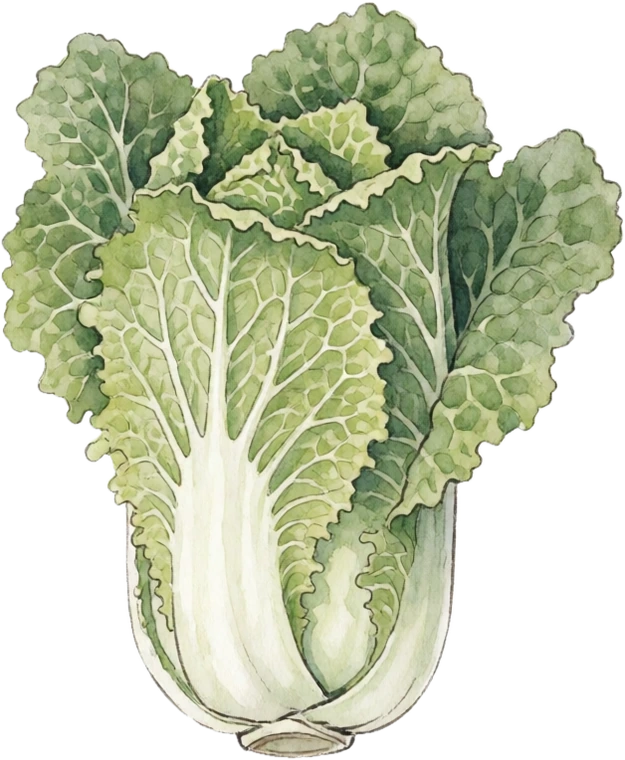
Botanical illustration of Napa Cabbage (Chinese Cabbage)
Annual · Brassica rapa subsp. pekinensis

The crisp, mild, frilly-leaved cabbage at the heart of kimchi, napa slaw, and countless stir-fries — sweeter and more tender than round cabbage. It's a fall crop through and through: spring sowings bolt, but a midsummer transplant heads up beautifully in the cool of autumn.

AnnualFull SunModerate waterFast growthExcellent edibleAttracts beesNone winter chill

Where to buy the plant — 2 nurseries

Turnip — a print from the Roots & Alliums collection

From the print shop

The closest print we make

Our Roots & Alliums collection carries Brassica rapa subsp. rapa — the same species as napa cabbage (chinese cabbage) — but the print shows “Turnip,” a different cultivar of it, not napa cabbage (chinese cabbage) itself.

16 designsfrom $21.99white or black groundmatte poster, unframed

Shop Roots & Alliums botanical prints →

I

Overview

Will napa cabbage (chinese cabbage) suit your garden, and what goes wrong.

Will it fruit where you are?

Enter your ZIP — we look up your USDA hardiness zone (2023 map) and check it against what napa cabbage (chinese cabbage) actually needs.

Life cycleAnnual
Winter chillNone

Napa Cabbage (Chinese Cabbage) at a glance

Life cycleAnnual
Mature size12-18 in barrels
PollinationN/A
Chill requirementNone (not chill-dependent)
Bloom seasonBolts in heat/long days
Harvest seasonFall (the reliable season): crisp, mild, oblong heads for kimchi, stir-fry, and slaw
Growth rateFast

Common napa cabbage (chinese cabbage) problems

II

Growing

Light, water, soil, propagation and the season’s jobs.

How to grow napa cabbage (chinese cabbage): light, water & soil

LightFull Sun
WaterSteady, even — uneven water splits heads
SoilRich, moist, firm · pH 6.0 - 7.5
FertilizerNitrogen-forward, steady
PruningNone — THE kimchi cabbage. It bolts fast in spring heat and lengthening days, so grow it as a FALL crop — transplant midsummer for crisp barrel-shaped heads in autumn. Even water is essential or the heads split.
Spacing12-15 in

How to plant & propagate napa cabbage (chinese cabbage)

Maturity70-85 days
From seedSow midsummer for fall; bolts in spring heat
PropagateFrom seed

When to spray napa cabbage (chinese cabbage)

Growing season. Row cover from transplant for flea beetles/worms.

The napa cabbage (chinese cabbage) growing playbook

Field-tested instructions for every job napa cabbage (chinese cabbage) asks of you, compiled from university extension guidance — in the order the season brings them.

Sowing

Sow for fall: count back about two months from your first hard freeze

Direct-sow a half inch deep in midsummer, timed so the heads fill during the cooling, shortening days of autumn. Chinese cabbage takes about two months to mature, so back up roughly 60 days from your average first hard freeze and add a week of margin. Sow three seeds every 18 inches for full-size napa heads, then thin to one plant per spot after emergence. This is a fall crop everywhere it is grown well. Heat and long days push it to bolt instead of head, so the goal is to make the plant do its heading in weather that is getting cooler, not hotter.

Planting out

Spring crop: set out transplants only after the cold snaps are done

If you want a spring crop, start seedlings indoors and set them out only once you are past any stretch of 10 or more days between 35 and 50 F. Do not direct-sow early into cold soil. Choose a variety with real bolt resistance - the Connecticut Agricultural Experiment Station's Bulletin 1061 Brassica Trials found Bilko, Nikko, and Rubicon still made good spring heads while Yuki, Taranko, Jazz, Apollo, and Monument bolted. A prolonged cold period after the plant is already growing vernalizes it, and a vernalized plant switches from making a head to making a seed stalk. The 10-days-between-35-and-50-F trigger is Clemson HGIC. Spring yields in the CAES Bulletin 1061 trial ran 11.6 T/A against 14.3 T/A in fall almost entirely because of bolting.

Watering

One inch a week, without a break

Give the crop about one inch of water per week from rain or irrigation, more on sandy ground. Dig down with a trowel to confirm the water actually reached the root zone instead of assuming it did. Water in the morning so the foliage dries. Organic mulch over the bed helps hold the moisture and keeps the soil temperature down. This plant grows fast and shallow, and an interrupted growth curve is what produces a loose head or a bolt. Steady moisture also keeps soil temperature from spiking, which is one of the triggers that makes a susceptible plant abandon leaf growth for flowering.

Feeding

Side-dress nitrogen when the plants are about half grown

Work a complete fertilizer such as 5-10-10 into the bed at about 3 pounds per 100 square feet before planting. Then side-dress once the plants are roughly half grown and before the head starts to close, using 34-0-0 at 1 pound per 100 feet of row or calcium nitrate at 2 pounds per 100 feet of row. Band it along the row 4 to 6 inches out from the stems and keep it off the leaves. Side-dress again if you are on sandy soil or heavy rain has leached the bed. Napa cabbage is a heavy nitrogen feeder building a lot of leaf in a short window, and any check to growth in that stretch gives you a loose, small head. The nitrogen has to land while leaves are still expanding, because once the head closes the plant cannot use it.

Keep granular fertilizer off wet foliage and water it in - salt burn on brassica leaves comes from fertilizer left sitting on the plant.

What to watch for

Check both sides of the leaves weekly for caterpillars

Starting right after the plants come up or go in, check both the upper and lower leaf surfaces at least once a week, and more often as the season warms. You are looking for imported cabbageworm, cabbage looper, and diamondback moth larvae plus their frass. Treat while the larvae are still small. Using the UMN cole-crop thresholds: from transplant until the head starts to cup, act when 30 percent of plants carry one or more medium-to-large imported cabbageworm larvae, or 50 percent carry five or more diamondback moth larvae. Once heads are cupping, tighten to 10 percent of plants infested. These thresholds were set for cabbage, not napa specifically, so treat them as a guide. Caterpillars bore into the folding head and tunnel where no spray can reach, so the whole decision has to be made before the head closes. Small larvae are also far easier to kill than large ones, which is why the threshold tightens once cupping starts.

Spraying

Caterpillars: spray Bt on small larvae, before the head closes

When scouting puts you over threshold, spray Bacillus thuringiensis and cover the leaves thoroughly, including the undersides. Bt only works if the caterpillar eats it, so coverage and small larvae are the whole game - repeat as new hatches appear rather than pushing the rate. If Bt is not holding, spinosad is the next step. Skip the broad-spectrum pyrethroids unless you have no alternative; they wipe out the parasitic wasps that are doing much of this work for you. Bt is a stomach poison specific to caterpillars, so it takes out the cabbageworms and loopers without touching the predators and parasitoids that suppress the next generation. Timing it before the head closes matters because larvae that get inside are untouchable.

Bt has a 0-day pre-harvest interval and a 4-hour REI. Spinosad has a 1-day PHI and a 4-hour REI, and it is toxic to predatory beetles, syrphid fly larvae, and predatory thrips when wet and for 5 to 7 days after - spray it late in the day and only when Bt has failed. Follow the label rate and PHI on whatever you use.

Protection

Row cover from day one, before the flea beetles find it

Lay a lightweight floating row cover over the bed the day you sow or transplant, and keep it on through the first few weeks of growth. Anchor the edges with soil or pins and hold the fabric up on wire hoops so wind cannot whip it against the seedlings. Napa cabbage needs no insect pollination, so the cover can stay on as long as you like. Flea beetles, cabbage maggot flies, and the cabbageworm and looper moths all arrive to lay on young plants, and a physical barrier at that stage prevents the damage rather than treating it. The cover also buffers wind and cold during establishment.

Harvesting

Cut as soon as the head is firm - it will not wait

Squeeze the head: when it feels firm and dense, cut it off just above the outer leaves. Do not leave a mature head standing in the garden hoping it will size up more. Harvest the whole planting as it comes ready rather than picking at it. Napa cabbage has no holding ability once it matures. A finished head left in the ground splits, or the plant reads the mature head as the end of its job and throws a seed stalk straight up through the middle of it.

III

The year

What napa cabbage (chinese cabbage) asks for, month by month.

The napa cabbage (chinese cabbage) year, month by month

MonthJanFebMarAprMayJunJulAugSepOctNovDec
Harvest

What each band means

  • Harvestpicking time — check ripeness every few days.

The napa cabbage (chinese cabbage) year as text

  • Jan quiet month
  • Feb quiet month
  • Mar quiet month
  • Apr quiet month
  • May quiet month
  • Jun quiet month
  • Jul quiet month
  • Aug quiet month
  • Sep harvest
  • Oct harvest
  • Nov harvest
  • Dec quiet month

These are the species' typical months — expect them a few weeks earlier in warm zones and later in cold ones. Watch the plant, not just the calendar.

IV

Ecology & uses

What it does for the garden, and what it is grown for.

Napa Cabbage (Chinese Cabbage) in the garden system

  • Herbaceous layer annual
AttractsBees
MoistureFacultative / average
DeerBrowsed — protect young plants
OriginIntroduced

What napa cabbage (chinese cabbage) is grown for

✓ Commonly eaten

UseKimchi
UseStir-fry
UseSlaw
UseFall crop
Edible value4/5

Harvesting & storing napa cabbage (chinese cabbage)

Fall (the reliable season): crisp, mild, oblong heads for kimchi, stir-fry, and slaw. About 70-85 days from planting.

Edibility, identification, and traditional-use notes here are general reference — not medical or veterinary advice, and not a claim that any plant treats or prevents anything. Medicinal ratings record how strongly a plant features in herbal tradition, nothing more. Never eat or dose a plant you have not positively identified. More on how to use this library.

V

Cultivars

Named varieties of napa cabbage (chinese cabbage), ruled as a catalogue.

Best napa cabbage (chinese cabbage) varieties & cultivars

9 on file

Named varieties of napa cabbage (chinese cabbage) differ in days to maturity, disease resistance, flavor, and habit — pick one that fits your season and space.

Bilko

DiseaseHigh resistance to clubroot and fusarium yellowsSizeAbout 12 inches tall

Mild, sweet — The standout of the Connecticut Agricultural Experiment Station's 8-trial Chinese cabbage series: the highest combined yield of all 14 cultivars (19.4 T/A), highest of any cultivar in spring (19.2 T/A), and second only to Yuki in fall (19.6 vs 21.9 T/A). It is the only cultivar CAES named a top pick in all three verdicts - spring, fall, and both seasons - which is why it is the one to plant if you plant only one. Bilko was grown in 4 of the 8 trials. The 57-day maturity and the clubroot and fusarium yellows resistance codes come from the Johnny's Selected Seeds catalog, not the trial; the clubroot resistance is the reason to choose it on ground that has grown brassicas before.

Where to buy ‘Bilko

Story Thyme Farms may earn a small commission from these links, at no cost to you — it never changes what we recommend.

Blues

DiseaseModerate tolerance to virus, downy mildew, alternaria leaf spot, and bacterial soft rot

Relatively pungent; the kimchi variety — One of three cultivars the CAES trial named good in both seasons, and remarkably even about it - 16.1 T/A in spring and 16.1 T/A in fall, which is exactly the consistency you want if you are planting twice a year. Fast at 52 days. The pungency that makes it a kimchi favorite is a Fedco catalog note; the trial data and the both-season verdict are CAES.

Where to buy ‘Blues

Story Thyme Farms may earn a small commission from these links, at no cost to you — it never changes what we recommend.

Nikko

The third of the CAES trial's both-season picks, at 16.6 T/A spring and 15.2 T/A fall, and separately named a top spring choice - meaning it held a head through the season that bolted five of the fourteen cultivars. HONEST GAP: days to maturity is blank because the trial does not report it and I could not find a catalog figure I trusted.

Where to buy ‘Nikko

Story Thyme Farms may earn a small commission from these links, at no cost to you — it never changes what we recommend.

Rubicon

CAES called out Rubicon for consistently high quality heads at a slightly smaller yield than the top three (14.4 T/A spring, 12.9 T/A fall), and named it a top spring pick. Choose it over Bilko when head quality matters more than tonnage. HONEST GAP: days to maturity is blank - the trial gives none and the catalog figures I found ranged 68-75 without a source I could verify.

Where to buy ‘Rubicon

Story Thyme Farms may earn a small commission from these links, at no cost to you — it never changes what we recommend.

Yuki

A fall specialist, and the sharpest split in the whole CAES trial: 21.9 T/A in fall - the highest fall yield of any cultivar tested - against 8.3 T/A in spring, where it bolted. CAES names it a top fall pick and explicitly says avoid it in spring. Plant it as a fall crop only and it will outyield everything; plant it in spring and you will get seed stalks.

Where to buy ‘Yuki

Story Thyme Farms may earn a small commission from these links, at no cost to you — it never changes what we recommend.

Minuet

DiseaseHigh resistance to downy mildewSizeAbout 9 inches tall; mini type

The mini napa, and the fastest here at 48 days - the pick for a small bed, a short season, or a head you will actually finish in one week of cooking. Johnny's calls it the best mini variety. Worth knowing the tradeoff: CAES trialed it all 8 times and listed it among the cultivars to avoid for fall on yield (11.6 T/A), which is what a mini head costs you in tonnage. Size and disease code from the Johnny's catalog.

Where to buy ‘Minuet

Story Thyme Farms may earn a small commission from these links, at no cost to you — it never changes what we recommend.

Haku

DiseaseIntermediate resistance to clubroot and downy mildewSizeAbout 11 inches tall; 5.5-6 lb heads

Listed by Johnny's as widely adapted, which is the reason to reach for it if you are outside the northern fall-crop pattern most of the extension guidance assumes. The intermediate clubroot resistance is a second-best option to Bilko's high resistance on ground with a brassica history. Not included in the CAES trial, so the bolt behavior is uncharacterized by any source I read.

Where to buy ‘Haku

Story Thyme Farms may earn a small commission from these links, at no cost to you — it never changes what we recommend.

Citrus

SizeAbout 11 inches tall; 5.5-6 lb heads

The novelty pick: a full-size 54-day napa with a deep orange interior instead of the usual pale yellow, which shows up in slaw and kimchi. No disease resistance codes are listed and it was not in the CAES trial, so treat its bolt tolerance as unknown and grow it as a fall crop.

Where to buy ‘Citrus

Story Thyme Farms may earn a small commission from these links, at no cost to you — it never changes what we recommend.

Red Trumpet

Size11-12 inches tall; michihili type

A michihili rather than a napa - the tall, narrow, upright head instead of the squat barrel - and red, which is unusual for the type. At 60 days it is the slowest here, so give it the full fall window. No disease resistance listed and not in the CAES trial; grow it as a fall crop until its spring behavior is known.

Where to buy ‘Red Trumpet

Story Thyme Farms may earn a small commission from these links, at no cost to you — it never changes what we recommend.

VI

Sources & plant ID

Where the care distinctions come from, and how the plant is filed.

Research basis

Sources behind this profile

No extension citations are attached to napa cabbage (chinese cabbage)yet. The care figures below come from the library's own catalogue rather than a traced primary source.

Plant ID

BinomialBrassica rapa subsp. pekinensis
FamilyBrassicaceae
TypeAnnual
USDA symbolBRRA
OriginIntroduced
Invasive riskLow

VII

Where to buy

Third-party nurseries — not Story Thyme Farms.

Third-party nurseries, not Story Thyme Farms. Prices are theirs.

Story Thyme Farms may earn a small commission from these links, at no cost to you — it never changes what we recommend.

VIII

Questions

Napa Cabbage (Chinese Cabbage) questions, answered straight.

Is napa cabbage (chinese cabbage) safe for kids and pets?

Napa Cabbage (Chinese Cabbage) is commonly eaten and isn't considered toxic, but "commonly eaten" isn't a guarantee for any particular person or animal — allergies, quantity, and which part you eat all matter. Never eat a plant you haven't positively identified, and check with a vet before letting pets or livestock graze anything new.

When do you harvest napa cabbage (chinese cabbage)?

Fall (the reliable season): crisp, mild, oblong heads for kimchi, stir-fry, and slaw. From planting, expect about 70-85 days to maturity.

How do you propagate napa cabbage (chinese cabbage)?

From seed.

IX

Elsewhere

Where napa cabbage (chinese cabbage) sits in the library.

Where napa cabbage (chinese cabbage) sits in the library

Grows in the same world