The illustrated growing guide

Radicchio

Cichorium intybus var. foliosum

Family Asteraceae

Est. zones 2-11

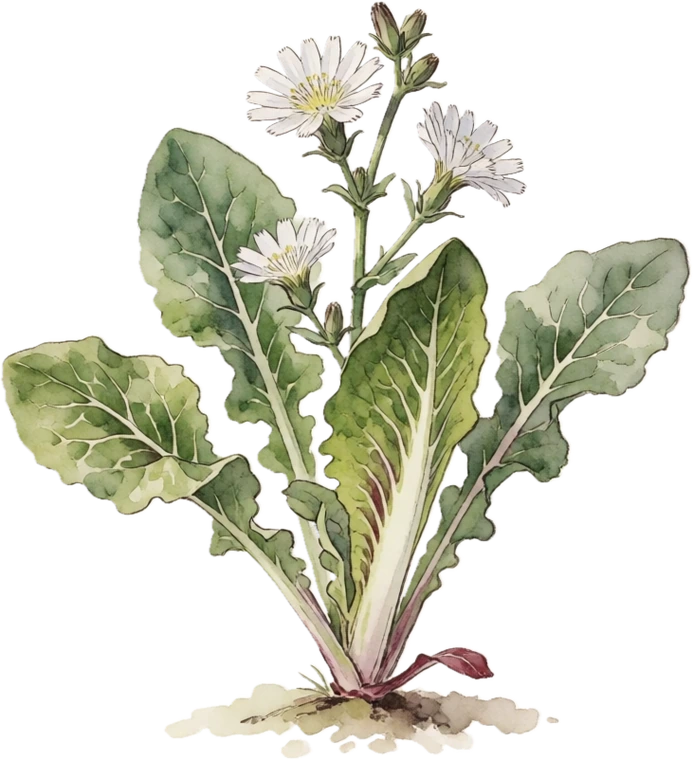
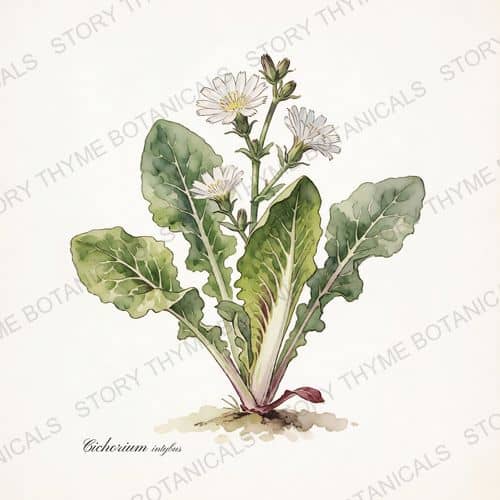
Botanical illustration of Radicchio
Biennial · Cichorium intybus var. foliosum

The beautiful bitter Italian chicory — burgundy-and-white heads that are aggressively bitter raw in summer but turn sweet, nutty, and smoky when frost-kissed and grilled or roasted. A cool-season crop; treat the bitterness as a feature to be tamed by cold and fire.

BiennialFull SunModerate waterModerate growthExcellent edible

Where to buy the plant — 2 nurseries

I

Overview

Will radicchio suit your garden, and what goes wrong.

Will it fruit where you are?

Enter your ZIP — we look up your USDA hardiness zone (2023 map) and check it against what radicchio actually needs.

Hardy inZones 2-11

Radicchio at a glance

HardinessUSDA 2–11
Mature size8-12 in heads
PollinationN/A (harvested before bloom)
Chill requirementNot yet established
Bloom seasonN/A
Harvest seasonFall/winter: tight red-and-white heads — bitter raw, sweet-smoky grilled or roasted; frost improves them
Growth rateModerate

Common radicchio problems

II

Growing

Light, water, soil, propagation and the season’s jobs.

How to grow radicchio: light, water & soil

LightFull Sun
WaterModerate, even
SoilRich, well-drained · pH 6.0 - 7.0
FertilizerLight
PruningNone — A chicory bred to head up like a small cabbage. It's a fall/cool-season crop — heat makes it purely bitter, cold sweetens it. Some types are cut back in late summer to force a fresh tight head. Frost and grilling transform the bitterness into something wonderful.
Spacing8-10 in

How to plant & propagate radicchio

Maturity80-100 days
From seedSow early summer for fall heads; cold sweetens it
PropagateFrom seed or division

The radicchio growing playbook

Field-tested instructions for every job radicchio asks of you, compiled from university extension guidance — in the order the season brings them.

Sowing

Sow in summer for a fall crop, not in spring

Sow seed 1/4 to 1/2 inch deep in midsummer, either directly in the bed or indoors in flats about four weeks ahead of setting plants out. Aim to have plants sized up as the nights start cooling, and keep the seedbed shaded and damp if soil is running hot. Radicchio heads properly only as temperatures fall, and sustained heat above 75F pushes it to bolt instead of forming a head. A crop that matures into cooling fall weather colors up red and stays sweet, while a spring sowing runs to seed as days lengthen.

Planting out

Set plants out at head spacing, about four weeks after sowing

Move transplants to the bed about four weeks after sowing, in soil held between pH 6.0 and 6.8. Space them 10 to 12 inches apart for full-size heads, or 6 to 8 inches apart if you want mini heads about 4 to 5 inches across. Radicchio wraps a head rather than spreading, so spacing sets head size directly. Crowded plants trade head density for leaf, and heads that touch hold water between them and rot at the base.

Watering

Keep it at an inch of water a week, and do not let it check

Give the bed about one inch of water per week counting rainfall, and keep it steady rather than letting the bed swing between bone dry and soaked. Expect to water this crop a little longer into the season than you would lettuce on the same ground. Radicchio needs a longer run to maturity than lettuce, so it sits on the same shallow root zone for more weeks and needs the extra irrigation to finish. Steady moisture matters more than volume: when watering or rain follows a dry spell the plants resume growth suddenly, and that check-then-surge is what shows up as tipburn, the browning of leaf edges inside the head.

Feeding

Work in a complete fertilizer, then side-dress at four inches tall

Work a complete fertilizer into the bed at about two pounds per 100 square feet before planting. Once the plants stand about four inches tall, side-dress with roughly one pound for every 25 feet of row and water it in. The whole crop is leaf, so head weight tracks nitrogen supply during the frame-building weeks. Feeding the plant while it is still open and growing fills the head out before cold shuts growth down.

Pruning

Forcing types: cut back to the crown, then lift the roots to force

If you are growing a forcing type such as Red Verona or Treviso, cut the leaves off to within 1 inch of the crown about two to three weeks before your first frost. Then dig the roots and store them in a burlap bag in a cool, dark place - the head forms in storage, not in the bed. Do not leave the cut-back plants in the ground and wait for them to re-head. Forcing types do not wrap a tight head on their own in the field. Cutting the top away and lifting the root sends the root's stored reserves into a fresh, blanched, tightly folded head, and the cool dark storage is what blanches it. Leaving a cut-back crown in the bed through frost gives you neither the old leaves nor a forced head.

What to watch for

Scout for aster yellows, cutworms, slugs and flea beetles - pull, do not spray

Walk the bed weekly. Pull and destroy any plant that is stunted with yellowed leaves and stems, and keep perennial broadleaf weeds knocked back around the planting. Watch also for cutworms, slugs and flea beetles chewing young plants. Aster yellows is a phytoplasma carried by aster leafhoppers, and once a leafhopper picks it up it transmits the pathogen every time it feeds for the rest of its life. An infected plant never recovers, so it is only a reservoir the next leafhopper feeds from. The pathogen also survives in perennial weeds from one season to the next, which is why clearing them out of the planting matters.

Do not reach for an insecticide here - leafhoppers are quick-moving and sturdy and are hard to manage effectively with insecticides, with few effective products available to home gardeners. Roguing infected plants and clearing perennial weed hosts is the control that works.

Harvesting

Cut when the head is full and solid, and let frost hit it first

Squeeze the heads and cut at soil level once they feel full and firm rather than spongy. Let a few frosts pass over the crop before you cut if you can, and trim off outer leaves the cold has burned. Store the cut heads cold and damp, at 32 to 34F and near-saturated humidity, where they will hold two to three weeks. Firmness, not the calendar, is what says the head has finished wrapping - days to maturity shift by variety and by how warm the run-up was. Cold weather deepens the red and takes the hard edge off the bitterness, and the tops shrug off short spells down to about 20F. If frost kills the outer green leaves, the red head underneath is usually fine.

III

The year

What radicchio asks for, month by month.

The radicchio year, month by month

MonthJanFebMarAprMayJunJulAugSepOctNovDec
Harvest

What each band means

  • Harvestpicking time — check ripeness every few days.

The radicchio year as text

  • Jan harvest
  • Feb harvest
  • Mar quiet month
  • Apr quiet month
  • May quiet month
  • Jun quiet month
  • Jul quiet month
  • Aug quiet month
  • Sep harvest
  • Oct harvest
  • Nov harvest
  • Dec harvest

These are the species' typical months — expect them a few weeks earlier in warm zones and later in cold ones. Watch the plant, not just the calendar.

IV

Ecology & uses

What it does for the garden, and what it is grown for.

Radicchio in the garden system

  • Herbaceous layer biennial
MoistureFacultative / average
DeerBrowsed — protect young plants
OriginIntroduced

What radicchio is grown for

✓ Commonly eaten

UseGrilled/roasted
Traditional useBitter salads
UseFall crop
Edible value4/5

Harvesting & storing radicchio

Fall/winter: tight red-and-white heads — bitter raw, sweet-smoky grilled or roasted; frost improves them. About 80-100 days from planting.

Edibility, identification, and traditional-use notes here are general reference — not medical or veterinary advice, and not a claim that any plant treats or prevents anything. Medicinal ratings record how strongly a plant features in herbal tradition, nothing more. Never eat or dose a plant you have not positively identified. More on how to use this library.

V

Cultivars

Named varieties of radicchio, ruled as a catalogue.

Best radicchio varieties & cultivars

10 on file

Named varieties of radicchio differ in winter-chill needs, ripening time, hardiness, and whether they set fruit on their own — pick one that fits your climate.

Giorgione · Variegato di Castelfranco

RipensspringZones2-11SizeEarly, pear-shaped, dense compact head

Balances classic chicory bitterness with sweetness, especially in fall - not a mild one — Open-pollinated Castelfranco type. Leaves are variable red-to-pink speckled on a cream ground rather than solid red, and the internal speckling intensifies in fall. Fastest of the group to a cuttable head. If you want the mild end of this catalog, that is Bel Fiore, not this.

Where to buy ‘Giorgione

Story Thyme Farms may earn a small commission from these links, at no cost to you — it never changes what we recommend.

Bel Fiore · Variegato di Lusia

RipensspringZones2-11SizeLoose to semi-dense variegated head

Open-pollinated Lusia type carrying deep red and pink spotting. Listed for year-round harvest slots rather than a single narrow window.

Where to buy ‘Bel Fiore

Story Thyme Farms may earn a small commission from these links, at no cost to you — it never changes what we recommend.

Perseo

RipensspringZones2-11SizeSmall round Chioggia head

Open-pollinated round Chioggia type. Smaller head lets you plant tighter and pull more heads from the same bed.

Where to buy ‘Perseo

Story Thyme Farms may earn a small commission from these links, at no cost to you — it never changes what we recommend.

Speeder

RipenssummerZones2-11SizeFull-size round head

Hybrid round Chioggia type slotted for warm-season planting, which is the hard slot for this crop. Colors bold red-purple even off a summer planting.

Where to buy ‘Speeder

Story Thyme Farms may earn a small commission from these links, at no cost to you — it never changes what we recommend.

Indigo · Indigo F1

RipenssummerZones2-11DiseaseBottom rot resistant; tolerant to tipburnSizeFirm heads 4-5 inches across

Burgundy heads with good flavor — Hybrid round Chioggia type. The one to pick if you are pushing radicchio into warm weather - it has performed in both hot and cool trials and is notably sure-heading. Tipburn tolerance matters because heat and uneven water are what cause tipburn.

Where to buy ‘Indigo

Story Thyme Farms may earn a small commission from these links, at no cost to you — it never changes what we recommend.

Leonardo · Leonardo F1

RipensfallZones2-11SizeDense heads 4-5 inches across

Flavor and bright purple color both deepen in cool fall weather — Hybrid round Chioggia type for fall and winter harvest. Days to maturity is counted from transplanting, not from seeding.

Where to buy ‘Leonardo

Story Thyme Farms may earn a small commission from these links, at no cost to you — it never changes what we recommend.

Fiero · Fiero F1

RipensfallZones2-11SizeUpright heads 7 to 8.5 inches tall

Hybrid tall Treviso type - deep maroon heads with contrasting white ribs, shaped like a small romaine rather than a ball. Good uniformity and sure-heading ability; listed as best for fall production. Days to maturity is counted from a cool-weather or spring transplanting: subtract 10-14 days for a warm-weather or early-summer transplanting, and add about 14 days if you direct seed.

Where to buy ‘Fiero

Story Thyme Farms may earn a small commission from these links, at no cost to you — it never changes what we recommend.

Virtus

RipensfallZones2-11SizeTall dense sugarloaf head

Mildest of the chicories — Hybrid sugarloaf (Zuckerhut) type - a green heading chicory rather than a red radicchio, listed for both spring and fall slots.

Where to buy ‘Virtus

Story Thyme Farms may earn a small commission from these links, at no cost to you — it never changes what we recommend.

Stella Rosa

RipensfallZones2-11SizePink head with distinct white ribs

Open-pollinated pink radicchio on a long 115-day run, typically transplanted in August for a late fall cut. The plants must get short days and cold weather before the pink color expresses - planting too early risks loose, non-pink heads, so this is not one to plant for an early cut.

Where to buy ‘Stella Rosa

Story Thyme Farms may earn a small commission from these links, at no cost to you — it never changes what we recommend.

Luna Rossa

RipenswinterZones2-11SizeCostarossa type with prominent red ribs

Costarossa type on a 120-day run, listed as best for late fall harvest in northern regions.

Where to buy ‘Luna Rossa

Story Thyme Farms may earn a small commission from these links, at no cost to you — it never changes what we recommend.

VI

Sources & plant ID

Where the care distinctions come from, and how the plant is filed.

Research basis

Sources behind this profile

No extension citations are attached to radicchioyet. The care figures below come from the library's own catalogue rather than a traced primary source.

Plant ID

BinomialCichorium intybus var. foliosum
FamilyAsteraceae
TypeBiennial · Perennial
USDA symbolCIIN
OriginIntroduced
Invasive riskLow

VII

Where to buy

Third-party nurseries — not Story Thyme Farms.

Third-party nurseries, not Story Thyme Farms. Prices are theirs.

Story Thyme Farms may earn a small commission from these links, at no cost to you — it never changes what we recommend.

VIII

Questions

Radicchio questions, answered straight.

Is radicchio safe for kids and pets?

Radicchio is commonly eaten and isn't considered toxic, but "commonly eaten" isn't a guarantee for any particular person or animal — allergies, quantity, and which part you eat all matter. Never eat a plant you haven't positively identified, and check with a vet before letting pets or livestock graze anything new.

When do you harvest radicchio?

Fall/winter: tight red-and-white heads — bitter raw, sweet-smoky grilled or roasted; frost improves them. From planting, expect about 80-100 days to maturity.

How do you propagate radicchio?

From seed or division.

IX

Elsewhere

Where radicchio sits in the library.

Where radicchio sits in the library

Grows in the same world