The illustrated growing guide

Kale

Brassica oleracea

Family Brassicaceae

Est. zones 2-11

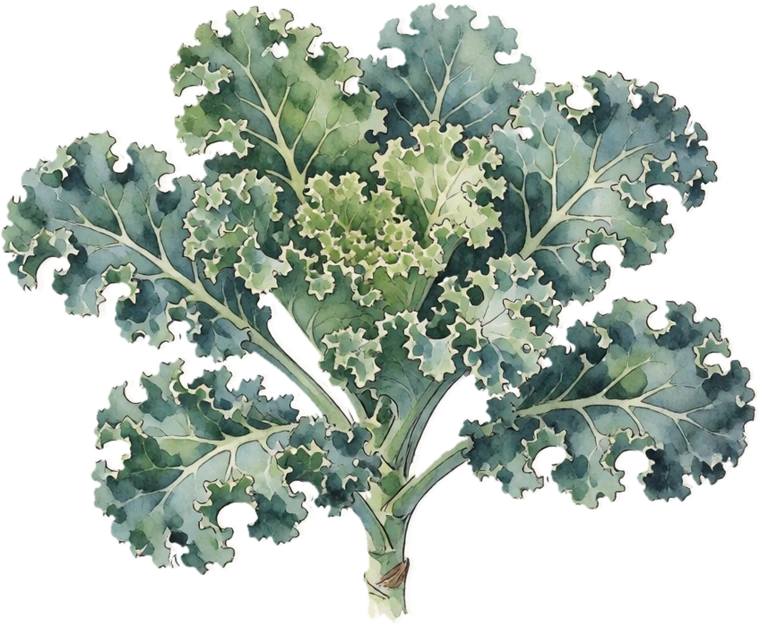
Botanical illustration of Kale
Annual · Brassica oleracea

Frost converts starch to sugar — December kale beats June kale. Overwinters to zone 6 with mulch.

AnnualFull Sun to Part ShadeModerate waterFast growthExcellent edibleAttracts beesAttracts butterflies

Where to buy the plant — 3 nurseries

Kale — a print from the Vegetables Vol. 1 collection

From the print shop

Growing kale? Hang it.

Our Vegetables Vol. 1 collection carries kaleBrassica oleracea, print Nº 5, “Kale.”

16 designsfrom $21.99white or black groundmatte poster, unframed

Shop Vegetables Vol. 1 botanical prints →

I

Overview

Will kale suit your garden, and what goes wrong.

Will it fruit where you are?

Enter your ZIP — we look up your USDA hardiness zone (2023 map) and check it against what kale actually needs.

Life cycleBiennial, grown as an annual

Kale at a glance

Life cycleBiennial, grown as an annual
Mature size2-3 ft
PollinationNone (harvested as leaves)
Chill requirementNot yet established
Bloom seasonN/A
Harvest seasonMay - December, sweetest after hard frost
Growth rateFast

Common kale problems

II

Growing

Light, water, soil, propagation and the season’s jobs.

How to grow kale: light, water & soil

LightFull Sun to Part Shade
WaterModerate
SoilRich, Well-drained · pH 6.0 - 7.5
FertilizerCompost + nitrogen side-dress monthly.
PruningNone (annual) — Harvest bottom leaves; crown keeps producing.
Spacing12-18 inches

How to plant & propagate kale

Maturity50-65 days
From seedDirect-sow or start; germinates 45-75°F; best as a fall crop
PropagateFrom seed

When to spray kale

Growing season. Bt (Bacillus thuringiensis) every 7-10 days handles cabbage worms organically. Row cover from day one prevents most everything.

The kale growing playbook

Field-tested instructions for every job kale asks of you, compiled from university extension guidance — in the order the season brings them.

Sowing

Spring crop: sow or set out transplants four to five weeks before your last frost

Start seeds indoors about four weeks before you plan to set them out, or direct-sow as soon as the soil is workable. Set transplants out four to five weeks before your average last frost date, spacing plants 12 inches apart in rows 2 feet apart. Harden seedlings off by reducing water and temperature for two to three days before transplanting. Kale grows best when temperatures do not exceed 75F, so the spring crop has to size up before summer heat arrives - high summer temperatures reduce growth and cause bitter, off flavors to develop.

Fall crop: sow in midsummer for the best kale of the year

Direct-sow about three months before your average first frost date, or start seedlings indoors in June to transplant out in midsummer. For a later fall crop choose an early variety and count back 50 to 75 days from when you want to start cutting. Kale keeps growing well past the first fall frosts and its flavor improves as temperatures drop, so a midsummer sowing lands the harvest in exactly the weather this crop was built for.

Feeding

Side-dress nitrogen four weeks after transplanting

About four weeks after transplanting or thinning, side-dress with half a cup of 21-0-0 per 10 feet of row, placed in a band six inches out from the plants, scratched in and watered. Repeat the same side-dress on your fall planting four weeks after it goes in. You are harvesting leaves, not fruit, so nitrogen is the crop - a plant that runs short mid-season puts out small, pale leaves and stops replacing what you cut.

Keep granular fertilizer off the leaves and six inches away from stems; concentrated nitrogen against wet foliage or crowns will burn them.

Spraying

Cabbageworms: Bt kurstaki while the caterpillars are still small

Watch weekly for small white butterflies over the bed, pale eggs laid singly on the leaves, ragged holes between the veins, and green frass pellets. When you find young larvae, spray Bacillus thuringiensis var. kurstaki, covering leaf undersides, and repeat as new larvae appear. Brassica leaves shed water, so add a spreader-sticker to the tank. Bt has to be eaten to work and only kills small early-instar larvae, so it succeeds or fails on timing - a caterpillar found at full size has already done its damage and will shrug the spray off.

Bt kurstaki carries a 0-day pre-harvest interval and a 4-hour re-entry interval on cole crops; its label strongly recommends an approved spreader-sticker.

Cabbage aphids: check the growing tips weekly once nights cool

Scout weekly and treat if more than 10 percent of plants carry aphids. Look at the youngest leaves and growing tips and at the undersides of older leaves, where the gray-green colonies pack in. Spray insecticidal soap or a horticultural oil with a spreader-sticker at high pressure aimed up into the undersides, and pull heavily infested plants rather than trying to rescue them. Cabbage aphids reproduce fastest between 50 and 68F and stall above 95F, so a fall kale planting sits inside their ideal range for months and colonies explode - and once they are wedged into the crown, no spray reaches them.

Soaps can burn foliage at high concentrations - use the lower labeled rate and avoid spraying in hot sun.

Protection

Floating row cover from the day you plant

Lay floating row cover or fine mesh netting over the bed the day you sow or transplant, and secure the edges to the soil so butterflies cannot get underneath to lay eggs. Because kale is harvested as leaves and needs no pollination, the cover can stay on right through to harvest - just lift it when you need to weed or cut. If you skip the cover, scout for tiny, pale, individually-laid eggs on the leaves and crush them by hand. Cabbage white butterflies have to land on the plant to lay their eggs, so fine mesh netting used as a physical barrier keeps the adults off the crop entirely and stops the infestation before there is anything to spray.

Low tunnel to carry kale through winter

Before hard freezes arrive, set hoops over the row and pull a 10 to 14 foot row cover blanket over them, secured taut with bricks, rocks or sandbags. Row cover gives protection down to roughly 24 to 28F depending on grade; add a second layer or a 4- to 6-mil plastic layer over it for colder nights. Vent by clipping or raising the sides on warm days so the tunnel does not cook. Kale is hardy enough to keep standing through winter under cover, and greens matured in cold weather are the sweetest of the year - the limit is not the plant's toughness but the handful of nights that go below what bare foliage tolerates.

Harvesting

Cut the outer leaves and let the crown keep going

Cut baby greens about 20 to 30 days after sowing, or full-size leaves at 50 to 75 days depending on variety. Strip the older, lower leaves first and leave the growing tip alone - the plant keeps producing from the center for months. Fresh leaves hold about a week in the refrigerator. Cut a spring crop before the weather turns hot and dry. Kale grows from a central crown, so removing the oldest outer leaves takes the ones already past their peak while leaving the factory intact; taking the whole top ends the harvest.

Kale companion plants

Good companions

Underlined names have their own growing guide in this library.

III

The year

What kale asks for, month by month.

The kale year, month by month

MonthJanFebMarAprMayJunJulAugSepOctNovDec
Harvest

What each band means

  • Harvestpicking time — check ripeness every few days.

The kale year as text

  • Jan quiet month
  • Feb quiet month
  • Mar quiet month
  • Apr quiet month
  • May harvest
  • Jun harvest
  • Jul harvest
  • Aug harvest
  • Sep harvest
  • Oct harvest
  • Nov harvest
  • Dec harvest

These are the species' typical months — expect them a few weeks earlier in warm zones and later in cold ones. Watch the plant, not just the calendar.

IV

Ecology & uses

What it does for the garden, and what it is grown for.

Kale in the garden system

  • Herbaceous layer annual
AttractsBees, Butterflies
MoistureFacultative / average
DeerBrowsed — protect young plants
OriginIntroduced

What kale is grown for

✓ Commonly eaten

UseFresh
UseCooking
UseChips
UseWinter greens
Edible value4/5

Harvesting & storing kale

May - December, sweetest after hard frost. About 50-65 days from planting.

Edibility, identification, and traditional-use notes here are general reference — not medical or veterinary advice, and not a claim that any plant treats or prevents anything. Medicinal ratings record how strongly a plant features in herbal tradition, nothing more. Never eat or dose a plant you have not positively identified. More on how to use this library.

V

Cultivars

Named varieties of kale, ruled as a catalogue.

Best kale varieties & cultivars

12 on file

Named varieties of kale differ in winter-chill needs, ripening time, hardiness, and whether they set fruit on their own — pick one that fits your climate.

Red Ursa

Sourced for BOTH bolt resistance and heat tolerance - the safest choice for a southern spring, where a curly kale would flower and stop. A Red Russian x True Siberian cross. Cornell lists 65-70 days; 65 is the low bound.

Where to buy ‘Red Ursa

Story Thyme Farms may earn a small commission from these links, at no cost to you — it never changes what we recommend.

Lacinato · Toscano; Dinosaur Kale; Nero di Toscana; Cavolo Nero

Mild — The rare kale sourced as good at BOTH ends, so plant it spring or fall without switching varieties. Cornell lists 60-80 days (60 is the low bound); slow enough that a short-season grower should transplant rather than direct-sow.

Where to buy ‘Lacinatoverified

Story Thyme Farms may earn a small commission from these links, at no cost to you — it never changes what we recommend.

Vates · Dwarf Blue Curled Vates; Blue Curled Scotch

Bolt resistance plus a 15-inch habit makes this the spring-planting curly kale for warm areas and small beds. About 30 days to baby leaf and 55 to full size, so one planting can be cut twice.

Where to buy ‘Vates

Story Thyme Farms may earn a small commission from these links, at no cost to you — it never changes what we recommend.

True Siberian · Siberian

The overwintering pick: sourced as pickable all winter in some areas, so plant it for standing harvest rather than a single cut. At 70 days it is the slowest kale here - start early enough to size up before hard cold.

Where to buy ‘True Siberian

Story Thyme Farms may earn a small commission from these links, at no cost to you — it never changes what we recommend.

Winterbor

Zones2-11SizeTall plants

Standard curly kale — Bolt resistance is the reason to pick this for spring: it holds through warming weather where curly kales quit. HONEST GAP: days is null because the Clemson page carrying the bolt claim gives none, and Cornell's 52-60 figure comes from a different page.

Where to buy ‘Winterbor

Story Thyme Farms may earn a small commission from these links, at no cost to you — it never changes what we recommend.

Red Russian

Zones2-11

Tender, sweeter after frost — Fast at 50 days, so it fits a short northern season and can be direct-sown late for a fall crop; baby greens at about 25 days. Kale grows best under 75F - high summer temperatures cause bitter, off flavours, so time it to finish in cool weather.

Where to buy ‘Red Russianverified

Story Thyme Farms may earn a small commission from these links, at no cost to you — it never changes what we recommend.

Redbor

Zones2-11

Sweetens with a hard freeze — Cornell explicitly says best in fall - do NOT treat this as a spring variety. Plants reach 5 feet in a long season, so space it generously and site it where it will not shade its neighbours. Cornell lists 55-65 days.

Where to buy ‘Redborverified

Story Thyme Farms may earn a small commission from these links, at no cost to you — it never changes what we recommend.

Toscano · Lacinato;Dinosaur;Tuscan;Black Kale

Zones2-11

Sweet, mild — Italian heirloom dinosaur-type kale with long, thin, heavily puckered dark blue-green leaves that tolerate both heat and cold - the one to plant if your summers push other kales into bolting.

Where to buy ‘Toscanoverified

Story Thyme Farms may earn a small commission from these links, at no cost to you — it never changes what we recommend.

Improved Dwarf Siberian

Zones2-11SizeDwarf

Dark-green frilly leaves on a compact plant; NC State Extension calls it very cold tolerant, which makes it a good pick for a fall crop you intend to push deep into winter.

Where to buy ‘Improved Dwarf Siberian

Story Thyme Farms may earn a small commission from these links, at no cost to you — it never changes what we recommend.

Starbor

Zones2-11

Fastest kale sourced and compact - fits a short northern season or a container, and works as a late succession for a fall frost harvest. SOURCE CONFLICT on maturity: USU says 55 days, Cornell 45; treat 45-55 as the honest window.

Where to buy ‘Starbor

Story Thyme Farms may earn a small commission from these links, at no cost to you — it never changes what we recommend.

Scarlet

Zones2-11

Red-leaf kale recommended by Utah State University Extension for strong yields and frost tolerance.

Where to buy ‘Scarlet

Story Thyme Farms may earn a small commission from these links, at no cost to you — it never changes what we recommend.

Rainbow Candy Crush

Zones2-11

Mildly sweet, thick tender leaves — F1 hybrid listed by WVU Extension for its mildly sweet flavor and thick, tender leaves; reaches full size in about 55 days.

Where to buy ‘Rainbow Candy Crush

Story Thyme Farms may earn a small commission from these links, at no cost to you — it never changes what we recommend.

VI

Sources & plant ID

Where the care distinctions come from, and how the plant is filed.

Research basis

Sources behind this profile

No extension citations are attached to kaleyet. The care figures below come from the library's own catalogue rather than a traced primary source.

Plant ID

BinomialBrassica oleracea
FamilyBrassicaceae
TypeAnnual · Biennial
USDA symbolBROL
OriginIntroduced
Invasive riskLow

VII

Where to buy

Third-party nurseries — not Story Thyme Farms.

Third-party nurseries, not Story Thyme Farms. Prices are theirs.

Story Thyme Farms may earn a small commission from these links, at no cost to you — it never changes what we recommend.

VIII

Questions

Kale questions, answered straight.

Is kale safe for kids and pets?

Kale is commonly eaten and isn't considered toxic, but "commonly eaten" isn't a guarantee for any particular person or animal — allergies, quantity, and which part you eat all matter. Never eat a plant you haven't positively identified, and check with a vet before letting pets or livestock graze anything new.

When do you harvest kale?

May - December, sweetest after hard frost. From planting, expect about 50-65 days to maturity.

What grows well with kale?

Proven companions include aromatic herbs, onions, nasturtium (aphid trap) — the full companion list, and what to keep away, is in the Growing tab above.

How do you propagate kale?

From seed.

IX

Elsewhere

Where kale sits in the library.

Where kale sits in the library

Grows in the same world