The illustrated growing guide

Cabbage

Brassica oleracea var. capitata

Family Brassicaceae

Est. zones 2-11

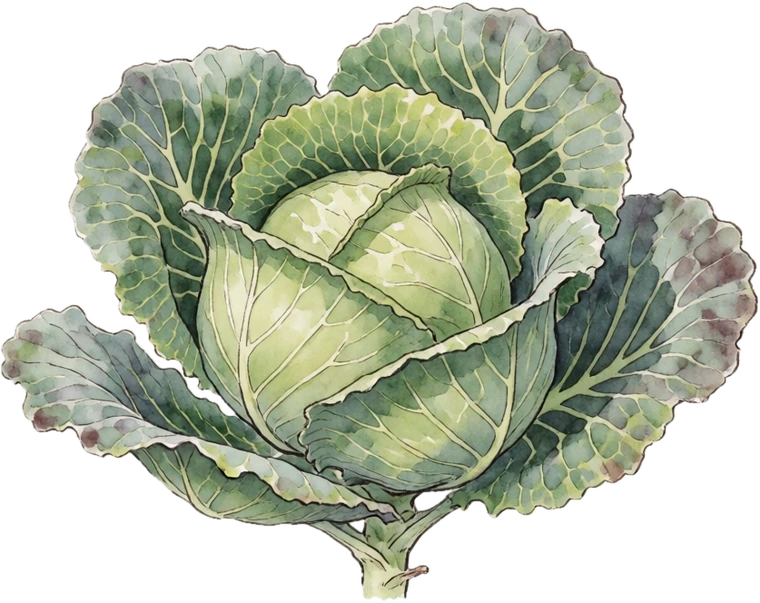
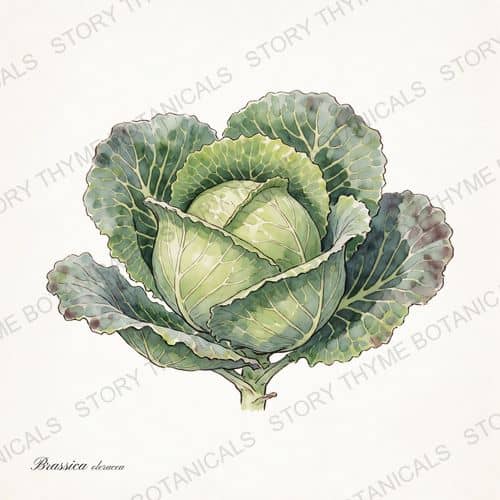
Botanical illustration of Cabbage
Annual · Brassica oleracea var. capitata

Fall cabbage beats spring in the Midwest — transplant mid-July, harvest sweet dense heads in October. One 'Late Flat Dutch' head = one crock of kraut.

AnnualFull SunModerate waterModerate growthExcellent edibleAttracts butterflies

☤ Juglone-sensitiveCabbage is sensitive to juglone — the toxin exuded by black walnut, butternut, and their relatives. Keep it 50+ ft from any walnut or hickory, or its leaves will yellow, wilt, and die back for no obvious reason.

Where to buy the plant — 3 nurseries

Cabbage — a print from the Vegetables Vol. 1 collection

From the print shop

Growing cabbage? Hang it.

Our Vegetables Vol. 1 collection carries cabbageBrassica oleracea, print Nº 6, “Cabbage.”

16 designsfrom $21.99white or black groundmatte poster, unframed

Shop Vegetables Vol. 1 botanical prints →

I

Overview

Will cabbage suit your garden, and what goes wrong.

Will it fruit where you are?

Enter your ZIP — we look up your USDA hardiness zone (2023 map) and check it against what cabbage actually needs.

Life cycleBiennial, grown as an annual

Cabbage at a glance

Life cycleBiennial, grown as an annual
Mature size1-2 ft heads
PollinationN/A
Chill requirementNot yet established
Bloom seasonN/A (harvested before bloom)
Harvest seasonJune - July; fall crop October - November (frost sweetens)
Growth rateModerate

Common cabbage problems

II

Growing

Light, water, soil, propagation and the season’s jobs.

How to grow cabbage: light, water & soil

LightFull Sun
WaterSteady 1-1.5 in/week — irregular water splits heads
SoilRich, firm, limed · pH 6.5 - 7.5
FertilizerHeavy feeder: nitrogen at transplant and 3 weeks later
PruningNone — When a head splits after rain, twist the plant a quarter-turn to break feeder roots and stop it.
Spacing15-18 in

How to plant & propagate cabbage

Maturity70-100 days
From seedStart indoors 6 wks early (spring) or sow July (fall); 45-75°F
PropagateFrom seed

When to spray cabbage

Growing season. Bt every 7-10 days from transplant; rotate brassica beds on 3-4 years.

The cabbage growing playbook

Field-tested instructions for every job cabbage asks of you, compiled from university extension guidance — in the order the season brings them.

Sowing

Start spring cabbage indoors, four to six weeks before set-out

Sow seed a quarter inch deep in flats and grow them on at normal room temperature, around 60 to 70 degrees. Count back four to six weeks from the date you intend to set plants out. A transplant is ready when it has four to six mature leaves and a root system that holds the plug together. Cabbage needs a long cool run to fill a head, and warm rooms above the mid-70s push weak, stretched seedlings that never size up. Starting on a countdown from your own set-out date is what keeps the head forming before summer heat arrives.

Sow the fall crop in midsummer for a cool-weather finish

Start seed about three weeks before you plan to set the plants out, counting back so the heads mature as weather cools. Keep the flats and the new transplants well watered - this is the hard part of a fall crop. A fall crop heads into falling temperatures instead of away from them, which is the weather cabbage actually wants. Watering is the difficulty: seed and young transplants have to get established in summer heat before the cool run they were sown for arrives.

Planting out

Set out hardened transplants ahead of the last frost

Harden the plants off outdoors over one to two weeks, then set them 12 to 18 inches apart in rows 24 to 36 inches apart. Cabbage is hardy enough to go out two to three weeks before your last frost date and is not seriously damaged by temperatures down to 25 degrees. Cabbage heads best in cool weather, so the earlier it establishes the better it fills. Its frost hardiness is what buys those extra weeks - the plant is working while tender crops are still waiting.

Watering

Even moisture at the soil line, never overhead

Give one to two inches of water a week, applied deeply and infrequently, and aim for steady soil moisture rather than swings. Water at the ground with drip or a soaker hose instead of a sprinkler. A head that dries out and then gets a heavy drink takes up water faster than the wrapped leaves can stretch, and it splits. Overhead water does a second kind of damage - it splashes the black rot bacterium from leaf to leaf, and black rot has no cure once it is in the plant.

Feeding

Side-dress nitrogen once, then stop before heads form

About four weeks after transplanting, band roughly half a cup of 21-0-0 per 10 feet of row about six inches out from the plants, scratch it in, and water it down. Do not add more nitrogen once heads begin to firm up. Cabbage builds its frame of outer leaves first and the head is filled from what those leaves make, so nitrogen pays early and only early. Nitrogen after heading pushes soft, loose growth into a head that is already tight, which is what makes heads split.

What to watch for

Check leaf undersides weekly for caterpillar eggs

Walk the planting once a week and turn over the lower leaves. Look for small yellow-orange eggs laid singly and for green caterpillars up to an inch long - the imported cabbageworm has a faint yellow stripe down its back, the looper arches its back as it crawls. Check even where you see no chewing yet. Caterpillar control works on small larvae and fails on big ones, so finding eggs before they hatch is the whole point of the walk. Waiting for holes means waiting until the larvae are past the stage where anything kills them cleanly, and by heading their droppings contaminate the head itself.

Spraying

Bt on small cabbageworms as soon as you find them

When scouting turns up small larvae, spray Bacillus thuringiensis var. kurstaki and cover the leaf undersides thoroughly, since the caterpillars have to eat treated tissue to take in the toxin. Repeat as new hatches appear, and reapply after rain. Bt is a stomach poison - the toxin releases in the caterpillar's gut, it stops feeding and starves. It is very effective on early instar larvae and much weaker on large ones, which is why it is tied to scouting rather than a calendar.

Bt kurstaki only affects caterpillars that eat treated leaves and is considered pollinator friendly, unlike malathion, which is harmful to pollinators. Spray late in the day to protect beneficial insects and because sunlight breaks Bt down.

Protection

Row cover at planting to shut out cabbage maggot and cabbageworm

Lay fine mesh row cover over the bed the day you plant, seal the edges to the soil, and leave it until the flies have finished laying. Cabbage does not need insects to make a head, so the cover can stay on through heading. Both the cabbage maggot fly and the imported cabbageworm butterfly have to land on the plant to lay eggs, and a barrier put on at planting denies them that. Once maggots are in the roots there is nothing to spray - there are no home-garden insecticides for cabbage maggot, which is why exclusion is the whole strategy.

Do not cover ground that grew cabbage family crops last year. Cabbage maggot flies emerge from the soil, so a cover over infested ground traps them in with the crop instead of out.

Harvesting

Cut when the head is firm, or break roots to hold it

Squeeze the head - harvest when it is full sized, firm and solid, cutting just above the outer leaves. A mature head will stand about two weeks in summer heat and three to four weeks in cool fall weather. If you cannot cut it yet, twist the head a quarter turn or bend the stem over to snap part of the roots. Once the head is solid the plant keeps pushing water into leaves that have no room left, and the head bursts. Breaking some roots throttles water uptake and buys you time without losing the head.

Cabbage companion plants

Good companions

Underlined names have their own growing guide in this library.

III

The year

What cabbage asks for, month by month.

The cabbage year, month by month

MonthJanFebMarAprMayJunJulAugSepOctNovDec
Harvest

What each band means

  • Harvestpicking time — check ripeness every few days.

The cabbage year as text

  • Jan quiet month
  • Feb quiet month
  • Mar quiet month
  • Apr quiet month
  • May quiet month
  • Jun harvest
  • Jul harvest
  • Aug quiet month
  • Sep harvest
  • Oct harvest
  • Nov harvest
  • Dec quiet month

These are the species' typical months — expect them a few weeks earlier in warm zones and later in cold ones. Watch the plant, not just the calendar.

IV

Ecology & uses

What it does for the garden, and what it is grown for.

Cabbage in the garden system

  • Herbaceous layer annual
AttractsButterflies
MoistureFacultative / average
DeerBrowsed — protect young plants
OriginIntroduced

What cabbage is grown for

✓ Commonly eaten

UseKraut
UseSlaw
UseStorage
UseRoasting
Edible value4/5

Harvesting & storing cabbage

June - July; fall crop October - November (frost sweetens). About 70-100 days from planting.

Edibility, identification, and traditional-use notes here are general reference — not medical or veterinary advice, and not a claim that any plant treats or prevents anything. Medicinal ratings record how strongly a plant features in herbal tradition, nothing more. Never eat or dose a plant you have not positively identified. More on how to use this library.

V

Cultivars

Named varieties of cabbage, ruled as a catalogue.

Best cabbage varieties & cultivars

15 on file

Named varieties of cabbage differ in winter-chill needs, ripening time, hardiness, and whether they set fruit on their own — pick one that fits your climate.

Early Thunder

DiseaseBlack rot, downy mildew, fusarium yellows

Mild — The only cabbage here with an explicit bolt-resistance claim - the one to plant in a spring that warms fast, where cabbage commonly flowers instead of heading. Excellent holding means it can stand rather than being cut all at once. Tip burn tolerance matters because heat drives tip burn in cabbage.

Where to buy ‘Early Thunder

Story Thyme Farms may earn a small commission from these links, at no cost to you — it never changes what we recommend.
Stonehead

DiseaseFusarium yellows; tip burn and bursting tolerant

Split resistance is the point: an early 3-4 lb head can stand past maturity without bursting, so harvest timing is forgiving - unusual for an early cabbage. Short cores and few outer leaves allow tighter spacing. Cornell lists 50-67 days.

Where to buy ‘Stonehead

Story Thyme Farms may earn a small commission from these links, at no cost to you — it never changes what we recommend.

Charmant

DiseaseFusarium yellows; tip burn tolerant

Slow-forming is the care consequence - it will not rush a head, so do not read a slow start as failure. Tip burn tolerance is the heat-relevant trait sourced here, making it the better bet where spring turns hot. Upright habit suits close spacing. No bolt claim is made.

Where to buy ‘Charmant

Story Thyme Farms may earn a small commission from these links, at no cost to you — it never changes what we recommend.

Golden Acre

DiseaseFusarium yellows

Early and compact with few outer leaves - plant closer, expect a 3-5 lb head, and do not expect it to store. Cornell's days are from TRANSPLANTING, not seeding, which matters for scheduling. SOURCE CONFLICT: Cornell 55-65, USU 58-65. No split-resistance claim sourced: moisture swings during heading cause splitting, and pulling the head to break side roots stops it.

Where to buy ‘Golden Acre

Story Thyme Farms may earn a small commission from these links, at no cost to you — it never changes what we recommend.

Early Jersey Wakefield

Sparse outer foliage is the care consequence - it tolerates close spacing, so it is the cabbage for a small or intensive bed. Small 2-3 lb pointed heads mean eat-fresh, not storage. HONEST GAP: the widely repeated split-resistance claim appears only on seed-vendor pages, not the extension record, so it is omitted.

Where to buy ‘Early Jersey Wakefield

Story Thyme Farms may earn a small commission from these links, at no cost to you — it never changes what we recommend.

Savoy Ace

Mid-season savoy - slots between the early eating cabbages and the late storage types. SOURCE CONFLICT on maturity: Cornell 74, USU 78-80, MSU 78. HONEST GAP: no bolt, heat, or split claim sourced, so do not treat harvest timing as forgiving.

Where to buy ‘Savoy Ace

Story Thyme Farms may earn a small commission from these links, at no cost to you — it never changes what we recommend.

Red Acre

Compact plants with 2-4 lb heads - the red cabbage for tighter spacing. HONEST GAP: no extension-sourced bolt, heat, or splitting claim; gardener reviews mention split resistance but that is user comment, not the variety record. Water evenly through heading.

Where to buy ‘Red Acreverified

Story Thyme Farms may earn a small commission from these links, at no cost to you — it never changes what we recommend.
Bravo

DiseaseBlack rot, fusarium yellows

An 85-day late cabbage - start it early or it will not finish in a short season; in the South it fits the fall planting rather than spring. Black rot resistance is why to pick it where spring is warm and wet. HONEST GAP: no splitting claim sourced, so a large late head left standing is at real risk if rain follows drought.

Where to buy ‘Bravo

Story Thyme Farms may earn a small commission from these links, at no cost to you — it never changes what we recommend.

Danish Ballhead · Danish Ball Head

A 90-100 day storage crop: plant it to mature into late fall and cure it for winter keeping, not for summer eating. This is the variety a short-season northern grower must start earliest - miss the window and it will not head. SOURCE CONFLICT: Cornell 90, USU 100; plan on the longer figure in the north.

Where to buy ‘Danish Ballhead

Story Thyme Farms may earn a small commission from these links, at no cost to you — it never changes what we recommend.

Gonzales · Gonzales Baby

SizeMini heads, 4 to 6 inches across

Early European hybrid producing softball-sized mini heads on a small plant, which is what lets it be spaced as close as a foot apart. Cornell lists 55-66 days, the earliest of the varieties here, so it suits short seasons and succession sowing. HONEST GAP: no extension-sourced disease resistance claim; the split resistance and storage life reported on the Cornell page come from gardener reviews, not the variety record.

Where to buy ‘Gonzales

Story Thyme Farms may earn a small commission from these links, at no cost to you — it never changes what we recommend.

Blue Vantage · Blue Vantage F1

DiseaseBlack rot; black leaf speck; Fusarium yellows; tip burn tolerantSizeRound heads, 3 to 4 lb

The disease pick of this set: Cornell lists resistance to black rot, black speck and Fusarium yellows plus tip burn tolerance. Black rot has no cure once it infects, so resistance is worth more than any spray - choose this where the crop has had black rot before. Mid-season, blue-green, with good wrapper leaves.

Where to buy ‘Blue Vantage

Story Thyme Farms may earn a small commission from these links, at no cost to you — it never changes what we recommend.

Tendersweet

DiseaseFusarium yellows; splitting tolerantSizeMid-sized flat heads

Thin-leaved — Cornell's variety record says the flat heads stand 5 to 7 weeks without splitting - the most forgiving harvest window of any cabbage here, and the reason to pick it if you cannot cut on schedule. Thin leaves make it a slaw cabbage. Mid-season at 71 days.

Where to buy ‘Tendersweet

Story Thyme Farms may earn a small commission from these links, at no cost to you — it never changes what we recommend.

Ruby Perfection · Ruby Perfection F1

DiseaseThrips tolerantSizeSolid deep-purple heads, 4 to 6 lb

The red storage cabbage, where Red Acre is the compact fresh-eating red. Cornell's record calls it slow to split and good storing, and separately lists it as resistant to disorders. HONEST GAP: the 6-8 month refrigerated storage and heat tolerance claims on that page are a single gardener review, not the variety record - do not plan storage around them.

Where to buy ‘Ruby Perfection

Story Thyme Farms may earn a small commission from these links, at no cost to you — it never changes what we recommend.

Deadon

DiseaseFusarium yellowsSizeMedium to large heads

A January King-type hybrid: late, red-tinged and semi-savoyed, with pinkish-purplish outer leaves over a pale green core. At 105 days it is a fall crop that finishes in cold weather - the slot where cabbage grows best - so it needs a midsummer sowing, not a spring one.

Where to buy ‘Deadon

Story Thyme Farms may earn a small commission from these links, at no cost to you — it never changes what we recommend.

Late Flat Dutch

SizeFlattened oval heads about 14 inches wide

Open-pollinated heirloom storage cabbage, so you can save seed from it - the difference from Danish Ballhead is head shape, flat and oval rather than round. At 110 days it is the longest season of this set and needs a fall finish. HONEST GAP: no extension-sourced disease resistance claim, and the record gives no split tolerance, so cut it on time.

Where to buy ‘Late Flat Dutch

Story Thyme Farms may earn a small commission from these links, at no cost to you — it never changes what we recommend.

VI

Sources & plant ID

Where the care distinctions come from, and how the plant is filed.

Research basis

Sources behind this profile

No extension citations are attached to cabbageyet. The care figures below come from the library's own catalogue rather than a traced primary source.

Plant ID

BinomialBrassica oleracea var. capitata
FamilyBrassicaceae
TypeAnnual · Biennial
USDA symbolBROL
OriginIntroduced
Invasive riskLow

VII

Where to buy

Third-party nurseries — not Story Thyme Farms.

Third-party nurseries, not Story Thyme Farms. Prices are theirs.

Story Thyme Farms may earn a small commission from these links, at no cost to you — it never changes what we recommend.

VIII

Questions

Cabbage questions, answered straight.

Is cabbage safe for kids and pets?

Cabbage is commonly eaten and isn't considered toxic, but "commonly eaten" isn't a guarantee for any particular person or animal — allergies, quantity, and which part you eat all matter. Never eat a plant you haven't positively identified, and check with a vet before letting pets or livestock graze anything new.

When do you harvest cabbage?

June - July; fall crop October - November (frost sweetens). From planting, expect about 70-100 days to maturity.

What grows well with cabbage?

Proven companions include aromatic herbs (dill, sage, thyme), onions, nasturtium (trap) — the full companion list, and what to keep away, is in the Growing tab above.

How do you propagate cabbage?

From seed.

IX

Elsewhere

Where cabbage sits in the library.

Where cabbage sits in the library

Grows in the same world