The illustrated growing guide

Eggplant

Solanum melongena

Family Solanaceae

Est. zones 2-11

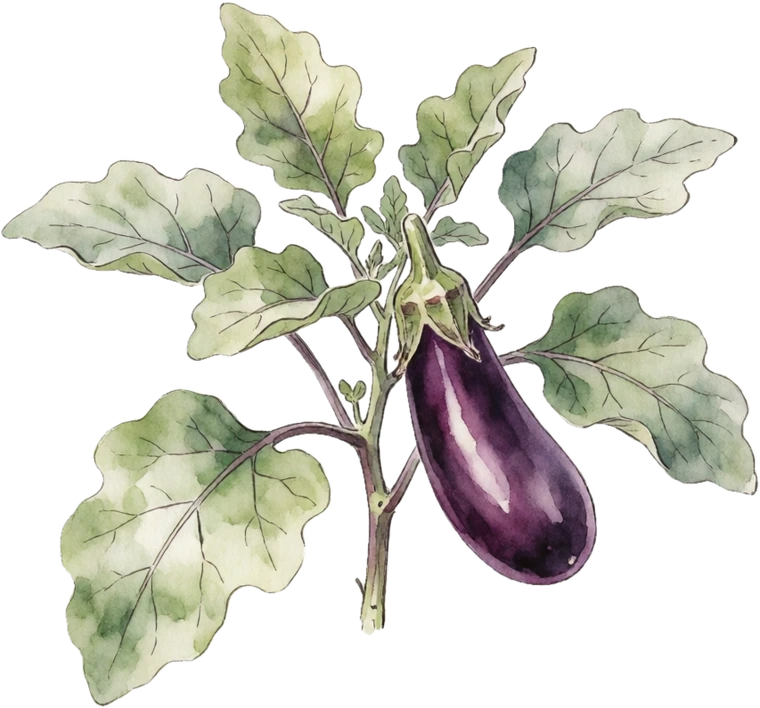
Botanical illustration of Eggplant
Annual · Solanum melongena

Refuses to grow until nights stay above 60°F — plant two weeks after tomatoes on black plastic. Slender Asian types outproduce the big globes 3:1 in short seasons.

AnnualFull Sun — the most heat-loving of the nightshadesModerate waterModerate growthExcellent edibleAttracts bees

☤ Juglone-sensitiveEggplant is sensitive to juglone — the toxin exuded by black walnut, butternut, and their relatives. Keep it 50+ ft from any walnut or hickory, or its leaves will yellow, wilt, and die back for no obvious reason.

Where to buy the plant — 3 nurseries

Eggplant — a print from the Vegetables Vol. 1 collection

From the print shop

Growing eggplant? Hang it.

Our Vegetables Vol. 1 collection carries eggplantSolanum melongena, print Nº 15, “Eggplant.”

16 designsfrom $21.99white or black groundmatte poster, unframed

Shop Vegetables Vol. 1 botanical prints →

I

Overview

Will eggplant suit your garden, and what goes wrong.

Will it fruit where you are?

Enter your ZIP — we look up your USDA hardiness zone (2023 map) and check it against what eggplant actually needs.

Life cycleTender perennial, grown as an annual
PollinationSelf-fertile

Eggplant at a glance

Life cycleTender perennial, grown as an annual
Mature size2-4 ft
PollinationSelf-fertile (shake blooms in still heat)
Chill requirementNot yet established
Bloom seasonSummer
Harvest seasonJuly - Frost — harvest GLOSSY; dull skin = bitter and seedy
Growth rateModerate

Common eggplant problems

II

Growing

Light, water, soil, propagation and the season’s jobs.

How to grow eggplant: light, water & soil

LightFull Sun — the most heat-loving of the nightshades
WaterModerate, even
SoilRich, warm, well-drained · pH 5.5 - 6.8
FertilizerBalanced at set, then every 3 weeks
PruningNone — Stake at planting (loaded plants topple); pinch tips in August so energy finishes existing fruit.
Spacing18-24 in

How to plant & propagate eggplant

Maturity65-85 days from transplant
From seedStart indoors 8-10 wks before last frost; germinates 75-85°F
PropagateFrom seed

When to spray eggplant

Growing season. Row cover until flowering is the flea-beetle answer; plant late when soil is truly warm.

The eggplant growing playbook

Field-tested instructions for every job eggplant asks of you, compiled from university extension guidance — in the order the season brings them.

Sowing

Start seed indoors 8 to 10 weeks before you can plant out

Sow indoors 8 to 10 weeks before your intended outdoor planting date, which is itself well after your last frost. Use containers of at least 2 inches so the roots are not cramped, and water in with a phosphorus starter solution when you finally set the plants out. Eggplant needs 65 to 90 days from transplanting to first harvest, so direct sowing wastes the warm weeks it actually needs. Bigger cells mean less transplant shock, and eggplant checked by shock is slow to recover.

Planting out

Plant out only once nights stay above 50F

Wait until nighttime lows are consistently above 50F and the soil has warmed before setting plants out. Space plants 18 inches apart in rows 30 to 36 inches apart. Choose ground that has not grown eggplant, tomato, pepper or potato for 4 to 5 years. Eggplant is more cold-sensitive than tomato and simply stops growing in cold soil; set out too early it may never recover and bear fruit, so an early planting gains nothing and often costs vigor. The rotation matters because Verticillium wilt survives as microsclerotia in soil for up to 10 years and there is no way to cure an infected plant (NC State, Verticillium Wilt of Tomato and Eggplant).

Mulching

Black plastic mulch to drive soil heat

Lay black plastic mulch over the bed once the soil has begun to warm, and plant through it. Do not lay it over cold soil. Black plastic traps heat in the root zone, and eggplant growth is governed by soil warmth more than by the calendar. It also keeps soil from splashing onto the lower leaves.

Feeding

Sidedress nitrogen at first flowering

When the first flowers open, sidedress nitrogen at roughly 40 to 60 pounds per acre, scaled to your bed. If you are on drip, feed about 10 pounds per acre per week for four weeks starting a week after transplanting instead. Skip the sidedress if the bed is under plastic mulch. First flower is when the plant switches from building leaves to filling fruit and its nitrogen draw jumps. Feeding earlier or heavier just makes a bushy plant that delays fruiting, which is why excess nitrogen is the classic eggplant mistake.

Do not use combination Weed and Feed products on a vegetable bed.

What to watch for

Count flea beetles every few days for the first month

Check young plants every few days for the first month after planting, looking for shot-hole feeding. Treat newly set transplants at 2 beetles per plant, plants 3 to 6 inches tall at more than 4 beetles per plant, and plants over 6 inches at 8 beetles per plant. Eggplant seedlings establish slowly and can be turned to lace with little chance of recovery, while a plant past 6 inches shrugs off the same feeding. The threshold rises with plant size because the plant's ability to outgrow the damage rises with it.

Spraying

Spinosad for flea beetles on young plants, before flowering starts

If scouting puts you over threshold while the plants are still small and have not begun to flower, spray spinosad. Handpick instead once plants are large and flowering, since Colorado potato beetle and flea beetle adults are both easy to pick off by hand in a garden. Flea beetle feeding is only economically serious in the first weeks, so the one spray that pays for itself lands well before the first flower opens. Spinosad also controls Colorado potato beetle, which arrives in the same window.

Spinosad is toxic to bees and must not be applied to a blooming crop. Pre-harvest interval is 1 day on eggplant. Rotate active ingredients rather than repeating one, because Colorado potato beetle develops insecticide resistance rapidly.

Protection

Row cover on hoops the day you transplant

Place floating row cover over hoops immediately after transplanting and seal the edges to the soil all the way around. Hoops are required here because the cover cannot rest directly on eggplant foliage. Flea beetle adults overwinter in leaf litter at field edges and walk or fly in within days of planting. A cover sealed before they arrive excludes them entirely during the window when the plant cannot afford any leaf loss, and it costs nothing in pollination because eggplant flowers set fruit on their own.

Harvesting

Cut while the skin is still glossy

Begin picking 65 to 90 days after transplanting, when the fruit has reached size and the surface is glossy and the flesh still firm. Clip the fruit with shears leaving about a 1 inch stem. A dull or bronzed skin means you waited too long. Gloss is the visible signal that the seeds have not yet browned and hardened. Once the skin goes dull the seed coats have set and the flesh turns bitter and spongy, and leaving overmature fruit on the plant also shuts down further fruit set.

Eggplant companion plants

Good companions

Avoid

Underlined names have their own growing guide in this library.

III

The year

What eggplant asks for, month by month.

The eggplant year, month by month

MonthJanFebMarAprMayJunJulAugSepOctNovDec
Bloom
Harvest

What each band means

  • Bloomflowers open — pollinators working, frost on blossoms is the danger.
  • Harvestpicking time — check ripeness every few days.

The eggplant year as text

  • Jan quiet month
  • Feb quiet month
  • Mar quiet month
  • Apr quiet month
  • May quiet month
  • Jun bloom
  • Jul bloom, harvest
  • Aug bloom
  • Sep quiet month
  • Oct quiet month
  • Nov quiet month
  • Dec quiet month

These are the species' typical months — expect them a few weeks earlier in warm zones and later in cold ones. Watch the plant, not just the calendar.

IV

Ecology & uses

What it does for the garden, and what it is grown for.

Eggplant in the garden system

  • Herbaceous layer annual
AttractsBees
MoistureFacultative / average
DeerBrowsed — protect young plants
OriginIntroduced

What eggplant is grown for

! Some parts toxic — see notesFoliage toxic — fruit safe

UseGrilling
UseBaba ganoush
UseParmigiana
Edible value4/5

Harvesting & storing eggplant

July - Frost — harvest GLOSSY; dull skin = bitter and seedy. About 65-85 days from transplant from planting.

Edibility, identification, and traditional-use notes here are general reference — not medical or veterinary advice, and not a claim that any plant treats or prevents anything. Medicinal ratings record how strongly a plant features in herbal tradition, nothing more. Never eat or dose a plant you have not positively identified. More on how to use this library.

V

Cultivars

Named varieties of eggplant, ruled as a catalogue.

Best eggplant varieties & cultivars

17 on file

Named varieties of eggplant differ in winter-chill needs, ripening time, hardiness, and whether they set fruit on their own — pick one that fits your climate.

Easter Egg

Small white egg-sized fruit — Fastest here at 52 days. Harvest while WHITE - it turns yellow at maturity and quality drops, so the colour change is your 'too late' signal, not a ripeness cue.

Where to buy ‘Easter Egg

Story Thyme Farms may earn a small commission from these links, at no cost to you — it never changes what we recommend.

Dusky

Classic purple-black oval — At 60 days the earliest full-size type - the pick where summers are short. Eggplant is cold-sensitive: do not transplant until well after frost and the soil is warm, or growth stalls outright.

Where to buy ‘Dusky

Story Thyme Farms may earn a small commission from these links, at no cost to you — it never changes what we recommend.

Epic

Tear-drop, purple — Like all eggplant it needs a long warm season and will not grow until temperatures warm - putting it out early gains nothing.

Where to buy ‘Epic

Story Thyme Farms may earn a small commission from these links, at no cost to you — it never changes what we recommend.

Black Bell

Round to oval, purple-black — Productive. Give full-size eggplant in-ground spacing - it is not a container plant.

Where to buy ‘Black Bell

Story Thyme Farms may earn a small commission from these links, at no cost to you — it never changes what we recommend.

Ichiban

Long, slim, tender — Long slim fruit is picked young and tender - it does not need the salting older large-fruited types sometimes want.

Where to buy ‘Ichiban

Story Thyme Farms may earn a small commission from these links, at no cost to you — it never changes what we recommend.

Slim Jim

Lavender turning purple, small clustered fruit — Explicitly noted as good in pots - grow it on a patio rather than committing bed space. Open-pollinated, so seed can be saved.

Where to buy ‘Slim Jim

Story Thyme Farms may earn a small commission from these links, at no cost to you — it never changes what we recommend.

Classic

Elongated oval — A long-season type. In cool-summer regions choose Dusky or Epic instead - eggplant is more cold-sensitive than tomato and simply stops growing when temperatures drop.

Where to buy ‘Classic

Story Thyme Farms may earn a small commission from these links, at no cost to you — it never changes what we recommend.

Black Beauty

Classic large purple-black — Open-pollinated, so seed can be saved unlike the hybrids. But 80 days plus eggplant's heat requirement makes it a poor fit for short or cool summers.

Where to buy ‘Black Beautyverified

Story Thyme Farms may earn a small commission from these links, at no cost to you — it never changes what we recommend.

Ghostbuster

White, slightly sweeter — White fruit gives NO dark-purple ripeness cue - harvest on size (6-7 in oval) and on the 80-day clock instead of by colour.

Where to buy ‘Ghostbuster

Story Thyme Farms may earn a small commission from these links, at no cost to you — it never changes what we recommend.

Millionaire

SizeElongated, purple-black

The fastest full-size type on the Missouri list at 55 days. Where summers are short this is the eggplant that finishes, because eggplant will not grow at all until the soil is genuinely warm and every lost week is a week off the end.

Where to buy ‘Millionaire

Story Thyme Farms may earn a small commission from these links, at no cost to you — it never changes what we recommend.

Tango

SizeCylindrical, white

White fruit gives you no darkening cue, so harvest on size and on the 60-day clock rather than waiting for a colour change that never comes.

Where to buy ‘Tango

Story Thyme Farms may earn a small commission from these links, at no cost to you — it never changes what we recommend.

Calliope

SizeSmall oval, white with purple

Small bicolour oval picked young. The white and purple pattern fades as fruit ages, so pick while the striping is still crisp and the skin glossy.

Where to buy ‘Calliope

Story Thyme Farms may earn a small commission from these links, at no cost to you — it never changes what we recommend.

Fairy Tale

SizeSmall elongated, purple with white stripes

Compact striped baby eggplant harvested at finger size in clusters. Pick continuously - the plant keeps setting as long as you do not let fruit go overmature on it.

Where to buy ‘Fairy Tale

Story Thyme Farms may earn a small commission from these links, at no cost to you — it never changes what we recommend.

Little Fingers

SizeSlim elongated, purple, clustered

Slim finger fruit in clusters, cut young and tender. Thin skin and undeveloped seed mean it never needs the salting that large old-fruited types sometimes want.

Where to buy ‘Little Fingers

Story Thyme Farms may earn a small commission from these links, at no cost to you — it never changes what we recommend.

Nadia

SizeOval, purple-black

Standard oval Italian type at a mid-season 65 days - the general-purpose pick where you want full-size fruit but cannot wait out an 80-day variety.

Where to buy ‘Nadia

Story Thyme Farms may earn a small commission from these links, at no cost to you — it never changes what we recommend.

Casper

SizeBell-shaped, white

White bell-shaped fruit. As with every white eggplant there is no dark-skin ripeness cue, so judge by gloss and size alone and cut before the skin dulls.

Where to buy ‘Casper

Story Thyme Farms may earn a small commission from these links, at no cost to you — it never changes what we recommend.

Rosa Bianca

SizeRound, violet and white

Italian heirloom with round violet-and-white fruit. At 73 days plus eggplant's heat requirement it wants a long warm summer, so it is a poor bet north of a reliable one.

Where to buy ‘Rosa Bianca

Story Thyme Farms may earn a small commission from these links, at no cost to you — it never changes what we recommend.

VI

Sources & plant ID

Where the care distinctions come from, and how the plant is filed.

Research basis

Sources behind this profile

No extension citations are attached to eggplantyet. The care figures below come from the library's own catalogue rather than a traced primary source.

Plant ID

BinomialSolanum melongena
FamilySolanaceae
TypeAnnual · Tender Perennial
USDA symbolSOME
OriginIntroduced
Invasive riskLow

VII

Where to buy

Third-party nurseries — not Story Thyme Farms.

Third-party nurseries, not Story Thyme Farms. Prices are theirs.

Story Thyme Farms may earn a small commission from these links, at no cost to you — it never changes what we recommend.

VIII

Questions

Eggplant questions, answered straight.

Do I need two eggplant plants to get fruit?

No — eggplant is self-fertile, so a single plant will set a crop. A second one usually improves yields, but it isn't required.

Is eggplant safe for kids and pets?

With care. Foliage toxic — fruit safe Site it accordingly if children or pets roam the garden. This is general reference, not medical or veterinary advice — call a vet or poison control if something has actually been eaten.

When do you harvest eggplant?

July - Frost — harvest GLOSSY; dull skin = bitter and seedy. From planting, expect about 65-85 days from transplant to maturity.

What grows well with eggplant?

Proven companions include beans (deter beetles), marigold, basil — the full companion list, and what to keep away, is in the Growing tab above.

IX

Elsewhere

Where eggplant sits in the library.

Where eggplant sits in the library

Grows in the same world